Showing posts with label outreach. Show all posts

Saturday, 22 November 2014

Handy hand-out: fold an octavo sheet

I took a handful of books to a medical museum object handling session on Monday 17 November, and made a fancy handout to go with them.

I wanted visitors to be able to take away the details of the books on show, but thought it might be fun if the handout was also a practical demonstration of one element book construction, namely of imposition and sheet folding.

So the fold-your-own-octavo-sheet handout template was born.

There are two main parts, which I'm happy for you to use and reuse as you wish. CC By 4.0 - you can do whatever you like, but please attribute the original to me:
  1. The template for creating your own handout.  This is put together in Powerpoint, and set up for an A4 page. You'll probably need to adjust the position(s) of the grid of boxes on one or both pages to allow for the peculiarities of your local printer: it might not print the pages exactly lined up on each other without a bit of fiddling.
  2. A how-to illustration showing how to fold the sheet into a booklet.
    1. As a Powerpoint file that you can fiddle with and substitute the 'FIRST PAGE' text with the actual first page/image of your handout, or add page numbers into the corners, or signatures into the other corners, if you want to.
    2. As a .png image file (use this link for full size file) ready to insert into any document.


There's also a bonus third part:
  1. The pdf of the handout I used for the event itself as an example and a prompt for you to create something better. It's set in house-style Calibri font, which doesn't give the most rare books vibe, it has to be said. 

Someone will doubtless point out that Powerpoint is a ludicrous choice of programme to do this in, but it worked for me when I was in quite a rush to get this done, and I'm pretty happy with the result.

And there's a non-zero chance that I've actually got something technically wrong with the layout and imposition, in which case, do please yell! It took an embarrassing number of attempts to get watermarks right. (The elephant is Briquet 5948, by the way.)

I'm going to write up further thoughts on museum-style handling sessions using rare books in due course, and I'll be hoping for contributions and thoughts from other people who are doing this already or who would like to. So get your thinking caps on!

Sunday, 16 November 2014

What are we here for and where are we heading? #dcdc14

At the end of October I went to ‘Discovering Collections, Discovering Communities’ (#dcdc14), a collaborative conference between The National Archives and Research Libraries UK, exploring ‘the ‘discoverability’ of collections across different formats, institutions and professions’. It had a focus on archive and museum collections and institutions, and was held at the new Library of Birmingham. The full programme is here (pdf link) and video of sessions will be going up in due course.

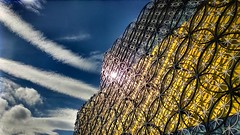
Birmingham Library by Chris(UK), on Flickr
Creative Commons Creative Commons Attribution-Noncommercial-No Derivative Works 2.0 Generic License   by  Chris(UK) 
There were 9 panel sessions and 10 workshops split over the two days. I went to:
  • Panel 1: Exploring the mechanics of cross-sector collaboration
  • Panel 6: Visualising the digital discovery
  • Panel 7: The community within: volunteers as a route to discovery
  • Panel 9: Collecting - for whose sake?
  • Jisc Workshop: Finding and Using Digital Collections: Do we need new tools?
There was a lot of interesting and engaged discussion on the Twitter hashtag, which cut across the different sessions and themes and helped to make connections between them. I think it’s also the first conference I’ve been to that had an end-of-day summary session in which each panel chair gave a short summary of their session. I found that very useful, too.

I found it interesting to hear about lots of different projects going on at institutions of different sizes, and in different sectors – archives, museum, and library. It’s easy to forget the different approaches of the three domains, given how often they’re lumped together as ‘heritage’ or ‘memory institutions’. It came out early on that museums have a very different attitude to research use compared to archives and libraries: it’s what the latter two exist to facilitate (in large part), but it’s not what a museum is set up for. So when a keen academic turns up to a tiny museum and spends a long time looking at artefacts or talking with the curator, that can feel like a huge investment of time for the museum, with little tangible reward.

Three broad themes appeared to me over the three days. So, as ever, I won’t prĂ©cis each session I attended, I’ll throw together some thoughts under headings.

Representation

This is something that I think all of the first three panels touched upon, but which certainly struck me in a session that was ostensibly about cross-sector collaboration. One speaker mentioned that in a museum display of archival material exploring ‘hidden histories’, people to whom no photograph or artefact could be attached had to be omitted from the display because of the visual demands of displays.

In the social media panel there was discussion of the double-edged sword of high-volume but low-depth attention: can we call click-bait archives images that go viral (44 medieval beasts that cannot even handle it springs to mind) successful engagement? Or, under what circumstances can we call that successful engagement, and how to we balance the demands and delights of that kind of promotion with archival collecting and use that allows for and encourages the discovery of more complex, more nuanced, stories and understandings?

It’s a concern that digitisation, an increased focus on exhibitions, and/or a focus on social media overly privilege the visual and the tangible and disadvantage the textual? Lots of people talk about their exciting online collaborative projects exposing hidden histories and forgotten stories, but I worry there’s a risk that we do this at the expense of another, doubly disadvantaged set of histories that aren’t sufficiently photogenic.

I’ve pulled together a Storify of the Twitter discussion on this topic, rather than paraphrasing it all in this post. 

Strategy

Collaborating

The first session I attended was all about the ‘mechanics of cross-sector collaboration’. We heard about the Making Britain project – a collaboration involving the BL, the OU and many others – and the Inspiring Women project – a collaboration between Tunbridge Wells Museum and the University of Kent. They both sounded like really interesting projects, but in both cases the collaboration was born out of pre-existing relationships and networks: people already knew people who’d be interested in working on the project. Now, there’s nothing wrong with using your network, but it can seem like an impossible task to create this sort of collaboration if you don’t have a handy connection already.

The third paper in the session sought to address this. The Share Academy is a project run by UCL, the University of the Arts London and London Museums Group that aims to ‘build sustainable and mutually beneficial relationships between the higher education sector and specialist museums in London’. They strongly advised taking a more strategic approach to collaboration, by taking a pragmatic approach to planning. It’s important to have collaborative relationships documented and agreed at the start: what will the outputs of the project be (academics and museums might want very different things)? What happens if and when key people move to new institutions? How much investment of time, money and resources is expected from each side?

One really striking point for me was the comment that small museums can feel used by academics who come and research their objects and then publish without seeming to give anything back to the museum. There’s a really large investment of very limited staff time involved in providing access for researchers, and it seems that museums having necessarily been doing a great job of explaining that – unlike in libraries and archives – facilitating this access isn’t part of their core work, and that they would appreciate a more equitable relationship.

Unfortunately, Share Academy is only short-term funded, so it’s not clear whether it will continue, and be able to act as the matchmaker many of us would like!

Lots of people agreed that national advice and support on setting up and running collaborative projects would be welcome, and there’s promise of this coming from TNA. In the meatime there is, for example, this report on collaborative working practices in science heritage: ‘Mind the gap’ (link via Melinda Haunton).

Collecting

Karen Pierce presented a really inspiring paper about her work on the History of Human Genetics library at the University of Cardiff Library. This is a collection of materials concerning the history of the study of human genetics.

It was conceived of by a geneticist – Peter Harper – who was concerned that the history of this comparatively new discipline wasn’t being preserved. It now includes three complete personal libraries as well as selected donations from other people’s collections. It includes printed books – including classic textbooks and other works – as well as grey literature. There was a conscious decision to collect grey literature, because it represents an otherwise undocumented stage in research: networks, transient developments, events, suppliers and so on.

(The quote of the conference was undoubtedly Karen’s two descriptions of grey literature: 'publications by organisations whose main business isn't publishing' or 'floppy stuff’. The subsequent cries of recognition and anguish from cataloguers on Twitter is worth a read.)

This paper really made me think how fine the line is, and how variable is the location of the line, between a library’s perception of something as ‘usefully collected stuff from and expert’ and ‘endless shelves of rubbish we don’t need’. There’s real, serious, professional skill in evaluating the value (current and potential) of collections particularly of this type, and sometimes the smart professional decision is to say ‘we don’t need it’, but this isn’t always so. Sometimes we need to be brave enough to say ‘yes, we’ll take it, and love it, and make it great’.

Karen’s paper was an inspiring example of how to negotiate this boundary by setting clear aims, remits and procedures for such a collection. It’s great to see that at least one place is negotiating this successfully, rather than succumbing to the inertia of the ‘bay and a half of Stuff that someone gave us three librarians ago’.

Data and the catalogue(s)

Ah, shouldn’t we have got past worrying about catalogues by now? More than once people said and tweeted ‘the aggregator is dead’ and ‘it’s all discovery now’ and so on, but in the JISC workshop on digital discovery tools I stuck my head above the parapet and pointed out that the one key thing that would improve the discoverability of my (so-far-non-digital-)collections would be better catalogue data. Or better metadata if you prefer. It turns out that I wasn’t, in fact, expressing the view of a behind-the-times old fuddy-duddy, but actually a feeling that was in the room and online, too. Never mind aggregators being dead, we’re still trying to sort out how to get stuff into them nicely.


Elsewhere, it was pointed out that even if we have all the resources to record all the stuff we want to record, we don’t have cataloguing systems that really allow us to usefully (or at all) record the stuff that makes special collections well, err, special.

A catalogue record for a Shakespeare first folio? Quite possibly won’t mention that it is the ‘first folio’. Probably can’t easily link through to that amazing exhibition you had about it last year. May manage to link through to the digitised version you have, though not necessarily. Unlikely to record other context or importance... As curatorial tools, and tools for the people Out There to understand our stuff, there’s a lot that’s still desired.

(Incidentally, the problems of what’s in the catalogue not matching what the users are looking for also cropped up a recent event at Harvard. We can’t easily meet the needs of researcher’s who’re interested in all sorts of copy-specific features, because they just haven’t been recorded. This extensive conversation is well worth a read – it brings out several different issues affecting our ability to achieve this.)

In summary...

There’s so much going on out there, and there’s so much that we can all do in our services (big or small). There’s huge pressure to do more, to reach more people, to work with more people, to get out stuff out there as much as we can. This is facilitated by things like social media, the spread of digitisation projects, and so on, but these tools don’t themselves ensure that we’re doing things well. We need to keep in sight that we should be doing stuff for a reason and that we ought to be able to set and measure against criteria for for doing this stuff well would look like and we need to consider how it will be sustained in the future.

Sunday, 7 October 2012

Yet another sale of historic books (Wigan edition)

An article from the local press has drawn attention to the sale of five early printed books belonging to Wigan Public Libraries. According the article these include incunabula and other rare books, including the eight-leaf Conradus' Brevis annotatio in errores scribentium S. Augustinum fuisse eremitam ([Rome: Johannes Schoemberger, not before 15 Nov. 1483]), which sold for £5,000 and was the known copy in the British Isles (I don't who has bought it, so it may yet still be available here, but then, it may not be).*

The saddest thing about this story is the quotation from Pete Gascoigne, executive director of culture on Wigan council, which demonstrates a disappointing (but sadly not necessarily unexpected in a council official) lack of understanding of the issues at hand.  I'm cross enough about it that I'm going to look at a couple of his points in detail.

Gascoigne states:
[A] decision was taken to sell some antiquarian books that are have received little or no public interest since they were acquired and are not intrinsically linked to the borough’s heritage, in that, they contain no information relating to Wigan or its people.

This sale will mean Wigan and Leigh retain a relevant modern library service for the people of this borough - not one where books sit on shelves gathering dust because they are of no relevance or interest to the majority of its people.
It's very narrow-minded to believe that a collection of books is "not intrinsically linked to the borough's heritage" simply because their content is not related to the area.  The ISTC records 82 incunables (pre-1501 printed books) in Wigan public libraries, and the ESTC a further 83 early printed books from the UK (or other English-speaking countries) or in English.  This isn't a bad haul, especially of incunables: one wonders what the story is behind their arrival in the Wigan public library service.  There's quite likely a story behind their ending up with this library, and that story might well demonstrate that they are, in fact, "intrinsically linked".  What if, for example, an important local businessman collected them and donated them to the town? That would surely demonstrate a link.

I say "what if" as it's not straightforward to find out much about these books.  A quick look at the library catalogue doesn't reveal any records for early printed books, the ESTC records don't include any provenance information, and I haven't tracked down a printed catalogue either. One fears that there's no good record of what's held at all. 

This lack of documentation might just explain why the books are (or were) "have received little or no public interest since they were acquired".  It doesn't take a genius to realise that if no-one knows that something is in a library, no-one will access it.  The onus is on the library service to promote its collections.  Yes, records on ESTC may attract the attention of a few serious scholars, but that's only one rather small segment of a much larger potential audience, and even they might not make the effort if you've no information at all on your library webpages.

Promoting collections take time, expertise, an understanding of what you've got.  But it's enormously worthwhile in the long-run, and provides benefit to institutions and communities far beyond the special collections corner of the library. 

Other public libraries (Manchester springs to mind) are doing great things in using their special collections in exciting ways as part of " a relevant modern library service". Yes, Manchester library is bigger and more obviously historic than Wigan. Dustiness and neglect isn't the natural state of old books: the responsibility to sweep away the dust lies with councils and library managements.


*It's worth nothing that £5,000 is quite a lot of money for a 16-page book, but it's not necessarily all that much money for a 500+-year-old book, and it's only a drop in the ocean of money required to implement self-service machines in one or more libraries.

Sunday, 23 September 2012

Useful links from #rbscg12

Further to my reflections on the CILIP Rare Books and Special Collections Group annual conference, 'Speaking Truth to Power', here are some of the useful webpages, projects and articles that were mentioned during the conference.

Collections currently or recently under threat


Collaborative digitisation projects


Other projects and libraries


New use(s) of library space


 Reports


Blog post


Tools and resources

  • COPAC collections management tool: "Libraries are continually faced with difficult decisions about what materials to keep, what to remove and what to conserve. At the moment, identifying whether items are rare, or indeed unique, within the UK is a time-consuming and expensive manual process. Our goal is to look at how Copac can make a real difference for collections managers. By making Copac data work harder and building the prototype on top of its extensive database, the collections management tool can provide valuable information from the catalogues of the UK’s major research libraries alongside rare collections held in museums, scholarly societies and university special collections." 
  • Information about the 2014 Research Excellence Framework (REF)

 Organisations, recognition and funding bodies


 Articles

Saturday, 22 September 2012

Speaking truth to power: Rare Books Group annual conference 2012 (#RBSCG12)

The annual Rare Books and Special Collections Group conference took place on 12-14 September at Lady Margaret Hall, Oxford.  This was the first year I was able to attend the conference, and I have to thank the CILIP East of England branch for financial support via their small grants fund.  I also must thank the RBSCG committee for organising a superb conference, the speakers for being so interesting, the other attendees for being friendly, and the staff at LMH for excellent hospitality.

The title of the conference was ‘Speaking Truth to Power: Making Special Collections Work in Times of Recession’, so fundraising, advocacy and outreach were major topics of conversation.  I’ve written up a narrative account of the conference for the East of England branch newsletter, Sunrise, which should be available later in the Autumn. What follows here are my thoughts arranged under what I felt were the main themes to emerge from the conference.  I’ve compiled a separate list of useful webpages, projects, reports and articles.

It’s fair to point out that I’ve always traditionally been sceptical about what university development offices do: I’ve had my fair share of half-hearted begging letters from my old college, and feel pretty cynical about their attempts to wring money from me (they know I’m a librarian, so I really don’t know why they try...). Remarkable to relate, this conference really changed the way I feel how we can engage with fundraising, and so my reflections seemed to have turned out more like a manifesto.

Show Don’t Tell

Our collections are our best and most powerful advocates, not only for themselves and for the library, but for the whole institution. The collections are most effective when people see and touch them up close and personal.  The ‘thingyness’ of our things matters; a digital reproduction is nice, but it just isn’t the same as the real thing, and allowing people not only to see, but to touch, gives them a big thrill and makes them feel important and valued.  Christopher Parking described that the physicality of objects is an important part of contemporary museum education practice, where the focus is on  handling collections, kinasthetic learning, and enquiry-based learning. School groups no longer just follow clipboard trails around objects safely kept behind glass.

We should be getting the important people inside and outside our institutions into our libraries to see just what it is that makes us special.  It’s no use just writing an email or a report describing what we hold: people have to come and see it to really understand.  Obviously it’s not always feasible to let everyone handle our objects, but don’t discount the impact it can make when it is possible to allow that.

Know Your Collections

We, as librarians, are fundamental in making our collections work, as we’re the people who know most about them.  We should be prepared to market ourselves as the people who can interpret the collections. There's something in most special collections that will appeal to everyone and anyone, so librarians are vital because we know what that item will be. This can make a big difference when, for example, the development office are bringing round potential donors.  We’re also important because we’re the people who know best just what a difference extra funding could make.

Our knowledge as librarians is what can make a big difference to academics, too.  They need access to our holdings to support their teaching, and they need access to our knowledge to help further and inform their research. Central to getting our collections used in research is getting them all catalogued, not only locally but as part of national and international indexes, and making the catalogue data available in useful ways.

It’s no longer acceptable for institutions to have basements of unknown collections, often the legacy of indiscriminate and undocumented collecting in the past.  So we need to take the initiative in working out what we have.  This is something that Manchester Public Library have been doing during the current refurbishment: they’ve been assessing what was, and what should be, stored in their closed stacks, and working out how that can be used in the future.

Know Your Institution

It’s not always easy to do, but you need to work out who has the power in your institution, and be prepared for the fact that once you’ve identified who that is, they’ll probably keep changing.  Alison Cullingford noted that people can have positive power (they can make things happen) and negative power (they can stop things happening).

Mark Nicholls gave a very clear account of the ways in which we can gain power for ourselves and influence those others who hold the positive and negative power.  He notes that "The worst mistake of a college (or any) politician is to be absent": we should do what we can to get on as many committees as possible and to cultivate allies on the others.  It’s important, he noted, to realise that those in charge can and will make decisions quickly when the time is right.  We have to be good at working out what ideas are right for the moment.  This gets easier as time goes on: one successful project, and attendant praise for the institution, will prime the organisation (and its nay-sayers) for further success.

Neil MacInnes and Judy Faraday both described the ways in which they were using special collections to further the aims and agendas of their institutions.  Manchester Public Libraries special collections are being used to engage communities that the local authority holds as priorities, including black and ethnic minority communities, place-based communities, and young people.  The materials held by the John Lewis archives and the community archives centred around the locations of John Lewis stores helps to support the partnership’s business cycle.  It does this both by providing materials for business use, including publicity and design, but also by creating community support and interest.  I suppose that you could call this latter effect ‘soft advertising’ - in any case, it’s part of the partnership’s commitment to corporate responsibility.  It’s important to be explicit about how your activities are supporting the mission and goals of your organisation.  Don’t just do it, but make sure everyone knows you’re doing it.

Know Your Audience(s)

We have lots of different audiences for our collections, activities and fundraising efforts.  Our traditional audience, academic readers, are still very important. Anne Welsh commented that their voices can be important in times of uncertainty, and that their support for services and collections can be vital.

There’s a general support for libraries and special collections amongst the general public.  Although there’s often a rather clichĂ©d and unfair impression that we’re just old and dusty, this support is still something we can and should work with.  Richard Ovenden mentioned the one-day display of a copy of Magna Carta at the Bodleian: lots people will queue up to see something if you advertise it well, and this will generate positive publicity for your institution.

When considering external funders, Mark Nicholls advises that we can improve our image easily for example by producing a professional and attractive annual report.  Oliver Urquhart Ivine described British Library work creating partnerships such as that with the Qatar Foundation.  They took time and effort to research potential donors in depth, and to plan how they will approach and encourage potential donors.  This advice chimed with Mark Nicholls caution that we have to anticipate potential objections to our plans and be prepared to knock them away one by one.

When planning fundraising efforts, Sean Rainey commented that it’s important to realise that there’s a difference between funding priorities and fundraising priorities. We have to recognise what things donors will and won’t be prepared to donate towards.  We won’t have much success campaigning for retrospective conversion, small facilities improvements, and supplies and equipment purchases, so we need to look critically and objectively at our plans and decide what we can realistically achieve via which means.

Don't Be Complacent

In straightened times it’s important to keep ourselves front and centre in the minds of the people who make the decisions.  This might seem mercenary and drastic, but it can make all the difference.  There are plenty of collections and collecting areas that are sadly under risk.  As well as recent high-profile threatened libraries, Richard Ovenden and Alison Cullingford both identified twentieth-century collections that haven’t traditionally been regarded as ‘special collections’ as areas that may not be receiving the attention they need now to be preserved for the future.

Fundraising, I think, isn’t something that comes naturally or easily to librarians.  We like to think that the importance of our collections is not merely monetary, and that their cultural and intellectual value will ensure they receive adequate support without our having to bring out a begging bowl.  But that, sadly, isn’t the case.  We need to make the case for our collections, and to use the existing mechanisms for fundraising (development offices, funding bodies, donors, and so on) to attract support.  Sean Rainey ended his paper by enjoining us not to let fundraising slip down the to-do list, and I’ll echo what he said: start working on it now.

Monday, 14 May 2012

Mobile technology and special collections: a perspective on the #mlibs conference

Last Tuesday saw the Mobile Technologies in Libraries Information Sharing Event, held in Birmingham and organised by the m-libraries project. As someone who's a late-adopter of technological gadgets (I got my first laptop last Autumn), I didn't take detailed notes throughout the day, and chose to consider the broader aspects of the topic and not the details.  There is lots of information about the individual sessions on the event Lanyrd page.

Throughout the day there were interesting discussions about what we mean by 'mobile' technology, and whether it is possible or useful to make a distinction between mobile technology and other technology.  My own view is that very soon the distinction will no longer be of any use, as what we now call 'mobile' technology will be the predominant kind of technology being bought and used.  At the moment the designation can be useful - it brought together people for this information-sharing event, at least, but it's very important always to focus on what service we're trying to offer, and not merely on the medium through which we're providing it.

Of course (as James Clay pointed out in his keynote) not all of our users are using this technology, and not all of them ever will.  We should make sure that all of our content is available in other ways too.  But people are using it now, and we have to make sure our services are available to them via their preferred device.

Design is key to providing any web-based service, but particularly in making it accessible from the multitude of devices now available.  Matt Machell gave a presentation about Responsive Web Design, which is a must-watch for anyone with an interest in web design and the *how* of making content accessible to mobile devices. (He linked to this super piece on User Interface Design, recently too, which is definitely worth looking at if you're interested in this sort of thing. As is Your Library Website Stinks and it's your fault.) The key is to create a flexible site that can adapt to whatever device is viewing it.  This requires planning from the start -- it's hard to retrofit -- but it saves you time and effort in the long run as you only have one site to keep up-to-date, your content is your own rather than being subject to app-store control, and your users get a much better experience as the service will look and feel the same across all the devices from which they're using it.

 The mobility of mobile technology is, of course, particularly relevant to apps that use geo-spatial data to provide information about your current location.  The Phone Booth Project at LSE (presented by Ed Fay) displays Charles Booth's late-nineteenth-century annotated maps of life, labour and poverty London for the user's current location.  They're laid over a Google Maps base, so you can closely compare the modern city with the historic city.  As the overlaying of data works just based on geographic location co-ordinates, it's possible to add further layers, such as modern deprivation information, or information from Booth's notebooks, very simply.  Georgina Parsons had a great idea for extending one of Surrey Libraries' current outreach projects: how about constructing a walking-tour map of a local area, with audio (talks, readings, music?) relating to literary (or other) history available around the route?

I was really interested in the session about the SCARLET (Special Collections using Augmented Reality to Enhance Learning and Teaching) Project at the John Rylands Library, University of Manchester.  The project has been investigating how to use augmented reality (AR) in teaching and learning with special collections.  I have to say that I'm not sure that I completely agree with its brief:
SCARLET addresses one of the principal obstacles to the use of Special Collections in teaching and learning – the fact that students must consult rare books, manuscripts and archives within the controlled conditions of library study rooms. The material is isolated from the secondary, supporting materials and the growing mass of related digital assets. This is an alien experience for students familiar with an information-rich, connected wireless world, and is a barrier to their use of Special Collections.
Yes, locating the useful secondary material relating to rare books and manuscripts can be quite a specialised skill, and one I fear isn't uniformly well-taught to undergraduates at the point at which they start accessing the special collections for their study and research.  However, most special collections reading rooms have reference books, allow the transfer of modern books from elsewhere in the library, and allow laptops to be used.  Granted, they might not all have wifi yet, but I was genuinely surprised to hear that this was considered one of the 'principal obstacles' to the use of Special Collections for teaching and learning.  From the student's point of view I would have thought that just not knowing where to start and what to order up, and then how to interpret what has been requested (e.g. how to find particular sections in a manuscript or early book, how to read the handwriting or typography, how best to handle the material, etc.) would be the biggest issue. From a teaching perspective, practical concerns such as arranging a time and location for a teaching visit, negotiating the level of supervision from library staff, and just thinking of it as an option in the first place, would seem to be big concerns. But I'm willing to believe I could be wrong, and would really like to hear what other people think.

Some of the AR content that SCARLET have produced really blew me away.  In particular, using AR to overlay a reconstruction and translation of this second-century papyrus fragment of St John's gospel.  This seems like just the sort of thing that technology should be doing.  The project say that feedback from first-year undergraduates has been very positive - they appreciate having a way to get to see and use the special collections materials that they've never previously used.  Third-year students enjoyed the videos of their course lecturers, but felt that on the whole the content was somewhat prescriptive and didn't allow for their own independent research.  These findings concur with what I might have expected: I'm not sure why I would want to produce a video-ed introduction to the material unless it really wasn't possible for students to receive such an introduction in person from their lecturers.  Not least because, when using special collections for the first time, it's good to have introductions to how to handle them properly.  I suppose that for students who've had some experience, but who still aren't at the advanced research stage, this content could be valuable.  Maybe I'm a curmudgeon, but it does still seem like a lot of effort for an unclear goal.  As I've already said, I'd love to hear other people's thoughts.

I'm not down on all AR, though.  I can see enormous potential for exhibitions (if issues of wifi/network connections and managing lighting to meet conservation requirements but also allow for the visual-recognition tech underpinning the AR to work in exhibition spaces can be overcome).  Having a reconstruction, or a translation, or annotations and explanations laid directly over the exhibit itself seems like a so much better way to interpret materials than with just a printed caption.  Audio, video, other images, complete digitisations, and more could all be accessible in the exhibition space in connection with the items on display.

All in all it was an interesting day - my thanks to Jo and the rest of the organising team.

Sunday, 22 April 2012

News and events

This is a quick round-up post of some recent reading, announcements and events. I've shared much if not all of this on Twitter, and it seems worth sharing here too.


Special Collections

NEW PROFESSIONALS DAY
CILIP is holding its annual New Professionals Day this year on 11 May. It's already fully booked, but there is a waiting list.  I was delighted to be invited to give one of the nine workshops on the day.  Under the unimaginative title 'Special collections librarianship: What's it all about?' I'll be taking a look at what special collections librarians do, what skills they need, and ways of getting into special collections work. Do let me know (in the comments here, or at maedchenimmond at gmail dot com or @girlinthe) if there's anything in particular you'd like me to cover. I'll be making the workshop materials available online after the day, so do get in touch even if you can't be there in person.

SPEC COLLS IN THE STATES
Continuing the careers theme, Brianna Marshall has written a great post on getting special collections librarianship in the USA over on the Hack Library School blog.  Do read the comments, too, for some further useful thoughts.

SPEC COLLS OUTREACH IN CAMBRIDGE
Polly Harper, current graduate trainee at Newnham College Library, Cambridge, has written an engaging post about her recent experiences taking part in special collections outreach in Cambridge on the always excellent Rarely Sited blog.  She ends by wondering which library sector will afford her the most opportunities to engage in this work later in her career.

SPEC COLLS IN THE LITERATURE
Geoffrey Little (Concordia University, Montreal) has an article in the forthcoming issue of The Journal of Academic Librarianship reviewing some of the ways in which special collections departments are harnessing technology.  I'd say that the article itself doesn't break much new ground, but the references are quite handy.

MAKING USE OF BOOKSELLERS' DESCRIPTIONS
Anyone who has looked through a high-end antiquarian bookseller's catalogue will have noticed that they can and do include far more information about the books (contents, significance, history, condition, details of binding, etc.) than most of even the most detailed rare books cataloguing can manager.  Mike Widener has written a very interesting post on the Yale Law Library Rare Books Blog about how his library is including booksellers' descriptions in the catalogue by making use of the OPAC's 'add a review' function.  Two immediate concerns: booksellers' copyright and disclosing sensitive information are dealt with by asking permission first, and by not including price information. I'd love to hear if any other rare books libraries are doing similarly and whether they have had any problems with it.  Sarah Werner has written a great post about this - do go and join in the conversation there (it's sad that the original post doesn't allow comments).

ARCHIVES ON DISPLAY IN A MUSEUM
A display of material from the museum's archives has just been opened in the Segwick Museum of Geology in Cambridge.  It's great to see that museum recognising its documentary holdings and heritage like this.


Library History

WALKING TOUR
The Library & Information History Group has organised a walking tour of 'some of London’s forgotten book collections', led by Dr Alice Ford-Smith of Dr Williams's Library.  Booking is essential, and I hear that tickets (£10) are going fast!

CONFERENCE
The Leeds Library is holding a one-day conference on 'Books of every variety of taste' - The advance of the library in the long-eighteenth century on 12 May.  The programme looks very  interesting, and it's a chance to visit the oldest surviving subscription library in the British Isles. Booking closes on 1 May.


General

CILIP PRESIDENT COMING TO TOWN
The East of England Branch have organised an audience with Phil Bradley on the afternoon of 12 May, taking place in central Cambridge.  The theme is ''Making CILIP work for you', and it's open to members and non-members alike.

MASH CAT IS COMING
Mashed Library events are unconference-style gatherings aimed at sharing ideas to do with using and reusing library data.  MashCat is a Mashed Library event focussing on catalogue data, and open to cataloguers, techies, and anyone else who's keen and interested.  It's happening on 5 July, in Cambridge, and booking is now open.


Thursday, 19 April 2012

Pinterest: some thoughts

It's hard to move on GLAM blogs at the moment for posts about Pinterest, one of the hottest new(ish) social media sites in town.

What is it?
'Pin Cushion' by Philippa Willitts on Flickr
Obligatory picture of some pins (1)
Pinterest is a tool for discovering, collecting, arranging, annotating and sharing images you found across the web. For me, its main strengths are both aesthetic and technical:
  • it looks great;
  • it automatically links every image back to the page from which it was 'pinned'.
It's a powerful combination of attractiveness (and ease of use) and usefulness (linking images back to their homepages: so a picture of a cake links back to the recipe, for example).

What are people doing with it?
People are using Pinterest to collect together images and ideas around a multitude of themes: boards about weddings are popular, as are recipes, home decorating, and crafts.

You can find out what's been pinned from your webpages by using a URL in the form http://pinterest.com/source/yourURL/, e.g.:
Just remember to remove the "http://www." bit from the front of the URL. (Tip o' the nib to Anne Clark.)


How is this different to Flickr?
Well, for starters, it's not just about publishing your own images: it's a tool for bringing together images from lots of different sources.  But even from the perspective of an institution wishing to create boards of its own photographs, Pinterest is much more easily social than Flickr, and it's much quicker to navigate.

Special collections folk - some ideas for what we could be doing
Pinterest provides a medium dedicated to finding, sharing and commenting on visual items.  It's one that lots of people are using, and it's one that facilitates following items back to source if you want to find out more.  It seems like a great forum for getting our stuff Out There.  A few things spring to mind:
  • put a 'pin it' button along with other social media sharing options next to images on your collections pages or online exhibitions pages - this will give visitors explicity permission to pin the pictures and thereby share them outside your usual visitor base.  Lots of people will likely pin even without express permission, but it's good to be clear if you want to encourage this!
  • use it to promote your own collections
    • either for quick and dirty online exhibitions, or to highlight particular items from a physical exhibitions.  I love this Brief History of Manchester made by Manchester Archives.
    • pinning your own things is easy - you can either pin from your own website, or upload images direct to Pinterest
    • you can also draw together material from other places that relates to your holdings in some way. Kettle's Yard art gallery has put together 'If you love Kettle's Yard you'll love...".
  • It's easy to change your pins and boards whenever you need to.
'Pins' by Richard Heaven on Flickr
Some more pins
Copyright
There has been much discussion about whether and how Pinterest and its users violate copyright.  It's quite possible that pinning copyright images on Pinterest constitutes a violation of copyright, although that's not certain yet. I am not a copyright lawyer, and I don't know what the definitive line on this issue is.  However, there are ways of using Pinterest without using copyright images at all: if you use images to which your institution holds the rights (with appropriate institutional agreement where required), or if you use creative-commons-licensed images (in accordance with the licence terms), or copyright-free images.  It means you can't pin and re-pin at will without a moment's thought, but it's worth being punctilious when acting institutionally!

Monday, 9 April 2012

Three #museums in Oxford

A couple of weeks ago I went over the The Other Place for a conference about library history.  The conference was very interesting, but I did manage to sneak a bit of time away from it to visit some of the other attractions of Oxford, and I thought I'd record some of my thoughts about what I liked.

A doorway in the Bodleian Library quad
photo by me
Bodleian Library Exhibition: The Romance of the Middle Ages
This exhibition looks at the variety of stories captured under the heading 'medieval romance', and how this genre has influenced later writing, right up to the present day.  It's a vehicle for the exhibition of a great number of medieval manuscripts, alongside some artefacts and some archival material.
  • I really enjoyed the selection of exhibits, and the way they were presented. Objects, such as ivory panels and a floor tile are displayed alongside books and texts, thus brining to life both the expected and unexpected exhibits by bringing out some of their wider cultural and artistic contexts. The inclusion of archival material from C.S. Lewis, J.R.R. Tolkein and Terry Jones was also very successful, because of the thematic links and their links to Oxford.  The inclusion of modern material may have seemed gimmicky if there weren't such strong connections with the rest of the exhibition.
  • The exhibition makes good use of the space available.  I appreciated the free exhibition guides at the entrance, and that there is a small shop (which doubles as a supervisor's desk). Two computers are also available, nicely screened off the main exhibition area, to allow visitors to explore the online exhibition.  It might seem redundant to have the online version available in the physical space, but I think that it's good to be able to explore the exhibition in more than one way, and as you can zoom in to the online exhibits, it can be easier to read them and to see the fine detail than is the case with physical object in a case.
  • My favourite exhibits:
Oxford Museum of the History of Science
This museum, housed in the original building of the Ashmolean Museum, has an enormous collection of scientific instruments spread over three floors, as well as a special exhibition area that mounts changing displays.  I only had time for a quick look round, but made a note to remember:
  • It's a cluttered, busy space, which isn't necessarily a bad thing but might be difficult to navigate for a new visitor.  This difficulty is mitigated by having a really clear, obvious floor plan displayed right in front of the entrance. It sounds like a silly little thing, but it stopped me getting too confused!
  • Another thing that helps a visitor navigate somewhere where the cases are very full and busy is that the museum guide and plan picks out highlights on each floor.  The location of these is marked, along with a photograph of the object in question and a short description of what it is.  This helps to establish a way to approach the visit.  Obviously, the museum's choice of highlight object might not match the individual visitor's favourite(s), but it's a nice way to start exploring. 
  • Again, there were computers available, this time allowing the exploration of current and previous exhibitions, and searching of the collections.
  • Favourite exhibits:
The Ashmolean Museum 
 The Ashmolean Musuem is enormous, and I only saw a little of it.  But I still had some thoughts:
  • Galleries 3 and 4 are dedicated to museum conservation work, and I particularly liked an exhibit that showed the effects of repeated touching on museum objects.  It was made from variety of materials (silver, silk, limestone, gilded picture frame), with half of each covered by a clear perspex screen.  Visitors are invited to touch the exposed side, and touches are recorded on an electronic counter.  Even the most study of the materials (the stone) was clearly showing damage, and the silk had completely disintegrated.
  • The museum has a liberal photography policy, which allows the use of cameras, without flash, for private non-commercial use, except where stated otherwise.
  • The museum actively uses Twitter: I asked a question about the availability of the collections online, and had a helpful and friendly response well outside working hours! The only downside is that I couldn't find this advertised on their website (a missed opportunity?) - I found the Twitter account by searching Twitter itself.
  • I had lots of favourite exhibits, including:

Thursday, 12 January 2012

#lac12, or The Libraries@Cambridge conference 2012: a special collections view.

Today was the sixth annual Libraries@Cambridge conference.  It was a full and interesting day, with a lot of tweets on the #lac12 hashtag, some live blogging by some intrepid volunteers, lots of discussion, and plenty of cake.

I won't do a full write-up here: some of my writing (although without many opinions) is already available on the conference blog, and I imagine that others will write up some aspects of the day better than I could manage.  I'm going to focus on the elements of the day that were of particular interest to me as a special collections librarian.

Righty-ho.  Special collections (or Unique and Distinctive Collections, as RLUK terms them) got a mention in the first session as promoting them is one of the 5 strands of the RLUK strategic plan. (This is, of course, being explored further in the RLUK Unique and Distinctive Collections Project.) Deborah Shorley, Director of Library Services at Imperial College London--keynote speaker--was adamant that we need to do all we can to open access to our collections to all people, whether they come from our institution or not.  Most of the places I know are doing this: it's very rare for scholarly access to special collections to be completely restricted, so I suppose that if a Director of Library Services doesn't see this we need to be promoting more loudly. (Incidentally, even the Imperial College Library, which in its modern collections aspires to be [physical] bookless, does have special collections, too.)

The second plenary session saw Liz Waller, Deputy Director of Information (Information Services), University of York speak about changing library spaces.  In amongst lots of lovely pictures of beautiful new and refurbished libraries we got a brief glimpse of the special collections reading room at the University of  Edinburgh. To be fair, it wasn't the most inspiring picture in the presentation: some tables and chairs, a few readers, no obvious reference book collection (essential for a lot of special collections readers).  Emily Dourish asked on Twitter if the flexible working spaces being discussed for elsewhere in the libraries would work for special collections.  That's an interesting question.  We could certainly benefit from having space available for teaching sessions: though those would need to be soundproofed, and I'm not sure if flexible and soundproofed go together?  Group work with special collections might well be popular and useful: we've all been in the situation where four people gather round trying to untangle a difficult inscription or hand.  But fully flexible space?  It seems an unlikely fit:
  • moving furniture about probably isn't best with fragile items around;
  • we need to be able to supervise and invigilate all our users, and the less open plan the room the harder it is to have clear lines of sight to all books and readers;
  • a lot of our readers will want quiet, traditional, reading room environments.
Still, it's really interesting to think about how we could extend the traditional special collections room with new types of library space.

The special collections parallel session was about digital libraries, and I've written it up for the conference blog. I particularly liked the Wellcome's pragmatic attitude to copyright issues, and their sensible approach to identifying and removing sensitive material and to allowing different access to different material.

'Rainbow' (a collaborative effort) by Jake Rome on Flick
'Rainbow' (a collaborative effort) by Jake Rome on Flickr

In the afternoon we heard from a range of library users from Cambridge and elsewhere about what they want from libraries and librarians.  The most interesting speaker for me was Dr Jason Scott Warren, lecturer at the Faculty of English and Director of the Centre for Material Texts. Jason works on early-modern English literature, the history of the book, the materiality of texts, and is a regular in the Rare Books Room at the UL.  Jason covered a lot of ground in his short talk. Here is some of it:
  • he 'suffers' from both digital greediness--wanting more and bigger and faster--but also digital anxiety--how do I know if I've found everything that's out there.
  • he recognises that libraries face a challenge in letting users know about all the available resources
  • he would like more standardisation across digitised material: he noted that, for example Early European Books photograph bindings, foredges, and everything else, but that other platforms do less, many are only black and white, some have poor quality images.
  • he'd also like better usability from the digital platforms: pages that fit a laptop screen, easy ways of browsing, etc.  Many of the current tools are rather clunky and slow to use.
  • access to special collections is mediated through cataloguing. Jason would like to see more high-quality cataloguing of rare books that takes into account copy-specific information such as provenance and binding, such as that seen in the UL Incunabula Project, and in the rare books records from St John's College Old Library 
  • Jason sees special collections as ripe for collaborative research projects.  Librarians and academics need to share their knowledge of the collections to get the most out of those collections.
  •  In the discussion after Jason's talk the issue of undergraduate use of primary sources (i.e. special collections) was raised: is it happening much here? could it happen more? Jason thought that there's scope for college special collections to be used more for this.
I had several thoughts in response to this...

Cataloguing
  • it's hugely heartening to hear that cataloguing is appreciated by academics.
  • to achieve the level of cataloguing that academics desire, we need more cataloguer time (of course), but also better cataloguing structures.  Copy-specific information is surely better represented in a hierarchical (FRBR?) way, rather than mixing copy-specific and bibliographic information in bibliographic records (current practise in Cambridge, for example).
  • and a great deal of manuscripts cataloguing isn't available at all online. Yet.
Collaboration
  • I'm hugely keen to develop relations between academics, researchers, teaching groups, undergraduates, Uncle Tom Cobbly and all, and special collections librarians.
  • It strikes me that the teaching sessions that currently take place generally grow out of existing relationships between librarians and academics: people know a librarian and go to them for advice/help/access. If they don't know any librarians they don't ask, and they don't ask librarians or libraries that they don't already know.
  • To increase collaboration (a recurring theme in the afternoon) we need to network more.  I know a few of the Centre for Material Texts folk by going to their seminars. As a rare books librarian, I ought to be interested in history of the book issues anyway: what better way than by going to seminars... Granted, they're sometimes a bit over my head, but the people there are friendly, and sometimes even ask me for a librarianly opinion.  I don't think I've ever seen another librarian there: we're possibly missing a trick.  And there are definitely other places we could be going to make connections.
  • I'd love to know more about what other special collections departments are doing towards academic outreach, and also to know where this sort of thing is being discussed.  Anyone have any tips for conferences, blogs, mailing lists?
  • If there isn't much out there already should we be creating them? Could there be a session at LILAC on this? Or somewhere else? Or a special collections TeachMeet or LibraryCamp? Ideas please!
That's it for now. I'm really keen to hear other thoughts on any and all of the things above. Do you agree? Are you doing this already? Have any tips? Do you disagree? Let us know!

Monday, 21 November 2011

HLF confernece report 2: using what we have

I'm grouping my write-ups from the HLF conference loosely according to topic, not in the order appeared.  This is the second post of three.

Collections in a Cold Climate

Alison Cullingford, of @speccollbrad, 100 Objects Bradford, RLUKUDC and other fame, gave the third talk of the day. She spoke about 'Collections in a Cold Climate: Caring for and Sharing Special Collections in difficult times'.

Alison offered 5 arguments in favour of special collections, and 10 things for us to think about and do. (She apologised that this doesn't add up to 23.)

Selling points:

1) Special collections are a treasure trove. Their uniqueness is not merely pretty frippery: it can have hard financial benefits.

2) We're about much more than text: it doesn't matter if Google Books has the text, your particular book is still important because of its story.

3) The power of the real: things being online isn't the same - people still want to see the real physical object.

4) Learning, teaching and research. The style of teaching (across school and university, I think), is increasingly geared towards engagement with primary material. We're the people that can make that happen.

5) Sharing via Amazing! New! Technology! is now easier that every before. There are fewer gatekeepers to the outside world: we can talk about our own collections, rather than going through intermediaries.

The things we should think about in caring for and sharing our collections are:

1) Proclaiming our value. Don't hide light under a bushel, don't be afraid to use robust language and to speak in the jargon that the people with the money respond to.

2) FInd partners and use them. Work out who's speaking on your behalf in your organisation and make use of them. Identify the people with soft power, too.

3) Be 'lazy' - don't try and do everything yourself, but try and find people who'll do it for you, e.g. collaborating with museums on schools work.

4) Explore new tech. Know what's out there, but you don't have to use it all.

5) Think about mission and strategy, i.e. work out how everything fits together, and which things you don't have to do.

6) Make the best use of your, or your staff's time. Staff time may be the only resource you have, so value it.

7) Dare to think creatively. You can't do more of the same with less of the same, but you can do something different instead. In Alison's case this means exhibiting online, not in a physical space.

8) Skills matter. Use the Rare Books and Special Collections Group framework (or the ALA equivalent) to campaign for training. Market yourself as someone with specialist skills and knoweledge.

9) Know what's going on - what the agendas are, and how you can use them to your advantage.

10) Share your own number 10. Mine is to use the enthusiasms of the people that you have - Alison added that if you do that you have to account for what'll happen if they leave!

If you want to know more, Alison has a book coming out soon.

The RLUK Unique and Distinctive Collections Project will be producing a report about special collections of all kinds and not just in RLUK libraries next September.

Using volunteers at Bishopgate's Institute

Edward Weech spoke about how the Library of the Bishopsgate Institute using volunteers to enhance what they can do and offer.  He was clear that they do not use volunteers to replace paid staff, but use them to work on specific projects that couldn't otherwise be undertaken.

Volunteers are used in the library to help with a retrospective cataloguing project.  There are a number of rules governing the volunteers' work: each volunteer comes in for half a day per week, and there is a miniumum commitment of three months.  Their travel expenses are paid, are their work is also recognised with twice-termly tea and cakes, a newsletter, a volunteering certificate, and (for those who have volutneered for 40 hours or more) a reference.  It was noted that not all the volunteers want to have tea, cakes, newsletters etc. - some just want to get on and catalogue!

Volunteers are generally recruited from retired librarians, library school students, and people currently working in libraries who would like to gain cataloguing experience.  Volunteers are expected already to have computing skills, and ideally to have knowledge of library work, library management systems, and possibly cataloguing.  There are around 6 volunteers at any given time.  The longest-serving has now been there four years, but some, especially those who have negotiated time away from work to participate, will only stay the minimum three months.

All of the volunteers' work is checked by staff before it is unsuppressed on the OPAC.  This means that, along with training and supervision, there is quite a lot of staff time invested in the volunteering programme. Since the retrospective cataloguing project started in 2005, 50,000 records have been added to the catalogue in total, of which 8,600 were added by volunteers (that's about 17%).

The benefits of the volunteer invovlement is not therefore that they're a cheap way of creating lots of catalogue records.  The benefits, as described by Edward are that the staff learn from the volunteers (whether they're students with new ideas, or more experienced librarians who have worked in other libraries), and that the Library and Institute are promoted by the volunteers and advocated for when they go elsewhere.

Friends Organisations

Karen Attar spoke about the Friends of Senate House Library. The Friends were founded in 1988, and in 2009 had a relatively modest membership of 140. Karen noted that the library's posistion within London, and within the University of London meant that it doesn't necessarily have a distincitve attraction for the general public.  However, the Friends have contributed to the Library, particularly through funds raised from bequests.  They have bought books and other materials, paid for conservation work and materials, paid for cataloguing, and have developed a 'Befriend a Book' programme.

The Friends of Senate House Library organise a variety of events including talks, visits, book club meetings and a newsletter.  Interestingly, special exhibition viewings don't need to be 'private' - the addition of a curator talk and some refreshments makes it a good draw for members.

Monday, 10 October 2011

#libcampuk session 2: special collections

(Library Camp UK 2011 home | my other posts about it)

In my best spirit of 'things will just work themselves out', I pitched a session for special collections librarians and anyone else interested at which we would (and I quote) "talk about stuff". Aim low, I say, and you can't fail!  We had a session. We talked. I got some ideas. I hope other people did to - thanks to those who came for making it good.  In retrospect (and based on experience in later sessions in the day) I reckon I could have probably been more of a proactive 'session leader', maybe by asking a starter question to get discussion going, or by starting off my describing my experience and ideas. I really didn't want to come across as hogging the limelight, or as though I was just telling people what I thought - I'm no expert, and I wanted to hear from everyone else.

Anyway, here's my write-up...  This is a combination of my notes from the day and my later reflections. 

The session attendees fell roughly into three types:
  1. People with responsibility for special collections, but not as their main work, who are trying to work out what to do with them.
  2. People whose job is special collections who're looking for ways to make the most of what they've got.
  3. People who want to know more about special collections/special collections work.
We started off with a quick, impromptu, round-up of Laura's MA dissertation research into exhibitions in libraries (the full dissertation will be online in due course).  Laura looked at the ways in which different institutions create exhibitions, and the feelings of those responsible for them about what training and support they needed in their roles.

Outreach: some issues
Special collections have been for too long treated as 'private libraries' and that's just not right. Very very few collections are of purely local interest - they are all relevant to wider research, history, stories, culture, etc. Special collections might even be one way of helping libraries in this time of peril - they are by their definition unique.  They're a way of demonstrating the value of libraries, or a unique selling point for individual institutions. (Whilst this is true to some extent, I'm wary of using special collections as a rallying point, as it might be seen to imply that all the other work that libraries do is obsolete, which I don't believe for one second.)

But getting started with widening access can be hard: time, money, co-operation from the organisation, hidden-ness of some libraries or special collections departments (it's hard to increase access if visitors have to be individually signed in and given a badge!) are all problems.

Which is better: physical exhibition or online?
If you have limited resources, which should you do? Is it better to draw out the stories behind objects, or to allow people access to the magic of the real thing? Both are good. Either are good. Any kind of improvement to access is good.  Andy Mabbett plugged his afternoon session about using Wikipedia (and Creative Commons licences allowing re-use) to increase access.  Other image/digitisation projects mentioned were Culture Grid, People's Collection Wales, and Europeana.

What if we become popular?
In small institutions it's easy to get scared that if you start to promote your collections, perhaps online via digital reproductions/blogs/etc., you'll suddenly be inundated with real-life visitors wanting to see the originals.  It's true that if you have information about your collections available online then the number of people enquiring about them will increase.  But this really shouldn't stop you showing off a bit: there are various ways to cope with the threat of popularity:
  • you can state outright that you have an online exhibition for the reason that you don't (currently) have facilities for physical exhibitions, and have no visitor facilities.
  • you can formulate a policy about what sort of visitors/readers can be admitted (e.g. 'academic research' only), and either publicise it or use it in response to queries.
  • if you do receive increased in-person interest in your collection(s) its a good way to demonstrate your collection's value to senior management, and possibly to gain extra resources. 
    • Anne from Ulster cited the example of The Ireland Collection, developed by JSTOR in association with Queen's University Belfast, which has raised the profile of the university across the world, but has also raised the profile of special collections within the university.
What are 'special collections'?
A good question! And one that it's important to keep answering.  Those 'in the know' might realise the breadth of the field, but those with small collections of 'special' things might not realise that they fall under the umbrella - they might think that 'special collections' might just mean the 'jewel in the crown' items like medieval manuscripts.  Some ideas as to what counts:
  • old, rare, fragile, valuable
  • coherent - items from a person/place/institution/time/purpose
  • significant - local, has a story, belonged to a person...
  • archival material (I'm editing out the long discussion of the overlap and interplay between spec colls and archives. I can't face trying to construct the necessary Venn diagram...)
Special collections aren't just 'piles of books'. It was interesting to hear tales of items being rescued from skips (things that others didn't value but that libraries do) vs donations that we wish we could put in skips - even a donation of books previously weeded from the same library!

    Hidden special collections - some possibilities
    The part of the session that I found most interesting was a discussion spurred on by a librarian who works in a private company library - not your traditional special collections hunting ground. But it turned out that they have a small-ish collection of company archival material, including auction records, house plans, and other lovely things.  They get about one reader for it a year - which to my mind isn't bad for something so hidden away (there's a brief listing on their main library catalogue, which is a good start, cataloguing wise).  But it sounded like a collection that has huge potential - for research, for public engagement, and to enhance the prestige of a long-established company.

    Some of the problems I saw for institutions holding collections of this type were:
    • people don't know what their stuff counts as - special collections? archives? local history? none of the above?
    • they don't know what the audience for it is
    • they don't know how best to store it
    • they don't know how to promote it
    • they don't know who can help them with it
    And so it languishes in a store room, costing money in storage costs...

    What to do?  The one sentence answer (to my mind) is: find a partner institution, to help with storage/care/cataloguing but also access/promotion/development. Many libraries and archives will accept donations or deposits (the terms of deposits vary individually, but there are ways of entrusting a collection and the care of said collection to an institution whilst retaining ownership by the origination company) from outside bodies, according to their existing specialist areas, collection strengths, and collection development policies.  The same, or other, institutions might be able to help with getting the collection used - with research projects, with community projects, with all sorts of things. If I were a better librarian I'd add links here.  Comment if you have good examples!

    And finally...
    Not mentioned in the session but probably useful: