Showing posts with label catalogues. Show all posts

Monday, 15 June 2015

Pressed flowers in books revisited

One of the things I'd like to change about my working life is that I don't currently find time to keep up with the research that's being done about, and using, rare book collections.  This is a pretty major omission, really, given that supporting research is one serious why 'my' collection exists and is made available. I'm sure I would be making much better decisions about all sorts of procedures and practices if I had a greater understanding of what academic readers would like to know and the research questions they're trying to answer. And I suspect I may not be the only one who feels like this...

So imagine my delight when a historian friend of mine stumbled across my post from last year about discovering, preserving and describing preserved plant specimens in rare books.  She writes:
I was fascinated by how librarians deal with the issue and just want to say that it would be great if catalogues did mention specimens enclosed in books. You will see why from the attached paper I wrote some time ago - the bit about loose specimens in books is towards the end of the article. The idea that librarians can decide whether a specimen is 'relevant' or not, fills a historian like me with dread! As does moving the specimens from their locations in the book without noting their original location. But I can see that loose specimens would seem a problem to librarians. 
...
I completely take your point about librarians and lack of time, and the difficulty of coping with something so out of the ordinary realm of cataloguing practice.  But perhaps if they knew that these scraps of plants might have significance this might make them feel it was more worthwhile to add the info to the entry.
The attached paper was:
  • Anne Secord, 'Pressed into service: specimens, space, and seeing in botanical practice', in David N. Livingstone and Charles W. J. Withers, eds, Geographies of Nineteenth-Century Science. Chicago: Chicago University Press, 2011, pp. 283–310.
So there you have it folks - it *is* worth carefully recording and keeping this things when we find them. If only there were time and staffing enough to describe all these copy specific features in the detail we'd like to.

If you have other examples of where going the extra cataloguing mile has helped research or other outputs, I'd love to here them.

Sunday, 16 November 2014

What are we here for and where are we heading? #dcdc14

At the end of October I went to ‘Discovering Collections, Discovering Communities’ (#dcdc14), a collaborative conference between The National Archives and Research Libraries UK, exploring ‘the ‘discoverability’ of collections across different formats, institutions and professions’. It had a focus on archive and museum collections and institutions, and was held at the new Library of Birmingham. The full programme is here (pdf link) and video of sessions will be going up in due course.

Birmingham Library by Chris(UK), on Flickr
Creative Commons Creative Commons Attribution-Noncommercial-No Derivative Works 2.0 Generic License   by  Chris(UK) 
There were 9 panel sessions and 10 workshops split over the two days. I went to:
  • Panel 1: Exploring the mechanics of cross-sector collaboration
  • Panel 6: Visualising the digital discovery
  • Panel 7: The community within: volunteers as a route to discovery
  • Panel 9: Collecting - for whose sake?
  • Jisc Workshop: Finding and Using Digital Collections: Do we need new tools?
There was a lot of interesting and engaged discussion on the Twitter hashtag, which cut across the different sessions and themes and helped to make connections between them. I think it’s also the first conference I’ve been to that had an end-of-day summary session in which each panel chair gave a short summary of their session. I found that very useful, too.

I found it interesting to hear about lots of different projects going on at institutions of different sizes, and in different sectors – archives, museum, and library. It’s easy to forget the different approaches of the three domains, given how often they’re lumped together as ‘heritage’ or ‘memory institutions’. It came out early on that museums have a very different attitude to research use compared to archives and libraries: it’s what the latter two exist to facilitate (in large part), but it’s not what a museum is set up for. So when a keen academic turns up to a tiny museum and spends a long time looking at artefacts or talking with the curator, that can feel like a huge investment of time for the museum, with little tangible reward.

Three broad themes appeared to me over the three days. So, as ever, I won’t précis each session I attended, I’ll throw together some thoughts under headings.

Representation

This is something that I think all of the first three panels touched upon, but which certainly struck me in a session that was ostensibly about cross-sector collaboration. One speaker mentioned that in a museum display of archival material exploring ‘hidden histories’, people to whom no photograph or artefact could be attached had to be omitted from the display because of the visual demands of displays.

In the social media panel there was discussion of the double-edged sword of high-volume but low-depth attention: can we call click-bait archives images that go viral (44 medieval beasts that cannot even handle it springs to mind) successful engagement? Or, under what circumstances can we call that successful engagement, and how to we balance the demands and delights of that kind of promotion with archival collecting and use that allows for and encourages the discovery of more complex, more nuanced, stories and understandings?

It’s a concern that digitisation, an increased focus on exhibitions, and/or a focus on social media overly privilege the visual and the tangible and disadvantage the textual? Lots of people talk about their exciting online collaborative projects exposing hidden histories and forgotten stories, but I worry there’s a risk that we do this at the expense of another, doubly disadvantaged set of histories that aren’t sufficiently photogenic.

I’ve pulled together a Storify of the Twitter discussion on this topic, rather than paraphrasing it all in this post. 

Strategy

Collaborating

The first session I attended was all about the ‘mechanics of cross-sector collaboration’. We heard about the Making Britain project – a collaboration involving the BL, the OU and many others – and the Inspiring Women project – a collaboration between Tunbridge Wells Museum and the University of Kent. They both sounded like really interesting projects, but in both cases the collaboration was born out of pre-existing relationships and networks: people already knew people who’d be interested in working on the project. Now, there’s nothing wrong with using your network, but it can seem like an impossible task to create this sort of collaboration if you don’t have a handy connection already.

The third paper in the session sought to address this. The Share Academy is a project run by UCL, the University of the Arts London and London Museums Group that aims to ‘build sustainable and mutually beneficial relationships between the higher education sector and specialist museums in London’. They strongly advised taking a more strategic approach to collaboration, by taking a pragmatic approach to planning. It’s important to have collaborative relationships documented and agreed at the start: what will the outputs of the project be (academics and museums might want very different things)? What happens if and when key people move to new institutions? How much investment of time, money and resources is expected from each side?

One really striking point for me was the comment that small museums can feel used by academics who come and research their objects and then publish without seeming to give anything back to the museum. There’s a really large investment of very limited staff time involved in providing access for researchers, and it seems that museums having necessarily been doing a great job of explaining that – unlike in libraries and archives – facilitating this access isn’t part of their core work, and that they would appreciate a more equitable relationship.

Unfortunately, Share Academy is only short-term funded, so it’s not clear whether it will continue, and be able to act as the matchmaker many of us would like!

Lots of people agreed that national advice and support on setting up and running collaborative projects would be welcome, and there’s promise of this coming from TNA. In the meatime there is, for example, this report on collaborative working practices in science heritage: ‘Mind the gap’ (link via Melinda Haunton).

Collecting

Karen Pierce presented a really inspiring paper about her work on the History of Human Genetics library at the University of Cardiff Library. This is a collection of materials concerning the history of the study of human genetics.

It was conceived of by a geneticist – Peter Harper – who was concerned that the history of this comparatively new discipline wasn’t being preserved. It now includes three complete personal libraries as well as selected donations from other people’s collections. It includes printed books – including classic textbooks and other works – as well as grey literature. There was a conscious decision to collect grey literature, because it represents an otherwise undocumented stage in research: networks, transient developments, events, suppliers and so on.

(The quote of the conference was undoubtedly Karen’s two descriptions of grey literature: 'publications by organisations whose main business isn't publishing' or 'floppy stuff’. The subsequent cries of recognition and anguish from cataloguers on Twitter is worth a read.)

This paper really made me think how fine the line is, and how variable is the location of the line, between a library’s perception of something as ‘usefully collected stuff from and expert’ and ‘endless shelves of rubbish we don’t need’. There’s real, serious, professional skill in evaluating the value (current and potential) of collections particularly of this type, and sometimes the smart professional decision is to say ‘we don’t need it’, but this isn’t always so. Sometimes we need to be brave enough to say ‘yes, we’ll take it, and love it, and make it great’.

Karen’s paper was an inspiring example of how to negotiate this boundary by setting clear aims, remits and procedures for such a collection. It’s great to see that at least one place is negotiating this successfully, rather than succumbing to the inertia of the ‘bay and a half of Stuff that someone gave us three librarians ago’.

Data and the catalogue(s)

Ah, shouldn’t we have got past worrying about catalogues by now? More than once people said and tweeted ‘the aggregator is dead’ and ‘it’s all discovery now’ and so on, but in the JISC workshop on digital discovery tools I stuck my head above the parapet and pointed out that the one key thing that would improve the discoverability of my (so-far-non-digital-)collections would be better catalogue data. Or better metadata if you prefer. It turns out that I wasn’t, in fact, expressing the view of a behind-the-times old fuddy-duddy, but actually a feeling that was in the room and online, too. Never mind aggregators being dead, we’re still trying to sort out how to get stuff into them nicely.


Elsewhere, it was pointed out that even if we have all the resources to record all the stuff we want to record, we don’t have cataloguing systems that really allow us to usefully (or at all) record the stuff that makes special collections well, err, special.

A catalogue record for a Shakespeare first folio? Quite possibly won’t mention that it is the ‘first folio’. Probably can’t easily link through to that amazing exhibition you had about it last year. May manage to link through to the digitised version you have, though not necessarily. Unlikely to record other context or importance... As curatorial tools, and tools for the people Out There to understand our stuff, there’s a lot that’s still desired.

(Incidentally, the problems of what’s in the catalogue not matching what the users are looking for also cropped up a recent event at Harvard. We can’t easily meet the needs of researcher’s who’re interested in all sorts of copy-specific features, because they just haven’t been recorded. This extensive conversation is well worth a read – it brings out several different issues affecting our ability to achieve this.)

In summary...

There’s so much going on out there, and there’s so much that we can all do in our services (big or small). There’s huge pressure to do more, to reach more people, to work with more people, to get out stuff out there as much as we can. This is facilitated by things like social media, the spread of digitisation projects, and so on, but these tools don’t themselves ensure that we’re doing things well. We need to keep in sight that we should be doing stuff for a reason and that we ought to be able to set and measure against criteria for for doing this stuff well would look like and we need to consider how it will be sustained in the future.

Sunday, 10 November 2013

Making the most of possibilities of digitisation: an #rbscg13 write-up

Rare Books and Special Collections Group Conference (programme (.docx)).  The theme this year was digitisation (last year was fundraising and advocacy).  The three recurring themes across all of the papers were audience, metadata, and the 'thinginess of things', with some very useful practical advice thrown in. I'm not going to give a blow-by-blow account of every paper, but rather to pick out the bits I've been chewing over since.

All three themes were addressed in Simon Tanner's keynote, which adeptly summed up the current situation as well as challenging us to think more imaginatively about the future and shaking us out of complacency about what we're doing now.

Tanner started by using the analogy of an ant mill to describe the fate of too many digitisation projects.  He emphasised that it's vital to plan properly and to seriously consider audience, opportunity costs (what aren't you doing if you are doing digitisation instead?), and to keep asking the 'so what' question to keep you focussed on why you're doing what you're doing. He also shared lots of useful resources:
Sian Prosser presented a case study on cataloguing and digitising a comparatively small collection of  manuscript fragments. She emphasised that even though there weren't many fragments, a very high level of specialist knowledge was required to describe them well, and that any project of this type is likely to take more time than envisaged.
  • TEI by example. Sian's project used TEI to mark up the descriptions. TEI by example is a set of free online tutorials.
  • Ransom Center Fragments. This is a very useful Flickr site displaying images from a large collection of manuscript fragments at the Harry Ransom Center, University of Texas at Austin.
My favourite paper from the conference was  Rowena Willard-Wright on 'Transforming our data for the internet on a tight budget'.  Willard-Wright works for English Heritage and described their work on digitising and improving their catalogue, including photographing objects, improving old records, cataloguing from scratch, and create varied means of access to the records.  Her talk really exposed infuriating and frustrating the problems faced by all cataloguers are.  As she spoke I wrote:
Willard-Wright's description of migrating and updating catalogue data is very familiar: data has been lost and garbled in transfers over years. Cataloguing has been and still is viewed as archane, and a thing not worth funding, because catalogues were and are seen as not for general consumption. I.e. they are perceived as been the exact opposite of their whole point. This problem that has been seen with the English Heritage catalogue is *exactly* what is being exposed as libraries moves from traditional OPACs to resource discovery/next-generation systems. And, most infuriatingly, the things that cataloguers have known and have been saying forever (e.g. consistency matters, access points matter) is suddenly being "discovered" as if it's new.
Willard-Wright was talking from the perspective of a museum catalogue, which is in some ways very different to a library catalogue.  Museums don't have such a tradition of the publicly accessible comprehensive catalogue, and write much more descriptive and less codified entries for their objects.

The English Heritage cataloguing project used teams of volunteers with very well-defined tasks.  They write clear, concise, engaging, small chunks of description - i.e. entries that confirm to the principles of good writing for the web. The volunteers aren't necessarily experts on the objects, and they're writing for audiences who aren't necessarily experts either. However, there's a recognition that the audience may have additional knowledge or stories to share, and for this reason a 'tell the curators something about this' button is being built into the public catalogue.  I absolutely love this - it's baffled me for years that so few library catalogues have a 'tell us if there's a mistake' button. Copac is a notable exception.  I fear that many libraries don't have one because, if it was ever mentioned in a meeting, someone piped up and said "but think of all the extra work" which likely trumped "think of how handy that will be for our readers, and how useful for us to make use of their knowledge".

That lack of connection to the audience was hammered home for me in another way throughout Willard-Wright's talk.  The museum descriptions are being written for general audiences.  Rare books records contain descriptions that are, frankly, written for librarians.  Not even, really, for most researchers. Yes, we include all sorts of useful information, but we code it up in impenetrable ways, and there's all sorts of information we don't include accessibly.  This has maybe been less of an issue in the past, when catalogue records were only seen by those initiated into our arcane world. But now catalogue records go along with beautiful/intriguing/important digitised books that all sorts of people might want to see, and our gibberish means *nothing*, and doesn't explain any of the basics. (How many records for the first folio show clearly that this is a first folio? Or the Nuremberg Chronicle?)

During Willard-Wright's paper Jill Dye commented that "The only difference between an online catalogue and a digitisation project is adding a photo?", and I think that in one way she's right: it's completely wrong to think that a digitisation project stands apart from cataloguing. However, making materials accessible in any way, but especially if they're freely available online demands a new attitude to description. We really need to step up our game.

Melissa Terras is director of the UCL Centre for Digital Humanities, and she presented a wide-ranging paper highlighting some of the possibilities of high-end digital imaging. She works on these projects in collaboration with computer scientists and engineers, and they're often adapting techniques already used elsewhere (such as in medical imaging). As well as drawing our attention to current projects, Terras made some important points about the theory and practice. Digitisation means lots more sorts of metadata needed so that we can properly interpret the images. As Hannah Thomas put it, Terras' work is "not just about creating a surrogate but about using the image to discover new things, inspire new research". Terras made the point that digital images are *not* exact reproductions of originals. Terras asked us to talk to her if we know of collections or items that would benefit from advanced digitisation and imaging work; part of her role is to connect the various people involved.
  • The one resource I'll share is this breathtaking (there were audible gasps in the room) video of the digital flattening of the great parchment book. Watch it. It's amazing.
Alixe Bovey spoke from the academic's perspective, and addressed some of the threats posed by digitisation. She was heavily involved in the campaign to try to prevent the sale of some of the Mendham Collection books last year. Bovey passionately explained that the digital is not the same as the physical, and we all need to communicate this better.  With the Mendham sale, the existence of digitised copies of the titles on databases such as EEBO and ECCO was used as justification for the sale, ignoring the copy specific details of the Mendham copies, as well as the failings of the scans themselves. Earlier digitisations have been particularly lacking. Never mind the poor black and white reproductions of scanned microfilm, they tended, for example, not to include any blank or apparently blank pages.in the source copy (see this post), and also ignored bindings, and made it difficult to determine the original size of the book. But we're not past such difficulties even with the best modern digitisations; they tend not to include scale rules, (see this post for difficulties of determining size), and give little indication of other factors such as weight, quality of materials used, or even smell.

Anne Welsh spoke very pragmatically from the point of view of libraries and library staff themselves.  She pointed out that we are continually needing to update and improve what we've done before: both content format and types of description.  She faced the fact that we can't do everything, and used the example of the University of Manchester Library Digitisation Strategy Group's 'Criteria for ensuring value to the Library for partnerships' (pdf link), which considers the value to the library of any potential projects.

Nicolas Pickwoad spoke about one element of early books which is too often overlooked in digitisations: book bindings. Most bookbinding digitisations (Pickwoad mentioned the Uppsala Probok project as an exception) show only beautiful, expensive, fancy and/or fine bindings, turning bookbinding digitisation has into "a decorative arts ghetto". This doesn't represent most early book bindings, which are less extravagant, but can tell us a very great deal about the book's history, and may often be the most interesting.

There's also a vicious circle at work: bindings aren't so often described in catalogue records, soscholars can't ask for them, so there's not so much research, so it's not seen as a priority... At least when books are viewed in person, the binding will be seen 'by accident' as it were.  If they're not included in digital surrogates they disappear altogether. Like many specialist aspects of digitisation, imaging bindings takes special requirements, including lighting, including to show structures accurately.
  • I'm keen to keep an eye on Pickwoad's Ligatus project, which is working on guidelines and terms for describing bindings better. It's hoping to develop vocabulary and multilevel descriptions for bookbinding including the ability to record negatives (e.g. 'no clasps'). This is key, because otherwise you just can't tell whether a feature is absent or it's just a bad record.

So all in all, my summary would be that we need to be using better, subtler and more flexible descriptive frameworks and presentational tools to make digitised materials accessible and available to the audiences who want to see them.  Digitisation can help with some, but not all, problems, and we need to advocate loudly for the intrinsic physical value of the things we want to digitise, to try to stem the tide of feeling that a copy is as good as, and entirely replaces, the original.
    There was lots of tweeting throughout the conference:

    Tuesday, 18 June 2013

    CILIP CDG visit to RCP - acronym soup, difficult questions and #speccolls resources

    Yesterday afternoon it was my great pleasure to host a group visit by the CILIP Career Development Group London and South East Divisions.  It's a super, and very active group, but I do wonder if it couldn't do with a better name? CILIPCDGLSED is a bit too much for even the most seasoned acronym mangler to manage.

    Royal College of Physicians by tonyhall, on Flickr
    Creative Commons Attribution-No Derivative Works 2.0 Generic License

    Royal College of Physicians by  tonyhall 
    Anyway, they came to see the Royal College of Physicians, and to hear a little from me about what working in special collections is all about, and how to get ahead in the field.  I feel much less like a fraud given a talk like that this year when I have what feels much more like a proper rare books job, than I did last year when I was hopping from temporary post to temporary post.

    I based what I said on various previous talks and presentations I've given, primarily those linked in my previous post.  The lovely guests also asked some really pertinent and difficult questions, and I promised I'd write up my thoughts about them here and add some useful links.

    What are the first steps you should take in exposing, and trying to get support for working with, a hidden collection?
    I've written about hidden collections before. Everyone has something that's hidden, and in some places the entirety of the special collections can be classed as 'hidden'.  There's some practical advice over on this write-up from earlier in the year. It's an issue that's being discussed more and more - there's an African Studies conference on the subject in a couple of weeks, for example.  I really think that the most important thing to do if you have a hidden collection is to start by getting a handle of just what it is.  You can't start by cataloguing in detail, but simply being able to say something like 'we have twenty shelves, mostly of printed books, with some pamphlets in 4 boxes.  It mostly looks 19th century and relates to cookery and gardening' starts to make the problem manageable, rather than being a great and mysterious unknown.

    Edited to add: Emma Greenwood has just written a really super blog post about her work with the special collections at the Jerwood Library at Trinity Laban, which I would recommend you read for a case study of how to begin dealing with hidden collections.

    How can you make special collections materials that have been long ignored seem relevant and worth supporting to an institution and library with a very different and tightly focussed audience and purpose (such as a hospital library)?

    This can be a very difficult question.  I think that answering it successfully depends on being able to get a grip on just what it is that makes the people in the organisation with the power tick. Very often it's the simple finances that matter: maybe the special collections can help to garner funding, by impressing donors or demonstrating history and prestige.  But maybe adherence to a strategic plan is most important? Then you can try to find a way in which uncovering hidden collections could contribute explicitly to a strategic aim.  In other places, personal connections matter, so finding one supporter whose opinion is valued can turn things around. I fear these are none of them very satisfactory solutions.  Some of my thoughts after last year's Rare Books and Special Collections Group conference, which focussed on funding, may be of use.

    If you would like to come and see the RCP building or gardens, we have free general tours once a month (first Friday for the building, first Wednesday for the medicinal gardens). And exhibitions and other events.

    Lastly, here are a couple of links to ways to get more involved with the profession in general, and special collections in particular:
    • The Historic Libraries Forum is free to join. It sends its members a twice-yearly bulletin, as well as updates about events and courses. It runs courses and an annual conference, which is consistently one of the friendliest and most useful I've been to. It also campaigns on behalf of historic libraries under threat, and gives advice to people in charge of historic libraries.
    • The CILIP London branch maintains a London Library Events Calendar, listing not only what they do, but also all sorts of other events. (If you have something to add, I think you email cilipinlondon at gmail dot com.)
    And last of all, Alison Cullingford's Special Collections Handbook is a very good place to start for all things #speccolls.

    If you were at the visit and think I've forgotten to mention something I promised I'd link to, please say in the comments and I'll make amends.

    And it would be great to hear other people's thoughts on the difficult questions. Any success stories of bringing hidden collections in small or uninterested institutions into the light?

    Edited to add links to RCP tours and events.

    Thursday, 7 March 2013

    'Knowing the need', or, How I learnt to stop worrying and love preservation management

    This British Library Preservation Advisory Centre (#blpac, @bl_pac) conference took place on Friday 1 March 2013 to launch the new Preservation Assessment Survey (PAS) 'Knowing the need: optimising preservation for library and archive collections, February 2013' (pdf link).
    Jams, jellies by Loozrboy, on Flickr
    Creative Commons Attribution-Share Alike 2.0 Generic LicensePreserves, geddit?
      by  Loozrboy 

    I set up a quick and dirty archive of the #blpac tweets from the day on Evernote (via ifttt.com). The formatting isn’t great, but it may be handy. Slides from the presenters are online via the PAC.

    The first paper, from Caroline Peach, summarised the findings of the report

    Some of the stand-out findings:
    • 29% of collections are not catalogued, and 62% are not findable online.
    • Preservation measures are best in the fields of handling, security and fire protection. They’re worst in are storage, environment (the worst of all) and emergency control. Its clear that the areas that are best are those that can be controlled by library staff themselves or that have high institutional importance anyway (i.e. fire protection).
    • Only 2% of items are in an unusable condition.
    • There wer need more cataloguing, and better storage, environmental and emergency control. Of these, cataloguing is the priority – we preserved for future use, and we can’t use if its not catalogued.
    It didn’t seem surprising to me that these results aren’t so different from the previous survey (published in 2006). Getting an emergency plan understood, regularly reviewed and incorporated into staff training at an institutional level, for example, can be very tricky.

    Things we can do:
    • Incorporate good housekeeping procedures, e.g. cleaning, into our regular work.
    • Make sure everyone’s trained on the emergency plan.
    • Implement taregetted environmental improvements.
    • Better prioritising of work, bu conserving or creating surrogrates of the poor condition items in highest demand first. (I wasn’t convinced by all the conclusions drawn from the statistics, e.g. that we’re not boxing the right items.)
    Useful tools and reports:

    Alison Cullingford spoke about the RLUK Unique and Distinctive Collections report (forthcoming)

    Physical preservation isn't rocket science - we know what we need to do. So... why isn't it happening?
    1. Our organisations don't exist primarily to preserve special collections, and the things that need doing need contributions from people beyond the library who don’t necessary appreciate the importance.
    2. Maybe we have too much stuff, as a hangover from past collecting decisions or none decisions. Even if 70+% of our stuff is locally/nationally relevant (as noted in the report), that means that up to 30% is irrelevant, which is still a lot of stuff.
    3. Much of this is uncatalogued, so it won't be asked for by users, it’ll be kept in poor conditions, stored remotely, etc. This is both psychologically and practically very difficult.
    There are differences between types of library. Though all have problems:
    • academic and research libraries have too much stuff
    • smaller libraries have storage and buildings problems
    • public libraries are a big worry because of cuts, because they had more hidden collections to start with, because special collections have long been a lesser priority (on average) than in other libraries, and because they didn’t benefit from past retro-cataloguing funding and initiatives.
    How to improve?
    1. Keep it simple!
      • Take baby steps, e.g. cleaning. Make a little of this every week a core part of work, which is owned by everyone. Cleaning books isn't menial - you get to know the collections and get to know the problems.
      • Get something online, even if it’s not a full itemised catalogue. Paper finding aids just aren’t good enough any more.
      • Even if you can’t do anything else to improve storage, get your collections 15com up off the floor and make sure you insist on everyday good practice.
    2. Think value, use and priorities. The term ‘Unique and Distinctive’ is useful for this as it implies that importance extends beyond traditional (outdated) definitiong of special collections (i.e. old and valuable). The phrase is a way to explain value beyond money or age. Leeds University uses a typology of heritage (develop these), legacy (you'll keep but not extend), self-renewing (reference books), finite (stuff you do not want).
    3. Make most of opportunities. Don't be overwhelmed by having too-much-stuff, use the Copac collections tool to work out your strengths, backed up by graphs and numbers. Develop partnerships, for example regional emergency planning.
    Jane Henderson spoke about decision-making under the title, ‘Confidence or evidence’

    This was, for me, the most useful and inspiring paper of the day.  Jane packed an awful lot into her allotted time, and I won't be able to do it justice in this write up.

    Her main argument was that you shouldn't be exerting more time and effort on making a decision than the ultimate effect of that decision will have.  She outlined two methods of decision-making: rational decision-making (we try to assess all the variables and calculate the best solution) and heuristic decision-making (we look at the big picture and work out what the most important aspects are).

    We feel we should be using rational decision-making so that we can demonstrate the numerical basis to our actions.  Some of the problems with rational decision-making are that:
    1. You can't ever calculate all the answers in the complex situations we're examining.
    2. Very often the effort needed isn't worth it.  You might not need to 5 year's of survey data to tell that your poorly insulated library fluctuates in temperature too much. 
    3. You probably can't remove all the subjective elements, and if the decision is ultimately subjective you maybe shouldn't be dressing it up with charts and graphs.
    4. A mathematical decision may not be satisfactory.  Even if we come up with number indicating a potential risk, research has shown that people systematically over- or under-estimate such risks.  (Jane made the lovely comment that disasters are predictable events that haven't been considered together.) 
    Heuristic decision making, on the other hand, starts by ascertaining which criteria really matter.  You then only need to collect information on those, and finding a solution may be much more straightforward.

    Obviously, neither of these methods are perfect: heuristics can be very subjective, and the rational approach can have its place, especially where you need to provide 'proof' for your suggestions to be taken seriously.

    Jane used the (rather nasty) word satisficing to describe an attitude that chooses to be satisfied with the good enough, rather than aiming for perfection.  It's what we all have to do, especially when time and resources are limited, but I think we all find it a difficult concept in professional practice.

    Conservation-wise, satisficing means asking:
    • who is this for?
    • why is it being done?
    • whoe else care about this?
    • what does this object / collection mean to various people?
    Lastly, Jane commented on the skills and abilities of experts. They're experts because they
    • see what's not there
    • recognise patterns & exceptions in familiar situations
    • they are selective in picking decision problems
    • can imagine set of good outcomes
    • can mentally simulate routes to desires goals
    Experts' use of intuition can appear not to carry weight. When someone voices an opinion without any apparent evidence this often, especially in wider institutional contexts, doesn't carry much weight.   Jane ended by saying that we need to be bombastic in support of the value of expertise.

    Barry Knight talked about ‘Changing times, changing standards’

    The first edition of BS5454 was published in 1977. As no other standards available, people adopted BS5454 for all sorts of other climates and collections for which it wasn’t intended, which was very detrimental to many collections and buildings.

    The current policy is to manage environmental conditions rather than to attempt to impose straight-jacket control. PD5454 and PAS 198 adopt an evidence-based approach. We are required to examine risks, how long we want a collection to last, what the significance of the items is (and therefore what sort of surrogates might or might not be useful). Then you can determine appropraite target conditions, and the energy cost of those conditions.

    Plenty of different types of items can co-habit in the same conditions, but one size doesn't fit all. You therefore need to know your collection and what its specific needs are.

    Assessing lifespan isn’t necessarily a question of a number of years. The issue is the cost/benefit of conservation work, and the whether a surrogate would be satisfactory.

    Caroline Peach presented a session on preservation surrogacy - creating analogue or digital reproductions to extend the usable life of an item

    Consider what else we could do instead of surrogacy. (lining, de-acidification (expensive, can be effective, especially combined with cooler storage), boxing, safe handling, reduction in handling).
    The key attributes of a preservation surrogate are that it:
    • replicates as far as possible the characteristics of the original
    • is discoverable by users and is issued in lieu of the item
    • will be retained for agreed period of time 
    For long time the medium of choice has been microfilm, but today various pressures suggest that a move towards digital surrogacy may be useful.  Users, for example, are less willing these days to come to a specific physical location to consult a surrogate.

    Caroline was keen to question the decision-making behind the creation of surrogates.  The results of the PAC survey suggested to her that there was little clear planning behind what to microfilm or digitise.  In my experience, these decisions are mostly driven either by users (those who a willing to pay for a copy of a microfilm of an item, and the library keeps a master cop to use as a potential surrogate thereafter) or by external funding bodies who wish to contribute to digitisation projects.  I think Caroline's argument that we should choose items based on importance, use levels and condition is sensible, but doesn't necessarily tie in well with short-term funding issues.


    Gerry Slater, Policy Adviser at the Scottish Council on Archives, spoke about assessing the preservation needs in Scotland

    The position of archives in Scotland is very complicated. As well as National Records of Scotland there are at least 133 public bodies holding archives. The SCA aims to be a force for advocating for archives in Scotland, as well as offering practical services.

    Its National Plan for Learning achieved consensus approval in the Scottish Parliament, and is a good example of positive work. Another useful document is the ARMS Quality Improvement Toolkit.

    The SCA funded surveys of 11 collections, which revealed that the state of preservation work in Scotland is in almost all areas, worse than the UK and Ireland as a whole. The only area in which its doing better is handling. They’re working on positive ways to break this news and to offer practical help to repositories.

    What I'll take away from the day

    Managing the preservation of a historic collection housed in a space not built specifically with preservation in mind can seem like a Sysiphean task. This conference really helped me think about how I'm making practical and strategic decisions about preservation and conservation at work.  It helped reinforce some of my opinions about what is a priority and how we should address that, and also gave me new ideas about how to present these ideas convincingly to the audiences inside and beyond my workplace.

    Edited 8 November 2014 to update link to report.

    Sunday, 3 March 2013

    #libcampldn: finding practical solutions

    I managed to snag a last-minute ticket for the Library Camp London unconference held at Senate House Library on Saturday 2 March. Despite my early-morning wobble--did I really want to spend a day talking to people about difficult stuff?--I had a really good time, and am glad I went.  Big thanks to Andrew Preater, David Clover and Gary Green for organising it.

    With such a wide spread of sessions to choose from, it was necessary to have a method for choosing what to attend.  I decided not to try and be worthy or hard-thinking, but to go to what sounded like the most practically useful and/or the most fun sessions. So I steered clear of the Future of the Library, DRM, Open Access, Librarian Personalities, and even Radical Libraries (although I eagerly await write-ups of that one), and instead, apart from my fairly worthy hidden collections session, went with fun, low-stress and useful.

    Hidden Collections

    I pitched this session as a forum for discussing the problems described in the 2012 RLUK Hidden Collections report (and touched on in the OCLC Survey of Special Collections), and hopefully to share ideas and strategies for dealing with the problem.
    The Problem
    There are millions of uncatalogued, or insufficiently well-catalogued books, files, manuscripts, recordings, maps, pieces of sheet music, etc. etc. etc. in libraries of all kinds across the country.  Getting this stuff catalogued is hard because good cataloguing takes time and skilled staff.  In an environment where more and more new stock comes 'shelf-ready' (i.e. ready-catalogued by the company that supplies it, often not very well), the number of in-house cataloguers, especially in public libraries, is declining.  This means that there's no-one available in the institution who could possibly take on the cataloguing backlog.  Even in institutions no buying shelf-ready stock there are serious and worrying pressures on cataloguer numbers, and cataloguing projects don't seem to be sexy enough to attract much outside funding.

    Apart from the obvious reasons (no record = no-one can use it because no-one knows it's there ), hidden collections are bad because they are far more likely than visible collections to be left languishing in poor environments leading to serious preservation problems, or to be inappropriately disposed of by penny-pinching managers (especially in public libraries, sadly).  Their mere existence is also psychologically wearing on those who know they should be dealt with but don't have the resources to complete such work.

    Convincing the powers-that-be to fund cataloguing work can be difficult.  Reference libraries can struggle to prove their worth as they don't have circulation data to show usage levels.  Trial projects putting a small number of new records into the catalogue can demonstrate a sharp uptake in use of a particular set of material, but this isn't always what happens.

    Some digitisation projects aimed to deal with a large quantity of unavailable archive data have returned data that's so poor as to be almost useless.  There's a fear about spending money on such projects in case they're not worth the effort.

    It can be difficult to know where to start when addressing your hidden collections problem.  Obviously it's best to start with what users want the most, but how can they know they want something that's hidden?  It's a worry to some that previous projects haven't focussed on the right stuff: maybe we should concentrate on more modern collections rather than the traditional blue-chip items such as early-printed books?

    Knowledge about collections and projects is very often only recorded in people's heads.  Once that person goes, all the information is lost.  This happens time and time again.

    Solutions
    Using our usersA project at the Institute of Education has engaged the help of specialists to improve the metatdata on newly-created brief catalogue records for historic textbooks. The discussion acknowledged that user-tagging facilities in catalogues often don't elicit many responses (even on Amazon!), but we agreed that maybe actively asking for specialist help might be much more successful than passively including 'tag this' buttons without explaining why users would want to bother.  Rare books users often, for example, notice that ESTC numbers in catalogues are incorrect.  We should have 'Is this record wrong? Please let us know!' buttons on records, just like COPAC does.  You can also let users tag based on a fixed vocabulary, rather than free text.  I was inspired with the idea of letting users tag rare book records with a selection from the RBMS Controlled Vocabularies, such as binding types and illustration terms.  I'd love to hear if anyone thinks this is possible, feasible, sensible...?

    What do they want?  We should be formalising a link between enquiry and reference work on one side and cataloguing and digitisation on the other: the enquiry people know what people are asking about.  In a small library it'll be the same people doing both, but in a large library a formal reporting mechanism would be very useful.  You can use your catalogue data to see what people want and can't find: look at which searches are turning up no (or very few) results, and then use this as a basis for choosing what to catalogue (or how to improve the cataloguing), what to digitise, or what to acquire.

    Publicity.  We need to publicise the material that we have catalogued so that the work can be shown to be a success.  This means talking to researchers, to people who write research grants, to our other users (such as people looking for dissertation topics), blogging our collections, holding events around them, etc. etc.

    Get the issue up the agenda.  We all appreciate the problem of and with hidden collections, but we mustn't assume that people higher up in our organisations either know that the problem is there, or why it is a serious problem.  The RLUK presents a opportunity to raise awareness, for example by including it on the agenda at a library committee meeting.  Summarise the findings, explain the local context, and maybe (just maybe) someone will take it up higher in the hierarchy. 

    Know your collections.  There is nothing more important in librarianship than knowing your collections.  It's not necessarily easy to do, of course, but when you start somewhere new it's important to ask questions about the shelves/boxes/collections that seem overlooked. What is it? Where did it come from? What's the plan?  And then document this information so that it isn't lost all over again in the future.  It's important to your users that you also know what else roundabouts is relevant to them - we can cross-publicise collections in other libraries.

    I was really pleased with how the session went.  A high proportion of the attendees spoke up, and shared perspectives from a range of different types of library and collection.  There were some keen 'amplifiers' (i.e. tweeter) and this facilitated some useful back-channel comments. As well as voicing concerns and problems, the conversation developed naturally into what we can actually do.. 

    Library Displays
    Pitched by a school librarian looking for inspiration, I found that this session really helped me clarify some of my own marketing plans, even though I don't do 'displays' in the traditional sense.  Ideas that Ill be thinking about using at work include:
    • investigating the non-fiction/science book prizes, and science prizes (e.g. Ignoble, Nobel, Darwin) to base publicity on the shortlists/winners.
    • making a note of national/international book days and events (e.g. World Book Day, World Poetry Day) and national/international history weeks and months (e.g. black history month, LGBT history month) to do things that tie in.  Although we're not primarily a book-ish institution, it might be effective to tie in library things with events that staff might have heard about on the radio/TV.
    • would blind date with a book work in a professional library context?
    • make an annual list of all this stuff, and--when something crops up that I'd forgotten about (it's usually small things, like Christmas...)--make sure to include them for next year.
    • make sure to record what was done this year in order not to repeat too closely next year, but also to build on success.
    Speed Networking
    I turned up late for this because I was distracted by The Itinerant Poetry Library (which is marvellous and must be seen to be believed) and therefore set a cat amongst the neatly-organised pigeons. A school librarian, Dominique, kindly let me circle round with her, and a met a selection of people familiar and new. I was very impressed by the way Liz Jolly facilitated an evaluation of how the session had gone, and how it might be improved at future library camps.  This was followed by a general discussion about networking methods.  Some familiar views about the value (or not) of Twitter and other online networks were raised, as well as a salient point from @Schopflin that an effective networker needs to use many different methods in order to meet lots of different people.  My opinion is that if you think you're meeting the people you want to meet and finding out the news you want to find using your current networks, then maybe you don't 'need' Twitter.  But if you feel you could or should be trying to do more then it's worth looking around to find your Twitter (or Linkedin, or whatever) niche.

    Rhyme Time
    Linsey Chrisman and Jody, both experienced children's librarians, led a participatory rhyme-time (or, rather, read-and-rhyme, which is for toddlers rather and babies, and they determined that a bunch of over-excited librarians are closer to the former than the latter) session.  Standing and sitting in a circle, we sang, signed and danced our way through several songs, and had enormous fun flinging toys into the air with a colourful parachute. It was really good fun to let our hair down, wave our arms about, and participate in something communal. There's definitely something in the idea that singing together with other people makes you happy.  Though how you can incorporate that into more of life successfully, I'm not sure - it only works if the people involved are willing...

    We also discussed some of the whys and wherefores of public library rhyme-times, such as how to balance holding them in spaces that are suitable (encourage parent participation by not being too public and prevent too many toddlers absconding) but still emphasise that this is a library thing (have the books nearby).  Absolutely top tip: if you're organising something like this, think about where you'll get people to park their buggies!

    And... rest
    It was a hard-work day, but very rewarding.  Fortunately there was plentiful coffee, lunch and cake to keep us going.

    Sunday, 22 April 2012

    News and events

    This is a quick round-up post of some recent reading, announcements and events. I've shared much if not all of this on Twitter, and it seems worth sharing here too.


    Special Collections

    NEW PROFESSIONALS DAY
    CILIP is holding its annual New Professionals Day this year on 11 May. It's already fully booked, but there is a waiting list.  I was delighted to be invited to give one of the nine workshops on the day.  Under the unimaginative title 'Special collections librarianship: What's it all about?' I'll be taking a look at what special collections librarians do, what skills they need, and ways of getting into special collections work. Do let me know (in the comments here, or at maedchenimmond at gmail dot com or @girlinthe) if there's anything in particular you'd like me to cover. I'll be making the workshop materials available online after the day, so do get in touch even if you can't be there in person.

    SPEC COLLS IN THE STATES
    Continuing the careers theme, Brianna Marshall has written a great post on getting special collections librarianship in the USA over on the Hack Library School blog.  Do read the comments, too, for some further useful thoughts.

    SPEC COLLS OUTREACH IN CAMBRIDGE
    Polly Harper, current graduate trainee at Newnham College Library, Cambridge, has written an engaging post about her recent experiences taking part in special collections outreach in Cambridge on the always excellent Rarely Sited blog.  She ends by wondering which library sector will afford her the most opportunities to engage in this work later in her career.

    SPEC COLLS IN THE LITERATURE
    Geoffrey Little (Concordia University, Montreal) has an article in the forthcoming issue of The Journal of Academic Librarianship reviewing some of the ways in which special collections departments are harnessing technology.  I'd say that the article itself doesn't break much new ground, but the references are quite handy.

    MAKING USE OF BOOKSELLERS' DESCRIPTIONS
    Anyone who has looked through a high-end antiquarian bookseller's catalogue will have noticed that they can and do include far more information about the books (contents, significance, history, condition, details of binding, etc.) than most of even the most detailed rare books cataloguing can manager.  Mike Widener has written a very interesting post on the Yale Law Library Rare Books Blog about how his library is including booksellers' descriptions in the catalogue by making use of the OPAC's 'add a review' function.  Two immediate concerns: booksellers' copyright and disclosing sensitive information are dealt with by asking permission first, and by not including price information. I'd love to hear if any other rare books libraries are doing similarly and whether they have had any problems with it.  Sarah Werner has written a great post about this - do go and join in the conversation there (it's sad that the original post doesn't allow comments).

    ARCHIVES ON DISPLAY IN A MUSEUM
    A display of material from the museum's archives has just been opened in the Segwick Museum of Geology in Cambridge.  It's great to see that museum recognising its documentary holdings and heritage like this.


    Library History

    WALKING TOUR
    The Library & Information History Group has organised a walking tour of 'some of London’s forgotten book collections', led by Dr Alice Ford-Smith of Dr Williams's Library.  Booking is essential, and I hear that tickets (£10) are going fast!

    CONFERENCE
    The Leeds Library is holding a one-day conference on 'Books of every variety of taste' - The advance of the library in the long-eighteenth century on 12 May.  The programme looks very  interesting, and it's a chance to visit the oldest surviving subscription library in the British Isles. Booking closes on 1 May.


    General

    CILIP PRESIDENT COMING TO TOWN
    The East of England Branch have organised an audience with Phil Bradley on the afternoon of 12 May, taking place in central Cambridge.  The theme is ''Making CILIP work for you', and it's open to members and non-members alike.

    MASH CAT IS COMING
    Mashed Library events are unconference-style gatherings aimed at sharing ideas to do with using and reusing library data.  MashCat is a Mashed Library event focussing on catalogue data, and open to cataloguers, techies, and anyone else who's keen and interested.  It's happening on 5 July, in Cambridge, and booking is now open.


    Wednesday, 12 October 2011

    #libcampuk11 session 3: Enabling reuse of library/catalogue data

    (Library Camp UK 2011 home | my other posts about it)

    This session was facilitated by Owen Stephens, who does lots of digital library stuff, is involved in mashedlib events, and is lovely. (He could probably write a better bio than that, though.)  I'm really keen to learn more about the techy side of librarianing, so I was really pleased to see him offer this session.  It was very interesting - and I've come away with an idea for something that would made catalogues more useful for some rare books users, and lots of places to start finding out more.  My notes are a bit sketchy - a lot of links and a few ideas. Sorry about that.

    The issues Owen said he hope to discuss in the session were "How do places with data interact with people who want to use it?" and "How do we make data available?".

    Why do organisations publish data?
    • Accountability: by releasing data people can see what's been done and for how much money. Etc.
    • To increase the available services. 
      • People 'out there' will be able to do things that you don't have the resources to do yourself.
      • They'll also think of better things to do with your data, and by combining your data with data from other places.
      • An example that covers both of these is the public toilet map.
    • NB, the government is currently consulting on what data Local Government should release: Making Open Data Real
    What does this have to do with libraries?
    Library catalogues have imposed on them librarian- or supplier-made decisions about what can/can't be searched and in what way.  Some of these decisions are limited by current cataloguing rules, but not all; often the data is recorded, but not in a usable way, or is there but isn't tapped by the intereface.  For example, in most catalogues you can limit by publication type to newspapers, but you can't limit by frequency of the issues.  Releasing data means that people can start to use it in the way they want to.

    Releasing data: issues
    Different uses will require different kinds of data release.  To work on the newspapers query above, a dump of all the MARC (i.e. cataloguing) information would be OK.  But for an app using circulation data you'd need to use a live API.
    Data protection is obviously a big issue for some kinds of data.  But it's not a deal-breaker.  You can base locations on postcode zone, not individual postcodes for example, or for course-based datasets (in a uni context), just not include data from very small courses.

    Useful links 

    Sunday, 9 October 2011

    #libcampuk11 session 1: cataloguing and classification (#hvcats)

    (Library Camp UK 2011 home | my other posts about it)

    I suggested this session in advance on the wiki. Adrienne stood up to pitch for it on the day - thank you!  The session pretty much ran itself - after intros (some 'expert' cataloguers, some who 'only catalogue to in house rules', some who 'will have to start cataloguing soon and haven't much experience yet', some systems folk and some just interested) various ideas and problems were discussed by the group.  Here are my notes (I've removed identities to protect the innocent...):

    We started with a comment inspired by the introductions: "Lots of people say that they 'don't follow a proper standard'. So what is the point of major international standards? Maybe it's only the national libraries that need/want to follow such standards.  Perhaps RDA moves some way, with the idea of 'cataloguer's choice', towards allowing greater freedom for individual organisations to creat their own scheme."

    "Maybe the most important thing is to get the data in in some form or other - 'mark it and park it'.  We need to ask what the motivation is for creating 'beautiful' records using loads of different obscure fields and all the right punctuation."

    "Some places aren't doing that now. [E.g. libraries in private companies] But there is value in big institutions 'doing it properly'."

    "But what is 'doing it properly'? Different users have different needs [example given of a researcher wanting to look at e.g. female authors of poetry in a given century, but we don't currently record genders of authors.] MARC is difficult to use - it's hard to meet the users' needs with it."

    "It's hard to meet user needs because cataloguers don't get much feedback about how their cataloguing is used.  [Example: not having it explained that the date in the leader is what's used for date-limited searches, so it's really important that it's there... There are lots more examples like this]"

    "Do we have feedback buttons on OPACs so that users can report mistakes in records? Are we keeping our user data and actually examining it meaningfully?"

    "So how to standards fit into this? Do we want standards or not?"

    "We want good standards. Web-friendly standards, e.g. URLs  for authors (i.e. linked data).  That's a different issue to on-the-ground cataloguing issues which are about how to identify which author a given work has, for e.g. (matching to authorities)."

    "How good/useful is Dublin Core in this context?"

    "There are lots of things available (Dublin Core, SXML, JSON...?) - stuff that helps cataloguers.  But some people (e.g. rare books) nee more fields/more granularity than available in DC."

    "Dublin Core, or whatever, won't be the solution if we just use it in the old way - with a reliance on punctuation, not separating components of an author's name, etc."

    "What about classfication? [Insert institution name here] has a frightful mess."

    "[Company library] has a bad classification system because it's not fine-grained enough.  There are lots anf lots of not very similar books all at one number."

    "What the point of classification? Why not just label the shelves?"

    "If it's done well, classification marked in the catalogue can be used to subject retrieval."

    "Does anyone actually do that?"

    "Perhaps it could be done retrospectively for closed access material - classify, and then extract textual subject information from the class no. and display that on catalogue.  Then shelve by running nos, etc. as is more efficient."

    "[A library] use complicated UDC but isn't browsed much - a mis-match of effort vs use."

    "OCLC are using DDC for book recommendations.   But what is the point of DDC?"

    "A legacy of the physical library. Class at the shelf is useful in a physical library for browsing.  The OPAC/online world hasn't yet replicated this yet, and that's a big issue."

    "Also an issue for e-books."

    "[A question from a systems librarian:] Do we enjoy cataloguing?"

    "Yes!"

    "We need to see more of the systems people so that we can collaborate and explain our side of the story."

    "Cataloguers make good systems people - if you can write an all-singing, all-dancing MARC record, you can probably code just fine!"

    "So how do we get a systems job?"

    "Go to a mashlib event!"

    "Learn and practice in your own time. Try building something! Fashionable programming languages are: python, php, perl [and one that I wrote so poorly I really can't decipher it... sorry.] [ETA Adrienne has identified it as ruby]"

    END.

    Conclusions: we need to re-evaluate what we're doing and how in collaboration with the people who have the data about what people are doing and trying to do with our catalogues, and can build the systems we want.

    Resources (plugged at the end of the session):

    #libcampuk11: an unconference to remember

    I'm just back from the UK's first Library Camp: an unconference for librarians held in Birmingham and organised by a team of wonderful, hard-working people.  People were *really* looking forward to it - it seemed like all of Twitter was going to be there - so I was a little concerned in advance that it might not live up to the hype.  I needn't have worried: it was superb.  Even getting up at 4.15am (and not getting home again until 11pm) and two visits to New St station didn't put a damper on it.

    'Night Light' by avhell on Flickr
    I took part in the following sessions, and will write about those separately soon:
    My opinions and thoughts on the event as a whole:
    • Everyone was very friendly.  At the intros at the start lots of people said they were there to meet people, so that shouldn't have been a surprise, but it was really very, very nice.
    • I think there was a good balance between organisation and chaos.  
      • Having people pitch their session ideas ended up with a wide range of different sessions, which seemed to fall into a few vague 'streams' of  related topics.
      • The timings were pretty good, everyone seemed to respect the balance between enjoying the current activity and getting on to the next. Unlike a 'proper' conference there was no slow by steady creep of everything getting later and later as people keep on talking to their slides past their allotted time...
      • Not only was there cake, there was plenty of tea and coffee and a nice coffee area to sit and talk/eat/rest.
      • I was a bit dubious about giving everyone there a chance to introduce themselves (with name, where they're from and why they've come), but think it was a good idea.  It did take a while to do, and there's no way you can remember everyone there, but it's a nice way to identify a few people you'd like to speak to later, and to break the ice.
    • I only went to 4 of 5 possible sessions - decided to bunk off the last (nothing in particular attracted my attention, and I was pretty tired) and sat around with other crafters having #knitcamp instead.  All lovely people, and no feeling of guilt that I wasn't 'getting the most' from the event.
    • Sorry to people I didn't say hello to, or whom I only said hello and nothing more to. Would have loved to have time to talk to more of you!

    Saturday, 30 July 2011

    A day at umbrella (#ub11)

    A couple of weeks ago I went down to Hatfield for CILIP's major conference, Umbrella. It was my first time at Umbrella, and it was the biggest conference I've been too so far in my career. I had two reasons for going: 1) to find out more about the library profession outside academia/special collections; 2) to present a poster about Library TeachMeets.

    Reactions

    'Stormy Weather' by JD Hancock on Flickr
    I must confess that I wasn't sure whether I'd enjoy it or not. I didn't have a lot of time available to prepare myself in advance: I wasn't sure which sessions I'd go to, I didn't know who the keynote speaker was, I wasn't really sure who else I knew was going. I wasn't really looking forward to spending time in a place with hundreds of other people, feeling bewildered...

    But the thing is, I had a really brilliant time there. There are various reasons for that:
    1. Plentiful coffee supplies, starting with coffee at registration. I am just a nicer person when properly caffeinated.
    2. With just three sessions of papers/panels in the day it felt like there was more time to breathe than at some other conferences I've been to. It felt like there was space to keep talking to people from the previous session, and to meet someone in the break, and then to move onto the next thing without feeling unduly harried.  Mentally, too, three main themes in a day left time to think and reflect.
    3. The sessions I attended were all brilliant (see below).  The speakers were articulate and interesting, the topics were covered well, I learnt new things and started to think about things I already knew in new ways.
    4. Everyone I met there was really friendly.  This went for people I already knew either in person or online, and people I met for the very first time.  I really noticed that having a few online contacts already made me much more willing and able to strike up conversation with people I'd never met before, which was an unexpected but very welcome discovery!
    5. My poster was well received, I thought, and the 23 Things Professional Development poster (presented by Claire Sewell, designed by me) was very well received, and won the judges' first prize and attendee vote runner-up prize (for which thank you!).
    So, how can I replicate this great conference experience elsewhere? That bit's hard to answer. Maybe the key is to just accept the event for whatever it is - not to try and wring out everything possible from it, and not to wish I was chatting with the 'right' people, but just to interact with who's there and see what I learn.

    Sessions

    I went to two sessions in the Big Society stream, and one in the Technologies and Access stream.  Inspired by Joseph Norwood, I tried drawing a few pictures to sum up ideas and themes from the sessions.  My drawing skills are no match for his, but looking back at my notes after a couple of weeks, I find that they're rather handy as short-hand ways of recollecting what I was thinking.

    Big Society, Big Opportunity: the response of government information professionals to the Coalition's agenda for the public sector - a panel discussion

    Sketch of a train marked 'change'Sketch of a civil servant who doesn't want to let go of any informationSketch of a member of the public bewildered by the available information

    This was a panel discussion between three government librarians, working in the Departments for Work and Pensions, Communities and Local Government, and Education. The three speakers all asserted that they don't really know what the Big Society actually is, but they also agreed, which is no surprise, that it means change.  For government departments it means both the devolution of powers and responsibilities--as quangos and other bodies are disbanded and more work is done locally/by communities--but also having to take on more responsibilities as intermediary layers of bureaucracy are removed (some quango business will be taken over higher up the hierarchy, and, for example, 'independent' community ventures such as Free Schools don't report locally but straight to the top).  So the first primary challenge they face is that roles and responsibilities across departments are changing, and information services need to prove their worth in straightened times. As in many other fields, they can do this by moving into non-traditional, but library-allied, roles, such as the linked tasks of records and knowledge management and managing Freedom of Information requests (and other related compliance issues).

    The second area of particular interest that was discussed several times was the Transparency Agenda: the government desire to make information and data freely available to the public, via data.gov.uk and similar means. It was pointed out that civil servants aren't traditionally keen on letting go of information, but also, and more significantly, that maybe just letting a lot of poorly ordered and managed data out into the public domain isn't really useful for anyone.  The problem is - are there the resources to sort it out?

    Gilding the Lily: Images and objects need useful metadata!

    Sketch of a photograph

    This session presented three case-studies of non-printed-book cataloguing.  Two were image collections in single institutions (the George Washington Wilson collection at the University of Aberdeen and the photographic collections of Frank Ludlow and George Sheriff at the Natural History Museum), one a mixed bag of archives and museum objects from a variety of institutions (Suffolk Heritage Direct).  The overriding message from the three was that whatever you, as the first cataloguer, put into the system will definitely not be the last word on the form that the data will take in years to come, either because systems will change over time, or because your one-institution-dataset will ultimately be brought together with data from other places.  In the absence of a perfect world, it's probably therefore more important to get something into a system, than to worry and fret over every last word and comma and not get so much done.  As someone managing a cataloguing project - consider in your decisions what will make the data flexible in the future.

    Librarians as Citizen Reporters

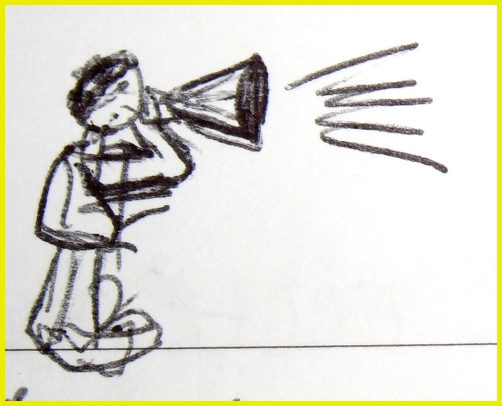
    Sketch of a person with a megaphoneSketch of people talking to each other

    I had no real idea what to expect from this session.  It turned out to be about local community websites and journalism endeavours, and that part(s) that libraries can play in these.  Some of the example sites mentioned were:
    These sites enable people to help each other out locally - by sharing information, answering questions, raising issues.  They positive impacts on' real life' community--people coming out onto the streets to help clear snow, for example--and can improve community opinions of institutions such as the police or the council, when such institutions engage with them in a sensible and helpful way.

    The implications for libraries of this are twofold:
    1. Libraries can support the necessary training and technology requirements for people to be involved in these endeavours.  Providing space, equipment and training is a way of showing that libraries are needed, useful, relevant, etc.  As a non-core activity, it's also something that could potentially use volunteers, without that volunteer involvement threatening current professional roles.  Perhaps.
    2. Librarians could get involved with these communities, in the manner that some councillors have done, to offer information to people who need it.  Either on a formal basis (an 'ask the librarian' thread) or informally - quietly lurking in the community and speaking up when they think can help. Either of these models strike me as being similar to the 'embedded librarian' which is growing in prominence in the academic/subject librarian world. This would, again, prove the usefulness of librarians, and hopefully raise the profile of the library and its services.
    There's information about research done into these communities on the Networked Neighbourhoods site.

      Conclusions/Action Points/What Next?

      I have few definite conclusions to draw from the conference, except perhaps 'just get on and act on your ideas'. Times are hard, but sitting around whinging won't make them any better. Everyone can do something to improve attitudes or services. So get on with it.