Showing posts with label academic libraries. Show all posts

Sunday, 9 November 2014

New space for old books: #rbscg14

At the end of August (Wednesday 27 to Firday 29), the CILIP rare books and special collections group met at the University of Aberdeen for its annual study conference, this year on the theme ‘New Space for Old Books: Building for the Future’. The full conference programme with details of all the speakers and paper titles should still be online (.docx link).

The conference took place in the new University Library building, a dramatic blue-ish cuboid that stands above the city on a hill, and which has probably the best views of any library anywhere:


There were 17 papers in total, and I don’t propose to write them up individually. I felt that three main themes emerged: project management, knowing your collections, and managing the environment.

Projects
Project management is hard. Everyone said this. Major building projects are incredibly complicated and you will need to set aside a lot of time to manage them. Architects, tendering for services, buildling, weather, finances … Try not to have everything happening at once, but do try to have a plan from beginning to end when you start. In particular, it’s very useful to have the utilities and air conditioning designed together, even if they’re implemented in separate phases.

Be prepared with ideas about what you’d like for your buildings. Decisions are sometimes made very quickly – particularly if money suddenly becomes available – and you’ll want to be able to put your case forward well. Don’t be afraid to be ambitious and imaginative when you do.

Unexpected difficulties will come up. You can try and prevent some of these – for example, by checking the financial health of your contractors – but some of them, like the weather, you can’t. And sometimes it may be that things don’t move forward because there just isn’t sufficient institutional interest.

Therefore you need to be pragmatic at all stages. You might be able to keep your service running as usual through most or all of a project, but you might not be. Communicate with your staff and readers about this – it’s not the end of the world to stop doing things if people know why, and for how long. It’s likely that staff roles will morph during the project, as different areas of expertise are needed. This might be uncomfortable for people who’re already adapting to the changed priorities and working conditions, so, again, being honest and upfront about what’s happening and why is important.

Two resources were mentioned as being useful:

    The stuff
    We heard about the construction of several brand new buildings, all of which to some extent or other also involved the bringing together of previously separate collections and services from one or more institution, the creation of new services, and deliberate moves to engage with new audiences and communities.

    The Keep in Brighton brings together the special collections from the University of Sussex, the East Sussex Record Office and Brighton’s Royal Pavilion & Museums Local History Collections. From the point of view of readers, there is no difference between the collections: everything can be searched in one place and there are no differences on access rules and regulations. However, behind the scenes the collections remain separately owned and managed. This meant that there was significant work to do in harmonising policies and procedures (such as fetching, handling, registration requirements for readers, reading room rules and so on) before opening the service.

    The Hive, Worcester, is Europe's first joint university and public library. It combines the University of Worcester research collections, the collections of the Worcestershire Archive and Archaeology Service, the university research repository, the public library, the local government one-stop shop and more. It has admirable aims, even if its list of ten core values reads to me like something from 2012: inspiration, connection, aspiration, learning, integration, inclusivity, enduring values, well-being, sustainability, visibility. I was very pleased to hear about the efforts that had been put into staff training and customer service. Staff for the Hive were drawn in from all the different areas represented in the collections. They held staff workshops about how to answer customers’ queries: customers see all the staff as the same, whereas each person has a particular background and areas of expertise and non-expertise. They devised a very structured referrals process, so that people know what they should pass on (and how to do it) and what they can answer themselves. All this under the matra: ‘We welcome, we innovate, we respect [each other's specialisms]’.

    Two members of staff from the Glasgow School of Art library spoke about the work they had been doing (pre-fire, of course) to encourage wider use by their students and others. This included bringing artists and writers in to use the collections to ‘inspire, challenge or expand their practice’ through a project called the hatchery. This has included using the library space for installations and tableaux vivants. They cited the Library as Incubator project as a useful resource and inspiration for this work. In a newly designed special collections area they’ve also been running workshops and sessions based on the collection both to draw out items to use as inspiration, but also to explain to students how special collections and archives work. Various pieces – such as a camel (!) - have been inspired by this.

    Bringing lots of things together can obviously have its benefits. Aberdeen University Library special collections reported a huge increase in use once they were in the same building as the rest of the university library, instead of being hidden in the back of somewhere else behind 5 doors and several corridors... But I wonder whether collaboration sometimes isn’t just seen uncritically as a Good Thing by senior management, without consideration of the individual requirements of user groups and services.

    The key, it seems to me, to making a collaborative project work, or to getting the most from your collections is to know really well what it is you have in the first place. You have to invest time and effort in understanding the potential of your collections and the interests and needs of your current and potential future readers. I think this is a moral I hear in a lot of conferences because I never feel like I spend enough time getting to know my own collections...

    Environment
    Environmental control can be really difficult whether you’re in a historic building or a new one.

    Susie Bioletti spoke about the difficulties in managing the conditions in the Long Room at Trinity College Dublin. It’s Dublin’s second biggest tourist attraction, with something like 550,000 visitors annually. It gets loads of sunshine, there’s heaps of dust (that follows no known settling pattern), people bring in humidity and heat with them. Since 2004 they’ve been undertaking detailed surveys. They measure dust using a ‘loss of gloss’ technique in which glass microscope slides are placed in various locations and their reflectivity (or lack of it) is measured to give a value for the quantity of dust that has settled. They plot environmental recordings against a calendar in order to demonstrate trends and to pick out dates that are particularly bad because of particular events – a useful visual way to map this data.

    You can expend a vast amount of time, energy and money trying to keep a very tight control on temperature and humidity, when it could be a lot more efficient to take a more relaxed attitude (especially considering that facilities management is rightly increasingly concerned with wider environmental impact, carbon usage and so on). NAME from ORGANISATION summarised the recommendations of PD 5454 (the replacement for the BS 5454 standard) as:
    • know your collection and assess the risks that apply to it specifically
    • recognise the difference between mixed traditional archive materials which can’t be split up easily, and those specialist materials that need particular conditions
    • re-conceptualise environmental control as ‘allowing fluctuations within set parameters’ rather than ‘rigid control’
    • Keep the RH up in reading rooms – it’s a shock for documents to move from 50% RH in the store to maybe only 25% in the reading room. Temperature is less of an issue. (Would that this will end the scourge of 16ÂșC reading rooms...)

    These are all sensible and encouraging, and echo what was said at the late BL Preservation Advisory Centre ‘Knowing the Need’ conference last year.

    Several people in the audience, however, raised a very important point: it’s all well and good to adopt a more relaxed approach to conditions in which PD 5454 is a guide not a rule when considering your own collections. However, the stipulations in PD 5454 are routinely used by institutions loaning objects and books as the guide for acceptable storage and display. If you want to be borrowing items for display and exhibition, then you need to trying to meet these conditions for many places to allow you to borrow. I’m not sure we’ve found a way to square these two approaches yet.

    And last but not least
    1. The recurring theme of the conference was having the Queen visit to open your building. It’s not compulsory but it does get all sorts of otherwise disinterested people to notice you.
    2. Need a better name for your basement? Try ‘Garden Level’, a term used at – I think – St Andrews.
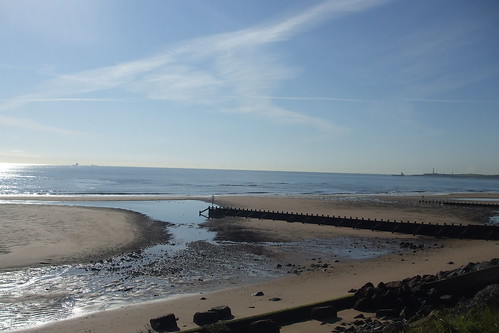
    3. Aberdeen is gorgeous. I can’t wait to go back:
    Sunday, 3 March 2013

    #libcampldn: finding practical solutions

    I managed to snag a last-minute ticket for the Library Camp London unconference held at Senate House Library on Saturday 2 March. Despite my early-morning wobble--did I really want to spend a day talking to people about difficult stuff?--I had a really good time, and am glad I went.  Big thanks to Andrew Preater, David Clover and Gary Green for organising it.

    With such a wide spread of sessions to choose from, it was necessary to have a method for choosing what to attend.  I decided not to try and be worthy or hard-thinking, but to go to what sounded like the most practically useful and/or the most fun sessions. So I steered clear of the Future of the Library, DRM, Open Access, Librarian Personalities, and even Radical Libraries (although I eagerly await write-ups of that one), and instead, apart from my fairly worthy hidden collections session, went with fun, low-stress and useful.

    Hidden Collections

    I pitched this session as a forum for discussing the problems described in the 2012 RLUK Hidden Collections report (and touched on in the OCLC Survey of Special Collections), and hopefully to share ideas and strategies for dealing with the problem.
    The Problem
    There are millions of uncatalogued, or insufficiently well-catalogued books, files, manuscripts, recordings, maps, pieces of sheet music, etc. etc. etc. in libraries of all kinds across the country.  Getting this stuff catalogued is hard because good cataloguing takes time and skilled staff.  In an environment where more and more new stock comes 'shelf-ready' (i.e. ready-catalogued by the company that supplies it, often not very well), the number of in-house cataloguers, especially in public libraries, is declining.  This means that there's no-one available in the institution who could possibly take on the cataloguing backlog.  Even in institutions no buying shelf-ready stock there are serious and worrying pressures on cataloguer numbers, and cataloguing projects don't seem to be sexy enough to attract much outside funding.

    Apart from the obvious reasons (no record = no-one can use it because no-one knows it's there ), hidden collections are bad because they are far more likely than visible collections to be left languishing in poor environments leading to serious preservation problems, or to be inappropriately disposed of by penny-pinching managers (especially in public libraries, sadly).  Their mere existence is also psychologically wearing on those who know they should be dealt with but don't have the resources to complete such work.

    Convincing the powers-that-be to fund cataloguing work can be difficult.  Reference libraries can struggle to prove their worth as they don't have circulation data to show usage levels.  Trial projects putting a small number of new records into the catalogue can demonstrate a sharp uptake in use of a particular set of material, but this isn't always what happens.

    Some digitisation projects aimed to deal with a large quantity of unavailable archive data have returned data that's so poor as to be almost useless.  There's a fear about spending money on such projects in case they're not worth the effort.

    It can be difficult to know where to start when addressing your hidden collections problem.  Obviously it's best to start with what users want the most, but how can they know they want something that's hidden?  It's a worry to some that previous projects haven't focussed on the right stuff: maybe we should concentrate on more modern collections rather than the traditional blue-chip items such as early-printed books?

    Knowledge about collections and projects is very often only recorded in people's heads.  Once that person goes, all the information is lost.  This happens time and time again.

    Solutions
    Using our usersA project at the Institute of Education has engaged the help of specialists to improve the metatdata on newly-created brief catalogue records for historic textbooks. The discussion acknowledged that user-tagging facilities in catalogues often don't elicit many responses (even on Amazon!), but we agreed that maybe actively asking for specialist help might be much more successful than passively including 'tag this' buttons without explaining why users would want to bother.  Rare books users often, for example, notice that ESTC numbers in catalogues are incorrect.  We should have 'Is this record wrong? Please let us know!' buttons on records, just like COPAC does.  You can also let users tag based on a fixed vocabulary, rather than free text.  I was inspired with the idea of letting users tag rare book records with a selection from the RBMS Controlled Vocabularies, such as binding types and illustration terms.  I'd love to hear if anyone thinks this is possible, feasible, sensible...?

    What do they want?  We should be formalising a link between enquiry and reference work on one side and cataloguing and digitisation on the other: the enquiry people know what people are asking about.  In a small library it'll be the same people doing both, but in a large library a formal reporting mechanism would be very useful.  You can use your catalogue data to see what people want and can't find: look at which searches are turning up no (or very few) results, and then use this as a basis for choosing what to catalogue (or how to improve the cataloguing), what to digitise, or what to acquire.

    Publicity.  We need to publicise the material that we have catalogued so that the work can be shown to be a success.  This means talking to researchers, to people who write research grants, to our other users (such as people looking for dissertation topics), blogging our collections, holding events around them, etc. etc.

    Get the issue up the agenda.  We all appreciate the problem of and with hidden collections, but we mustn't assume that people higher up in our organisations either know that the problem is there, or why it is a serious problem.  The RLUK presents a opportunity to raise awareness, for example by including it on the agenda at a library committee meeting.  Summarise the findings, explain the local context, and maybe (just maybe) someone will take it up higher in the hierarchy. 

    Know your collections.  There is nothing more important in librarianship than knowing your collections.  It's not necessarily easy to do, of course, but when you start somewhere new it's important to ask questions about the shelves/boxes/collections that seem overlooked. What is it? Where did it come from? What's the plan?  And then document this information so that it isn't lost all over again in the future.  It's important to your users that you also know what else roundabouts is relevant to them - we can cross-publicise collections in other libraries.

    I was really pleased with how the session went.  A high proportion of the attendees spoke up, and shared perspectives from a range of different types of library and collection.  There were some keen 'amplifiers' (i.e. tweeter) and this facilitated some useful back-channel comments. As well as voicing concerns and problems, the conversation developed naturally into what we can actually do.. 

    Library Displays
    Pitched by a school librarian looking for inspiration, I found that this session really helped me clarify some of my own marketing plans, even though I don't do 'displays' in the traditional sense.  Ideas that Ill be thinking about using at work include:
    • investigating the non-fiction/science book prizes, and science prizes (e.g. Ignoble, Nobel, Darwin) to base publicity on the shortlists/winners.
    • making a note of national/international book days and events (e.g. World Book Day, World Poetry Day) and national/international history weeks and months (e.g. black history month, LGBT history month) to do things that tie in.  Although we're not primarily a book-ish institution, it might be effective to tie in library things with events that staff might have heard about on the radio/TV.
    • would blind date with a book work in a professional library context?
    • make an annual list of all this stuff, and--when something crops up that I'd forgotten about (it's usually small things, like Christmas...)--make sure to include them for next year.
    • make sure to record what was done this year in order not to repeat too closely next year, but also to build on success.
    Speed Networking
    I turned up late for this because I was distracted by The Itinerant Poetry Library (which is marvellous and must be seen to be believed) and therefore set a cat amongst the neatly-organised pigeons. A school librarian, Dominique, kindly let me circle round with her, and a met a selection of people familiar and new. I was very impressed by the way Liz Jolly facilitated an evaluation of how the session had gone, and how it might be improved at future library camps.  This was followed by a general discussion about networking methods.  Some familiar views about the value (or not) of Twitter and other online networks were raised, as well as a salient point from @Schopflin that an effective networker needs to use many different methods in order to meet lots of different people.  My opinion is that if you think you're meeting the people you want to meet and finding out the news you want to find using your current networks, then maybe you don't 'need' Twitter.  But if you feel you could or should be trying to do more then it's worth looking around to find your Twitter (or Linkedin, or whatever) niche.

    Rhyme Time
    Linsey Chrisman and Jody, both experienced children's librarians, led a participatory rhyme-time (or, rather, read-and-rhyme, which is for toddlers rather and babies, and they determined that a bunch of over-excited librarians are closer to the former than the latter) session.  Standing and sitting in a circle, we sang, signed and danced our way through several songs, and had enormous fun flinging toys into the air with a colourful parachute. It was really good fun to let our hair down, wave our arms about, and participate in something communal. There's definitely something in the idea that singing together with other people makes you happy.  Though how you can incorporate that into more of life successfully, I'm not sure - it only works if the people involved are willing...

    We also discussed some of the whys and wherefores of public library rhyme-times, such as how to balance holding them in spaces that are suitable (encourage parent participation by not being too public and prevent too many toddlers absconding) but still emphasise that this is a library thing (have the books nearby).  Absolutely top tip: if you're organising something like this, think about where you'll get people to park their buggies!

    And... rest
    It was a hard-work day, but very rewarding.  Fortunately there was plentiful coffee, lunch and cake to keep us going.

    Saturday, 29 October 2011

    Visit to Ipswich: three libraries

    On Monday 22 August 2011 Abby Barker organised a visit to three Ipswich libraries for the CILIP East of England Branch.  I went along because I'd never been to Ipswich before, and because the libraries in question sounded pretty interesting and were from sectors I know little about : a private institute, a large FE college, and a new university.

    These notes have been languishing, half-written, for months.  They're clearly never going to get written up in full, so I'm publishing this post in note form.

    Grainy camera phone picture by yours truly
    An entrance to a hidden world
    Ipswich Institute

    What?
    • Founded in the nineteenth century for the purpose of educating mechanics.
    • Today it offers members a lending library, a coffee shop, space in the centre of town to sit down and read, and educational courses and talks.
    • It inhabits two historic buildings in centre of town. One has been its home for a long time, the other was acquired recently.
    So what?
    • As with any organisation using historic buildings, the facilities aren't ideal. There currently isn't access to the first floors of the buildings (where many of the talks take place) for those who can't manage stairs, for example.
    • As a member organisation, everything they do has to be approved of by the membership. This means that innovation can be hard - things like using some coffee shop space for part of the library can cause upset. 
    • The Institute seems to function as a public library for some of its members. Obviously it's a tricky issue to wonder whether this library 'takes people away' the public libraries: they've paid for something, so why not enjoy it? But given the trouble facing public libraries this did just make me a little uneasy.
    • Several of the people on the visit were fairly local to Ipswich, and said that they'd seen the Institute doorway in the middle of town, and never really known what it was. I wonder how many other 'hidden gems' there are out there - and how much public libraries (or others) are like this for many people. To be fair, the Institute said that it's numbers were healthy and that they weren't particularly marketing themselves to get more.
    Now what?

      'Suffolk New College, Ipswich, Suffolk' by mira66 on Flickr
      The swirly  Suffolk New College logo
      Suffolk New College (Learning Curve)

      What?
      • This is the library for an FE college

      So what? 
      • Crowd control: the librarian said this was better than it could be, but she still had to work to get people not to eat, to behave appropriately, etc.
      • Getting the students to make the most of the resources
        • The librarian has brought material for particular courses together on the shelf, rather than sticking rigidly to Dewey.  All sizes are also together - no oversize shelves.
        • Trying to make stuff appeal
        • Success with some subjects in getting librarians into induction sessions - trying to spread this through subjects
      • Getting stuff back - only very few books at a time - many go missing
      • Wider responsibilities are being given to the library as part of the development/reorganisation of the College (it seems as though continual change is part of the furniture):
      • Uncertainty about funding/future - this year's intake only known at enrolment at the start of September
      Now what?
      •  Think about how HE institutions (or public libraries) can and should be helping students come from an FE background like this: the library was well-run, but small.  How can we mitigate the overwhelmingness of the libraries they'll face later on?

        'Ipswich Marina' by Martin Pettitt on Flickr
        The Waterfront Building
        University Campus Suffolk
        (The library's web presence is almost entirely via a VLE, with no outward-facing webpage, so sorry - no handy link!)

        What?
        • UCS is very new.  It offers HE courses validated by other local universities.
        • Most of the campus is housed in brand new buildings (such as the Waterfront Building, right). 
        • The library is in an old ('60s) building that has been refurbished.
        • The Library is in a separate building to the rest of facilities, across a road from the rest of the campus 
        So what?
        • As the institution's so new, there's no 'average' student yet - changing student profile(s) mean that the services required keep changing.
        • A new institution undergoes constant change: for example, initially there was a Learning Resource Centre (i.e. computer room) in the Waterfront Building, which was very popular with students.  This has now been removed to make way for a tiered lecture theatre (requested by the student body).
          • Another new innovation for the new academic year is the inclusion of the library in the 'infozone' in the lobby of the Waterfront Building: hope it will help people find out about the library and how to use it.
        • Students come from a lot of different backgrounds, often not 'typical' HE backgrounds, so there's a heavy emphasis in the library on the accessibility of resources
          • DVDs are interfiled with books, not kept separately
          • The journals archive is colour-coded according to broad subject areas, so encourage people to use it by browsing
          • There's an emphasis on making more time and space for learning support and info literacy teaching
          • The library offers taster study-skills sessions before courses start - these are popular with new students and they find them useful.
          • Students can book time with a  subject librarian
        Now what?
        • What can an 'elitist' institution like Cambridge learn from libraries like UCS?  They go all out on making access as easy as possible: what's the best way for us to do similarly?  What are the barriers to us doing this?


        Thursday, 2 December 2010

        Brown bag lunch: 'Is the physical library redundant in the 21st century?'

        At this month's Cambridge Librarians' networking/discussion 'brown bag' lunch, we took as our subject the BL/THES debate ''Is the physical library redundant in the 21st century?' held on 26 October, featuring Mary Beard, Clive Bloom, Sarah Porter, and Martin Lewis, and part of the BL Growing Knowledge project.  As well as a good summary blog post, there's a podcast, an archive of tweets, and some attendees' and participants' blog posts also available.
        'Study, study, study' by pnoeric on Flickr
        'Study, study, study' by pnoeric on Flickr

        The topic - do we still need physical libraries - is enormously broad, and it's one that cuts to the heart of many current debates about the future of libraries (and gives me flashbacks to my very first LIS MA essay on 'the paperless library').  To be able to answer the question you need to be able to discern what the true purpose(s) and value(s) of libraries is(are).  This breadth of scope put me off listening to the podcast until the evening before the meeting, but, having braved it, I can report that I found it really interesting listening, and also a debate that wasn't so broad as to avoid all summarization.

        There were several main strands that ran through each of the four speakers' pieces, and through the subsequent lengthy question session:
        Physicality | Space for thinking and working | Librarians | E-stuff is great | Democratisation of knowledge | Money
        We covered all of these in the brown bag discussion one way and another, and what follows is an attempt to synthesise all the various opinions and to discern my own.
        'Library' by Stewart on Flickr
        'Library' by Stewart on Flickr

        Physicality

        Books are lovely objects and libraries are often lovely spaces (Mary Beard made a rather impassioned, nay passionate, defence of the library as a, quite literally, sexy space, though no-one at the Brown Bag went quite that far!).  Clive Bloom's assertion that you 'learn nothing more' by actually touching a book rather than reading it in e-form is clearly only true in some instances, and I strongly believe that special collections and book historical research are one of the major selling points for the continued existence of physical libraries.  Andy Priestner however reminded us to remember that the magic of serendipitous discovery in dusty tomes is something of a myth promulgated by academics who don't want anything ever to be weeded.

        Space for thinking and working

        Everyone at the Brown Bag seemed to agree that there's still demand for working space in libraries, and that in Cambridge there's still considerable demand for quiet study space.  We discussed the effectiveness of the Sheffield University Information Commons (it was great to have a recent Sheffield Graduate, one of this year's Graduate Trainee librarians) to give the student perspective of the IC - it seemed to be felt that it was a nice idea, but that it took a while for the 'policing' to make it an effective space.  Another interesting avenue of discussion centred on the 'cachĂ©' of the library space: two librarians noted that their users wanted to have non-traditional library spaces (such as IT training rooms and informal cafe-style spaces) inside the library, and not just near by.

        Librarians

        Not all the speakers at the debate mentioned librarians, but those who did viewed them as a positive asset because of their knowledge and skills.  But we need to be marketing ourselves more so that people think of us as the 'person to ask' for help (the Judge Business School seem to be having great success with their information-service-in-the-common-room scheme).

        E-stuff is great

        There was general agreement at the lunch that e-resources are often brilliant, so far as they go, but that the idea that 'everything is online' was patently rubbish.  What with delays in availability of new editions of books in e-format, slow download speeds (a reader bugbear), difficulties with access and reliability, the simple fact that not nearly everything is available digitally yet, and the difficulty with, for example, browsing e-journals or e-books, mean that paper equivalents are still heavily used.  Martin Lewis said more than once that more needed to be done to inform readers that when they're using online journals and databases, they're using the library, as most don't realise that it's the library that provides the access.  It would be interesting to think further about how this could be done without making access slower or taking the user through extra, apparently unnecessary screens...

        Democratisation of knowledge

        This was a phrased used by Clive Bloom and Sarah Porter.  They suggested that libraries were intimidating, exclusive spaces, and that now 'everything's online' anyone could access whatever information they wanted. As I've already said, this is patently false - you can't get everything you might need with just an internet connection and free search tools.  I have more sympathy with the idea that a library can be an intimidating space, and that some users might prefer to be able to access its resources remotely.  But that fact doesn't invalidate the existence of a physical library or, more importantly, a physical librarian in it.

        Money

        Quite a lot was said in the BL debate about the cost of physical storage, and the need for collaborative efforts (such as the UK Research Reserve) to manage the long-term retention of older material.  The distinction was drawn between 'elite' research libraries and general academic libraries, which will have different priorities for retention.  This isn't really news, although it's a good reminder that the general view of libraries amongst the public, students, and academics is that 'they (should) keep everything'.  If we recognise that that statement is false, that each library keeps what its users need, then the idea of collaborative retention programmes stops looking like the threat that at least one questioner seemed to view it as.  As I said at the top - central to the debate is the issue of 'what are libraries actually for' - and one answer to that is that each library is for someone, and therefor something different, and the top priority is to identify who and what.

        Conclusion

        So far as I have one, my conclusion is that, of course, libraries are hybrid spaces. People don't just use e-material or books; they use the best bits of both.  The title 'Is the physical library redundant' sets up a false dichotomy: the most important issue isn't 'phyical library' vs 'digital library' it's 'how do we ensure that our readers can meaningful access to as many of the resources that they need or want'.

        Monday, 26 July 2010

        A day in the life

        This my first post as part of the fifth round of Library Day in the Life a project started by Bobbi L. Newman, Librarian by Day. I only heard about Library Day in the Life on Sunday, so I've not followed any of the previous rounds and this is something of a leap in the dark.

        I ought really to start with a post explaining my rather cryptic job title ('Hoyle Project Associate') and my place of work (St John's College Library, Cambridge, UK), but I'm going to leap right in with Monday, and will try and fill in the gaps later and/or as I go along.

        Readers
        I work in the Library's Rare Books Reading Room, a place for readers to consult, under supervision, items from the Library's special collections.  Today saw two phone calls and one email arranging three separate reader visits to see one medieval and two post-medieval manuscripts.  We also had two readers in the room, one looking at a post-med manuscript, and one using the photocopier.  Most photocopier users outside of other Library staff require some assistance with the machine, and interpreting its repertoire of cryptic error beeps, at some point or other.

        Correspondence
        Emails sent and answered today included:
        • receiving the thanks of another College department for supervising the Old Library during a reception on Friday evening;
        • Contacting a member of the public who donated sound recordings to the Hoyle Collection to ask about permission to use them on a Hoyle-related website;
        • Confirming the details of a medical librarians' visit to the Library on Wednesday;
        • Reminding attendees of an informal meeting tomorrow evening to discuss organising TeachMeet in Cambridge.
        CPD
        I'm currently undertaking the CILIP Chartership process, and am also participating in the 23 Things Cambridge programme. Today I read through the Thing 18 post about Zotero. Noticing that Zotero is a browser-based tool, and looking for something web-based that I can use from home, work, the UL, and all points north, I had a quick look round the Mendeley site, noted the Mendeley Web feature, and that it supports MHRA-style citation.

        Cataloguing
        The bulk of my workload is cataloguing Fred Hoyle's personal papers.  Today I started a new box (the papers have all been transferred from the filing cabinets they arrived in into archival-quality boxes) which demonstrates the flexibility of the term 'papers' in this context.
        Personal papers in folderBox of personal papers
        These pictures show not only a folder of papers removed from the books in Hoyles' library (also held at St John's and catalogued on Newton as the Hoyle Collection), but also a film reel of Stonehenge, volumes 2 to 5 of a children's encyclopaedia of science (articles within which include 'Phosphorescence' and 'The earthworm'), and a number of issues of the Monthly notices of the Royal Astronomical Society.

        Outreach
        The other main strand of my work is outreach to schools, special interest groups and the general public.  Forthcoming events include participation in Open Cambridge and the University of Cambridge Festival of Ideas.  Much of this morning was spent designing a flyer to advertise our Festival of Ideas event (an exhibition of literary manuscripts and free expert talk from College fellows).

        Tomorrow's to-do list
        • Continued cataloguing;
        • Chasing up contacts regarding a possible Autumn event to mark the re-publication of a Hoyle science fiction novel;
        • Bringing some of my Chartership notes into order;
        • Genning up on TeachMeet.

        Wednesday, 23 June 2010

        Cambridge Conversation (1)

        This is the first part of my report about a discussion between health, academic, business and school librarians held in Cambridge on Tuesday 22 June as part of the CILIP Conversation. Part 1 is all about CILIP and part 2 is about the future of libraries.

        Lots of the other participants have also reported: Anna, Anne, Isla, Niamh, Sheila, and Jenni.

        What do we think about the Conversation?
        CILIP asked us to say what we think will happen in 10 years time, but we really can’t do that; it’s a job for futurists. What we can do is to evaluate what has changed in the last few years, and how this might develop in the next 1, 3, or 5 years, and we could have been asked about this in more detail in the survey.

        We really didn’t like the CILIP survey much ; it felt irrelevant and lacking in detail. Some of the questions just didn’t even make any sense at all, such as ‘do you think that expectations of your role are increasing’. We also wanted more detailed questions about what we want from CILIP.

        What do we think about CILIP?
        CILIP feels distant, remote and irrelevant to many - particularly those working in business, school and health libraries – it seems like Update and Gazette have little that reflects our working lives.

        The principal of chartership is worthwhile, but there was opposition to having to remain a member of CILIP for life to retain it. Personally, I understand this objection, but I suspect that this is the case for most professional bodies and that it isn’t just a CILIP issue.

        CILIP CPD courses are expensive. Many people were very impressed with the courses organised by special interest groups, at very reasonable prices, although it was noted that speakers for these courses are often only paid travel expenses. CILIP courses are much more expensive than those from other similar professional bodies such as the Museums Association, and they’re not reliably good enough for people to want to risk spending £400 to attend them.

        CILIP’s building in London is very unpopular; issues regarding its costs and value have been addressed elsewhere.

        We read Update and Gazette for the job advertisements, and some people (those training and chartering) try to read it all, but we don’t find much that is relevant or interesting to us. The job advertisements are sometimes for such poorly paid jobs that we wonder whether CILIP should be advertising them at all. It was also noted that it’s so expensive to advertise in Update and Gazette that many jobs are missing.

        It was thought that there could just be one CILIP magazine, possibly delivered online only. (I have a lot of thoughts about the online magazines, and the CILIP website in general, but I’m saving them up for another post.) It was even suggested that the magazine format could be dispensed with in favour of personalised news bulletins. There is an e-bulletin feature already, but there’s not a lot of refinement to it.

        So why do people continue to pay for membership? Some jobs do need chartered status, and for professionals without an LIS degree, chartered status is important evidence of competence. People couldn’t praise the special interest groups enough – they seem to make membership worthwhile.

        We do want a professional body
        We want it to advocate for us, and to have good PR abilities and a strong public and media profile. The Royal Institute of Chartered Surveyors was mentioned; we’d all heard spokesmen from it on the TV and radio. We really want CILIP to have someone whose job it is to appear on Newsnight, instead of making excuses about how hard it is to face up to Jeremy Paxman.

        We approved of Phil Bradley’s idea that it would good to see a proactive CILIP that gets things wrong sometimes, instead of seeming to sit back and let us get on with it.

        The example of Micahel Rose advocating for children reading was made. Andrew Motion (chairman of the MLA) wrote in 2008 about libraries in a way that suggested he hadn’t been in many recently, but he has been speaking up for them in the last few weeks. His opinions may not be nuanced enough to capture all the issues that concern librarians and information professionals, but CILIP could benefit from having someone similar to make a public impact.

        Cambridge Conversation (2)

        This is the second part of my report about a discussion between health, academic, business and school librarians held in Cambridge on Tuesday 22 June as part of the CILIP Conversation. Part 1 was all about CILIP and part 2 is about the future of libraries.

        Other peoples' reports are also available:  Anna, Anne, Isla, Niamh, Sheila, and Jenni.

        What is ‘librarianship’?
        There was some debate about whether libraries and librarians need to rebrand as ‘Learning Resource Providers’ or something similar, but this term seemed far too narrow. Maybe there’s something else we could call ourselves, or maybe we just need to be clearer about what librarians do.

        One good summary of librarianship (or information professionalism, if you like) that we thrashed out was:
        Librarianship is helping people to work what question they’re really asking.

        The emphasis was very much on personal interaction and support. The organisation of data can happen from anywhere, but user support and training is best done face-to-face, and one-to-one. This 1947 promotional film emphasises personal interaction in the role of the librarian. Why are we having to work to re-emphasise this now, when it’s surely never stopped being true?


        This level of personal interaction and help needs professional staff. There’s definite concern about the de-professionalization of public libraries, and in a similar way about also the closure of government libraries: what impact will this have in the long term?

        We discussed some of the ACRL predictions for future of academic libraries, in particular the idea that in 2025 there will be ‘no need to search’ (link to pdf page 16, item number 17 ). This ‘no search’ environment (we wondered if it would be something like foursquare, about which I know nothing) will surely require a lot of unseen work in the background, and it will need common languages and standards across all sources and platforms, and not continual re-invention of standards as we see today (apparently the Europeana project isn’t using Dublin Core standards for metadata but inventing some different standards [I've been corrected in the comments - Europeana are tweaking Dublin Core instead of using it straight, which is clearly better but still not ideal]).  Librarians will have to keep interpreting what people say and want until the semantic web is very, very good indeed, and that won’t be soon! Users expect intuitive interfaces, and need to be shown that there are benefits to learning more complex search techniques.

        In 5 years time...
        We ended the discussion by trying to imagine the future of libraries and information services on a more manageable timescale than the 10 years asked about by CILIP. If you have thoughts about what your library or service will look like in 5 years (both best and worst case scenarios!), then please continue the discussion in the comments.

        School Libraries
        School librarians can be very isolated. They rely on local networks, feel distant from CILIP, and unrecognised by teachers. School budget cuts means that there may be no money at all for CPD.
        School libraries will have to adapt to match evolving teaching methods and to provide tools to help students find what they need outside the physical library, as well as providing project collections of books for use in the classroom.
        There are currently not enough computer resources, but this might change as increasing numbers have their own laptops. Even with their own computers they will need help to locate resources online, and in the physical library.

        Academic/Faculty/Subject Libraries
        Subject librarians will have to know their subject more so as to be able to provide tailored search and indexing services. They might not need to be the academic, or doctor, but will need to speak enough of their language not to sound stupid, but to sound reliable and useful instead.

        Business Libraries
        Publications need more detailed metadata, for example about the precise materials used in engineering. This has to be added somewhere in the process, but it will be a lot of work, and it’s unlikely that author or user tagging is the answer.

        A Cambridge College Library
        In five year’s time the physical library with books in it will still be here. Students are currently very clear that they want to have the physical space to work in, and not even all new academic books will be available as e-books by then, never mind the older texts that are still needed.
        Special collections are being digitised, but this can’t replace the importance of the books and manuscripts themselves, and will often lead to increased reader numbers through improved publicity. Digitisation also isn’t futureproof.

        What can we do to improve the situation?
        • Collect evidence of what we do in order to prove our worth.
        • Ask our readers and researchers what they want from libraries: this might include help with copyright, and with getting published, more detailed enquiry answering about specific items (see Greening the material text).
