Showing posts with label museums. Show all posts

Sunday, 16 November 2014

What are we here for and where are we heading? #dcdc14

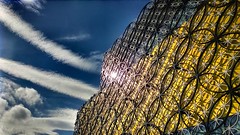
At the end of October I went to ‘Discovering Collections, Discovering Communities’ (#dcdc14), a collaborative conference between The National Archives and Research Libraries UK, exploring ‘the ‘discoverability’ of collections across different formats, institutions and professions’. It had a focus on archive and museum collections and institutions, and was held at the new Library of Birmingham. The full programme is here (pdf link) and video of sessions will be going up in due course.

Birmingham Library by Chris(UK), on Flickr
Creative Commons Creative Commons Attribution-Noncommercial-No Derivative Works 2.0 Generic License   by  Chris(UK) 
There were 9 panel sessions and 10 workshops split over the two days. I went to:
  • Panel 1: Exploring the mechanics of cross-sector collaboration
  • Panel 6: Visualising the digital discovery
  • Panel 7: The community within: volunteers as a route to discovery
  • Panel 9: Collecting - for whose sake?
  • Jisc Workshop: Finding and Using Digital Collections: Do we need new tools?
There was a lot of interesting and engaged discussion on the Twitter hashtag, which cut across the different sessions and themes and helped to make connections between them. I think it’s also the first conference I’ve been to that had an end-of-day summary session in which each panel chair gave a short summary of their session. I found that very useful, too.

I found it interesting to hear about lots of different projects going on at institutions of different sizes, and in different sectors – archives, museum, and library. It’s easy to forget the different approaches of the three domains, given how often they’re lumped together as ‘heritage’ or ‘memory institutions’. It came out early on that museums have a very different attitude to research use compared to archives and libraries: it’s what the latter two exist to facilitate (in large part), but it’s not what a museum is set up for. So when a keen academic turns up to a tiny museum and spends a long time looking at artefacts or talking with the curator, that can feel like a huge investment of time for the museum, with little tangible reward.

Three broad themes appeared to me over the three days. So, as ever, I won’t prĂ©cis each session I attended, I’ll throw together some thoughts under headings.

Representation

This is something that I think all of the first three panels touched upon, but which certainly struck me in a session that was ostensibly about cross-sector collaboration. One speaker mentioned that in a museum display of archival material exploring ‘hidden histories’, people to whom no photograph or artefact could be attached had to be omitted from the display because of the visual demands of displays.

In the social media panel there was discussion of the double-edged sword of high-volume but low-depth attention: can we call click-bait archives images that go viral (44 medieval beasts that cannot even handle it springs to mind) successful engagement? Or, under what circumstances can we call that successful engagement, and how to we balance the demands and delights of that kind of promotion with archival collecting and use that allows for and encourages the discovery of more complex, more nuanced, stories and understandings?

It’s a concern that digitisation, an increased focus on exhibitions, and/or a focus on social media overly privilege the visual and the tangible and disadvantage the textual? Lots of people talk about their exciting online collaborative projects exposing hidden histories and forgotten stories, but I worry there’s a risk that we do this at the expense of another, doubly disadvantaged set of histories that aren’t sufficiently photogenic.

I’ve pulled together a Storify of the Twitter discussion on this topic, rather than paraphrasing it all in this post. 

Strategy

Collaborating

The first session I attended was all about the ‘mechanics of cross-sector collaboration’. We heard about the Making Britain project – a collaboration involving the BL, the OU and many others – and the Inspiring Women project – a collaboration between Tunbridge Wells Museum and the University of Kent. They both sounded like really interesting projects, but in both cases the collaboration was born out of pre-existing relationships and networks: people already knew people who’d be interested in working on the project. Now, there’s nothing wrong with using your network, but it can seem like an impossible task to create this sort of collaboration if you don’t have a handy connection already.

The third paper in the session sought to address this. The Share Academy is a project run by UCL, the University of the Arts London and London Museums Group that aims to ‘build sustainable and mutually beneficial relationships between the higher education sector and specialist museums in London’. They strongly advised taking a more strategic approach to collaboration, by taking a pragmatic approach to planning. It’s important to have collaborative relationships documented and agreed at the start: what will the outputs of the project be (academics and museums might want very different things)? What happens if and when key people move to new institutions? How much investment of time, money and resources is expected from each side?

One really striking point for me was the comment that small museums can feel used by academics who come and research their objects and then publish without seeming to give anything back to the museum. There’s a really large investment of very limited staff time involved in providing access for researchers, and it seems that museums having necessarily been doing a great job of explaining that – unlike in libraries and archives – facilitating this access isn’t part of their core work, and that they would appreciate a more equitable relationship.

Unfortunately, Share Academy is only short-term funded, so it’s not clear whether it will continue, and be able to act as the matchmaker many of us would like!

Lots of people agreed that national advice and support on setting up and running collaborative projects would be welcome, and there’s promise of this coming from TNA. In the meatime there is, for example, this report on collaborative working practices in science heritage: ‘Mind the gap’ (link via Melinda Haunton).

Collecting

Karen Pierce presented a really inspiring paper about her work on the History of Human Genetics library at the University of Cardiff Library. This is a collection of materials concerning the history of the study of human genetics.

It was conceived of by a geneticist – Peter Harper – who was concerned that the history of this comparatively new discipline wasn’t being preserved. It now includes three complete personal libraries as well as selected donations from other people’s collections. It includes printed books – including classic textbooks and other works – as well as grey literature. There was a conscious decision to collect grey literature, because it represents an otherwise undocumented stage in research: networks, transient developments, events, suppliers and so on.

(The quote of the conference was undoubtedly Karen’s two descriptions of grey literature: 'publications by organisations whose main business isn't publishing' or 'floppy stuff’. The subsequent cries of recognition and anguish from cataloguers on Twitter is worth a read.)

This paper really made me think how fine the line is, and how variable is the location of the line, between a library’s perception of something as ‘usefully collected stuff from and expert’ and ‘endless shelves of rubbish we don’t need’. There’s real, serious, professional skill in evaluating the value (current and potential) of collections particularly of this type, and sometimes the smart professional decision is to say ‘we don’t need it’, but this isn’t always so. Sometimes we need to be brave enough to say ‘yes, we’ll take it, and love it, and make it great’.

Karen’s paper was an inspiring example of how to negotiate this boundary by setting clear aims, remits and procedures for such a collection. It’s great to see that at least one place is negotiating this successfully, rather than succumbing to the inertia of the ‘bay and a half of Stuff that someone gave us three librarians ago’.

Data and the catalogue(s)

Ah, shouldn’t we have got past worrying about catalogues by now? More than once people said and tweeted ‘the aggregator is dead’ and ‘it’s all discovery now’ and so on, but in the JISC workshop on digital discovery tools I stuck my head above the parapet and pointed out that the one key thing that would improve the discoverability of my (so-far-non-digital-)collections would be better catalogue data. Or better metadata if you prefer. It turns out that I wasn’t, in fact, expressing the view of a behind-the-times old fuddy-duddy, but actually a feeling that was in the room and online, too. Never mind aggregators being dead, we’re still trying to sort out how to get stuff into them nicely.


Elsewhere, it was pointed out that even if we have all the resources to record all the stuff we want to record, we don’t have cataloguing systems that really allow us to usefully (or at all) record the stuff that makes special collections well, err, special.

A catalogue record for a Shakespeare first folio? Quite possibly won’t mention that it is the ‘first folio’. Probably can’t easily link through to that amazing exhibition you had about it last year. May manage to link through to the digitised version you have, though not necessarily. Unlikely to record other context or importance... As curatorial tools, and tools for the people Out There to understand our stuff, there’s a lot that’s still desired.

(Incidentally, the problems of what’s in the catalogue not matching what the users are looking for also cropped up a recent event at Harvard. We can’t easily meet the needs of researcher’s who’re interested in all sorts of copy-specific features, because they just haven’t been recorded. This extensive conversation is well worth a read – it brings out several different issues affecting our ability to achieve this.)

In summary...

There’s so much going on out there, and there’s so much that we can all do in our services (big or small). There’s huge pressure to do more, to reach more people, to work with more people, to get out stuff out there as much as we can. This is facilitated by things like social media, the spread of digitisation projects, and so on, but these tools don’t themselves ensure that we’re doing things well. We need to keep in sight that we should be doing stuff for a reason and that we ought to be able to set and measure against criteria for for doing this stuff well would look like and we need to consider how it will be sustained in the future.


Sunday, 8 June 2014

A shoal of ganseys

'The Mo', the museum of the North Nofolk fishing town of Sheringham, is currently hosting an exhibition all about fishermen's sweaters, A Shoal of Ganseys.

2014.06.07 Sheringham groyne by Katie Birkwood, on Flickr

2014.06.07 Sheringham shoal of ganseys l by Katie Birkwood, on Flickr

A gansey is a particular type of sweater or jumper, knitted in the round with no sewn seams, most often (but not exclusively) in navy blue, using fine wool at a tight gauge or tension. They were worn by fishermen all down the east coast of the Great Britain, along the whole route of the herring fishing fleet from the Moray Firth in Scotland to Sheringham and Cromer in Norfolk. They were also knitted and worm elsewhere, including inland waterways, the channel islands and the Netherlands.


The exhibition is absolutely splendid. It displays 70+ ganseys in amongst the boats and artefacts that form the museum's permanent displays. The overall effect is very attractive to look at and very evocative. Detailed attention has also been paid to each individual knitted item; the knitting nerd can see where and when each comes from, and care is taken to demonstrate the range of different styles and techniques that were and are used, rather than reducing the tradition to one single model that all ganseys are supposed to have followed.

There's a handling collection of labelled knitted samples upstairs, so there's a chance to see the knitting up really close (with low lighting levels in some areas of the museum this was particularly welcome!) and to take away detailed inspiration for future projects.

I'd thoroughly recommend this exhibition if you're interested in knitting, coastal heritage and history, or if you're just passing through Sheringham or North Norfolk. Sheringham's lovely, too, if you like chips, ice-cream and gulls. (And who wouldn't?)

The exhibition runs until 10 September 2014. I haven't found details of these online, but the exhibition leaflet advertises knitting on the prom on Saturday 14 June, children's knitting sessions on Thursdays during the summer holidays, and a symposium 'Gathering Ganseys' on Saturday 6 and Sunday 7 September.

Sunday, 10 November 2013

Making the most of possibilities of digitisation: an #rbscg13 write-up

Rare Books and Special Collections Group Conference (programme (.docx)).  The theme this year was digitisation (last year was fundraising and advocacy).  The three recurring themes across all of the papers were audience, metadata, and the 'thinginess of things', with some very useful practical advice thrown in. I'm not going to give a blow-by-blow account of every paper, but rather to pick out the bits I've been chewing over since.

All three themes were addressed in Simon Tanner's keynote, which adeptly summed up the current situation as well as challenging us to think more imaginatively about the future and shaking us out of complacency about what we're doing now.

Tanner started by using the analogy of an ant mill to describe the fate of too many digitisation projects.  He emphasised that it's vital to plan properly and to seriously consider audience, opportunity costs (what aren't you doing if you are doing digitisation instead?), and to keep asking the 'so what' question to keep you focussed on why you're doing what you're doing. He also shared lots of useful resources:
Sian Prosser presented a case study on cataloguing and digitising a comparatively small collection of  manuscript fragments. She emphasised that even though there weren't many fragments, a very high level of specialist knowledge was required to describe them well, and that any project of this type is likely to take more time than envisaged.
  • TEI by example. Sian's project used TEI to mark up the descriptions. TEI by example is a set of free online tutorials.
  • Ransom Center Fragments. This is a very useful Flickr site displaying images from a large collection of manuscript fragments at the Harry Ransom Center, University of Texas at Austin.
My favourite paper from the conference was  Rowena Willard-Wright on 'Transforming our data for the internet on a tight budget'.  Willard-Wright works for English Heritage and described their work on digitising and improving their catalogue, including photographing objects, improving old records, cataloguing from scratch, and create varied means of access to the records.  Her talk really exposed infuriating and frustrating the problems faced by all cataloguers are.  As she spoke I wrote:
Willard-Wright's description of migrating and updating catalogue data is very familiar: data has been lost and garbled in transfers over years. Cataloguing has been and still is viewed as archane, and a thing not worth funding, because catalogues were and are seen as not for general consumption. I.e. they are perceived as been the exact opposite of their whole point. This problem that has been seen with the English Heritage catalogue is *exactly* what is being exposed as libraries moves from traditional OPACs to resource discovery/next-generation systems. And, most infuriatingly, the things that cataloguers have known and have been saying forever (e.g. consistency matters, access points matter) is suddenly being "discovered" as if it's new.
Willard-Wright was talking from the perspective of a museum catalogue, which is in some ways very different to a library catalogue.  Museums don't have such a tradition of the publicly accessible comprehensive catalogue, and write much more descriptive and less codified entries for their objects.

The English Heritage cataloguing project used teams of volunteers with very well-defined tasks.  They write clear, concise, engaging, small chunks of description - i.e. entries that confirm to the principles of good writing for the web. The volunteers aren't necessarily experts on the objects, and they're writing for audiences who aren't necessarily experts either. However, there's a recognition that the audience may have additional knowledge or stories to share, and for this reason a 'tell the curators something about this' button is being built into the public catalogue.  I absolutely love this - it's baffled me for years that so few library catalogues have a 'tell us if there's a mistake' button. Copac is a notable exception.  I fear that many libraries don't have one because, if it was ever mentioned in a meeting, someone piped up and said "but think of all the extra work" which likely trumped "think of how handy that will be for our readers, and how useful for us to make use of their knowledge".

That lack of connection to the audience was hammered home for me in another way throughout Willard-Wright's talk.  The museum descriptions are being written for general audiences.  Rare books records contain descriptions that are, frankly, written for librarians.  Not even, really, for most researchers. Yes, we include all sorts of useful information, but we code it up in impenetrable ways, and there's all sorts of information we don't include accessibly.  This has maybe been less of an issue in the past, when catalogue records were only seen by those initiated into our arcane world. But now catalogue records go along with beautiful/intriguing/important digitised books that all sorts of people might want to see, and our gibberish means *nothing*, and doesn't explain any of the basics. (How many records for the first folio show clearly that this is a first folio? Or the Nuremberg Chronicle?)

During Willard-Wright's paper Jill Dye commented that "The only difference between an online catalogue and a digitisation project is adding a photo?", and I think that in one way she's right: it's completely wrong to think that a digitisation project stands apart from cataloguing. However, making materials accessible in any way, but especially if they're freely available online demands a new attitude to description. We really need to step up our game.

Melissa Terras is director of the UCL Centre for Digital Humanities, and she presented a wide-ranging paper highlighting some of the possibilities of high-end digital imaging. She works on these projects in collaboration with computer scientists and engineers, and they're often adapting techniques already used elsewhere (such as in medical imaging). As well as drawing our attention to current projects, Terras made some important points about the theory and practice. Digitisation means lots more sorts of metadata needed so that we can properly interpret the images. As Hannah Thomas put it, Terras' work is "not just about creating a surrogate but about using the image to discover new things, inspire new research". Terras made the point that digital images are *not* exact reproductions of originals. Terras asked us to talk to her if we know of collections or items that would benefit from advanced digitisation and imaging work; part of her role is to connect the various people involved.
  • The one resource I'll share is this breathtaking (there were audible gasps in the room) video of the digital flattening of the great parchment book. Watch it. It's amazing.
Alixe Bovey spoke from the academic's perspective, and addressed some of the threats posed by digitisation. She was heavily involved in the campaign to try to prevent the sale of some of the Mendham Collection books last year. Bovey passionately explained that the digital is not the same as the physical, and we all need to communicate this better.  With the Mendham sale, the existence of digitised copies of the titles on databases such as EEBO and ECCO was used as justification for the sale, ignoring the copy specific details of the Mendham copies, as well as the failings of the scans themselves. Earlier digitisations have been particularly lacking. Never mind the poor black and white reproductions of scanned microfilm, they tended, for example, not to include any blank or apparently blank pages.in the source copy (see this post), and also ignored bindings, and made it difficult to determine the original size of the book. But we're not past such difficulties even with the best modern digitisations; they tend not to include scale rules, (see this post for difficulties of determining size), and give little indication of other factors such as weight, quality of materials used, or even smell.

Anne Welsh spoke very pragmatically from the point of view of libraries and library staff themselves.  She pointed out that we are continually needing to update and improve what we've done before: both content format and types of description.  She faced the fact that we can't do everything, and used the example of the University of Manchester Library Digitisation Strategy Group's 'Criteria for ensuring value to the Library for partnerships' (pdf link), which considers the value to the library of any potential projects.

Nicolas Pickwoad spoke about one element of early books which is too often overlooked in digitisations: book bindings. Most bookbinding digitisations (Pickwoad mentioned the Uppsala Probok project as an exception) show only beautiful, expensive, fancy and/or fine bindings, turning bookbinding digitisation has into "a decorative arts ghetto". This doesn't represent most early book bindings, which are less extravagant, but can tell us a very great deal about the book's history, and may often be the most interesting.

There's also a vicious circle at work: bindings aren't so often described in catalogue records, soscholars can't ask for them, so there's not so much research, so it's not seen as a priority... At least when books are viewed in person, the binding will be seen 'by accident' as it were.  If they're not included in digital surrogates they disappear altogether. Like many specialist aspects of digitisation, imaging bindings takes special requirements, including lighting, including to show structures accurately.
  • I'm keen to keep an eye on Pickwoad's Ligatus project, which is working on guidelines and terms for describing bindings better. It's hoping to develop vocabulary and multilevel descriptions for bookbinding including the ability to record negatives (e.g. 'no clasps'). This is key, because otherwise you just can't tell whether a feature is absent or it's just a bad record.

So all in all, my summary would be that we need to be using better, subtler and more flexible descriptive frameworks and presentational tools to make digitised materials accessible and available to the audiences who want to see them.  Digitisation can help with some, but not all, problems, and we need to advocate loudly for the intrinsic physical value of the things we want to digitise, to try to stem the tide of feeling that a copy is as good as, and entirely replaces, the original.
    There was lots of tweeting throughout the conference:

    Wednesday, 26 September 2012

    Book history heaven in Antwerp: the Plantin-Moretus Museum

    Earlier this month, in a whistle stop visit to the wonderful Belgian city of Antwerp, I spent a very happy couple of hours in the Plantin-Moretus Museum.

    The museum is located in the former premises of the Plantin-Moretus family printing and publishing firm, which started when Christpher Plantin came to Antwerp in the 1550s and stayed in business until the 1860s.  In 1876 the premises, library, archives, furnishings, typographical material, printed stock and artworks were sold to the the city and country to be preserved as a museum. Today the former printing house, family residence,company and family archives are recognised as a UNESCO World Heritage Site, and they open year-round (excluding Mondays) as a well-appointed and presented museum. 

    The premises, known as the Golden Compasses, comprise several town houses acquired by the family over the centuries, surrounding a beautiful courtyard garden and opening off a lovely little square, Vrijdagmarkt (we sadly didn't get a chance to try any of the cafes or bars dotted around its edges). The various rooms display books and papers from the libraries and archives, including a splendid collection of incunables as well as the expected collection of publications (over 90% complete) printed by the Officina Plantiniana.  Furnishings include sumptuous seventeenth- and eighteenth-century Spanish Mechelen gilded leather wall 'paper', something I'd never seen before.  The printing house shop still retains shelves of books behind a grill, weights for checking the coinage proffered by customers, and a copy of the Librorum prohibitorum index--the list of books prohibited in the Spanish Netherlands--is displayed on the wall by the entrance.  The correctors' room displays proof copies of works in a dazzling selection of languages, marked up by early-modern correctors.

    The printing room contains five working seventeenth- and eighteenth-century hand presses, and the two oldest surviving presses in the world, which date from around 1600.  Along one wall are a number of type cases, holding type both familiar (roman and blackletter type for printing in Latin or German) and unfamiliar (Hebrew type and type for printing music were both displayed).  Next door is the type store: tonnes of letters stored in shelves from floor to ceiling. 

    Upstairs a library or three, displays of cartographic and music printing, the type foundry and much more.  Two hours wasn't nearly long enough, and I'm planning a repeat bibliographic pilgrimage before too long at all.  If you are even vaguely interested in the history of printing and ever find yourself in Antwerp, do go there!

    Monday, 9 April 2012

    Three #museums in Oxford

    A couple of weeks ago I went over the The Other Place for a conference about library history.  The conference was very interesting, but I did manage to sneak a bit of time away from it to visit some of the other attractions of Oxford, and I thought I'd record some of my thoughts about what I liked.

    A doorway in the Bodleian Library quad
    photo by me
    Bodleian Library Exhibition: The Romance of the Middle Ages
    This exhibition looks at the variety of stories captured under the heading 'medieval romance', and how this genre has influenced later writing, right up to the present day.  It's a vehicle for the exhibition of a great number of medieval manuscripts, alongside some artefacts and some archival material.
    • I really enjoyed the selection of exhibits, and the way they were presented. Objects, such as ivory panels and a floor tile are displayed alongside books and texts, thus brining to life both the expected and unexpected exhibits by bringing out some of their wider cultural and artistic contexts. The inclusion of archival material from C.S. Lewis, J.R.R. Tolkein and Terry Jones was also very successful, because of the thematic links and their links to Oxford.  The inclusion of modern material may have seemed gimmicky if there weren't such strong connections with the rest of the exhibition.
    • The exhibition makes good use of the space available.  I appreciated the free exhibition guides at the entrance, and that there is a small shop (which doubles as a supervisor's desk). Two computers are also available, nicely screened off the main exhibition area, to allow visitors to explore the online exhibition.  It might seem redundant to have the online version available in the physical space, but I think that it's good to be able to explore the exhibition in more than one way, and as you can zoom in to the online exhibits, it can be easier to read them and to see the fine detail than is the case with physical object in a case.
    • My favourite exhibits:
    Oxford Museum of the History of Science
    This museum, housed in the original building of the Ashmolean Museum, has an enormous collection of scientific instruments spread over three floors, as well as a special exhibition area that mounts changing displays.  I only had time for a quick look round, but made a note to remember:
    • It's a cluttered, busy space, which isn't necessarily a bad thing but might be difficult to navigate for a new visitor.  This difficulty is mitigated by having a really clear, obvious floor plan displayed right in front of the entrance. It sounds like a silly little thing, but it stopped me getting too confused!
    • Another thing that helps a visitor navigate somewhere where the cases are very full and busy is that the museum guide and plan picks out highlights on each floor.  The location of these is marked, along with a photograph of the object in question and a short description of what it is.  This helps to establish a way to approach the visit.  Obviously, the museum's choice of highlight object might not match the individual visitor's favourite(s), but it's a nice way to start exploring. 
    • Again, there were computers available, this time allowing the exploration of current and previous exhibitions, and searching of the collections.
    • Favourite exhibits:
    The Ashmolean Museum 
     The Ashmolean Musuem is enormous, and I only saw a little of it.  But I still had some thoughts:
    • Galleries 3 and 4 are dedicated to museum conservation work, and I particularly liked an exhibit that showed the effects of repeated touching on museum objects.  It was made from variety of materials (silver, silk, limestone, gilded picture frame), with half of each covered by a clear perspex screen.  Visitors are invited to touch the exposed side, and touches are recorded on an electronic counter.  Even the most study of the materials (the stone) was clearly showing damage, and the silk had completely disintegrated.
    • The museum has a liberal photography policy, which allows the use of cameras, without flash, for private non-commercial use, except where stated otherwise.
    • The museum actively uses Twitter: I asked a question about the availability of the collections online, and had a helpful and friendly response well outside working hours! The only downside is that I couldn't find this advertised on their website (a missed opportunity?) - I found the Twitter account by searching Twitter itself.
    • I had lots of favourite exhibits, including:

    Saturday, 31 March 2012

    Making the most of what you've got: Kettle's Yard mini exhibition

    Today I visited the current exhibition at Kettle's Yard in Cambridge. Kettle's Yard is currently undergoing major development to create a new education space, and so most of the exhibition gallery is unavailable.  Rather than close the gallery altogether, they are using the remaining small space to host small exhibitions of works from the extensive permanent collection.

    photograph of Kettle's Yard sign
    Photograph by Andy Field on Flickr
    The latest of these mini exhibitions is Henri Gaudier-Brzeska: Vorticist! (closes 1 April). Kettle's Yard owns a substantial collection of Gaudier-Brzeska's work, which was produced in a startlingly short time (the artist died in active service in 1915, aged only 24).

    I really enjoyed the exhibition, not only because I enjoy the art itself. I think it made use of the restricted space very well:
    •  Firstly, bigger isn't always better: having just a few exhibits helped me feel able to flit between things, to revisit items several times, and to get a feeling for the whole display.  In a large exhibition I feel more pressure to go round *in order*, because it's harder to get a grasp of the whole thing.
    • Although only a small space is available, every corner of it is used, so a couple of drawings are hung in a small alcove that might ordinarily have been overlooked.  This makes the space feel more dynamic, as there's somewhere slightly hidden to walk into, and it makes for a nice surprise when you notice a picture on the wall inside.
    • The content was well chosen (I'm sure that the choice must have been overwhelming), so, for example, we get to see a sculpture along with a preliminary sketch and a drawing probably made afterwards.  This emphasis on the depth of the collection, and on the artistic process, is (to me at least) more satisfying than and exhibition that just tries to show breadth.
    • Books about the artist, the vorticists, and about early 20th British sculptors were available to browse, so visitors could find out more without having to move.
    All in all, a lovely trip out this afternoon.

    Find out more:

    Monday, 16 May 2011

    Threat of library closure at the British Museum

    Oh dear. Very worrying news has trickled out from the British Museum. It seems that the Museum is considering closing its Paul Hamlyn Library.
    Photograph of the British Museum Great Court, 'Shadow and Light' by scott1723 on Flickr
    British Museum Great Court

    This library is open to the public, to all visitors to the Museum.  It brings together resources relating to all of the cultures present in the Museum, to support both visitors' and curators' understanding of Museum artefacts.  The Library has a significant outreach role: it provides a children's library, school sessions, and lends out resource packs for families.  It also houses unique special collections and archival material: Museum guidebooks dating back to 1762, copies of Museum publications and exhibition ephemera, and a poster archive.

    The Paul Hamlyn library moved into the famous round Reading Room in the centre of the Museum's main court after the British Library opened in the 1990s.  For the last few years it's been moved elsewhere as the Reading Room has been turned over to blockbuster exhibitions. New exhibition space is due to open fairly soon, and it had been planned for the Paul Hamlyn Library to move back in when the exhibitions moved out. With no Library to live in it, one worries about what might happen to the Reading Room in the long term.

    There is little concrete information available about this threat.  There has been no public statement from the Museum, despite the apparent existence of a 90-day consultation period.  Everything I know about this I've heard from the Historic Libraries Forum (who are a great organisation, by the way, and you can be a member for free!).  Worryingly, it seems as though the Museum is trying to slip through this closure without many people noticing.  No-one seems to know, for example, when the 90-day consultation period actually started!

    The HLF is trying to raise awareness of this threat as widely as posisble, and is asking you to write to the Director and Deputy Director of the Museum to express your concern about the loss of the library.  Closing the Paul Hamlyn Library would mean: the loss of services to the public, families and schools; the possible break up of a unique collection relating to the Museum and the collection it holds (including unique material), the loss of staff expertise; and an uncertain future for the iconic British Museum Reading Room.

    Neil MacGregor, OM, FSA
    Director of the British Museum
    Great Russell Street
    LONDON
    WC1B 3DG
    Dr Andrew Burnett
    Deputy Director of the British Museum
    Great Russell Street
    LONDON
    WC1B 3DG

    Sunday, 27 March 2011

    Quickly, quickly...

    A quick and dirty news round-up of things I'm never going to get round to blogging in full.

    Me, me, me


    Things that are happening


    Things that have happened

    • On Friday 4 February I went to the first Museums TeachMeet, held at the British Museum. It was really interesting to hear about some of the techie things that museum educators are using - it rather puts libraries in the shade. I particularly liked the speaker who had made a 5-minute screencast of things he wanted to talk about - a really good way of sticking to the time slot! I really wanted to write this up in full, but it's starting to look like that won't happen, so I'll just put up the list I made of things to investigate futher:
    • The Personalised Library Symposium (#pls11) happened last Monday. I didn't manage to follow much of it on Twitter, but the idea that students like to 'womb' in libraries did come up. I think that's a rather unpleasant way of saying they like to make themselves nests

    Cool stuff

    Two delightful ways of increasing engagement with reading:

    And finally...

    Long-standing readers may remember that last year I posted about how I don't like the format of Update Digital. Update Digital now has a new, slightly re-jigged format, and I don't honestly think it's much better, but I'm not going to write a full-blown post on that unless you rise up in the comments and demand it.

    Wednesday, 24 November 2010

    Reach out!

    Yesterday I attended the Historic Libraries Forum annual conference, 'Going Public: how Outreach Can Benefit Your Library'.  The programme included papers and case studies from a wide range of institutions using their special collections to 'reach out' in a wide variety of ways.  At least half my working time (and more of my working thought, I'd say) is dedicated to outreach, so I agree totally with the overarching message of the day -- that special collections/historic library outreach is vital because we have to demonstrate that special collections are a vital, and valuable, part of the library.  We need to show that we're not elitist, and that our doors are open.  By engaging with new audiences, or with current audiences in new ways, we improve the lives of those audiences, raise the profile of and improve the the image of our institution (and our own part of that institution), and we can also learn new things about our collections. 
    'Reach Out!' by ~diP on Flickr
    'Reach Out!' by ~diP on Flickr

    Sheila Hingley started the day off with an account of the almost intimidatingly broad 'Education, Exhibitions, and Outreach' being done at Durham University Library Special Collections.  They're in the middle of a refurbishment programme which will create a dedicated, secure, exhibition space as well as an education room, a history of the book gallery, a gallery on the history of the university, and a cafe space.  The 'Treasures of Durham University' will open in January 2011 and will be desinged so that items can be replaced on a rolling programme, without having to continually re-write the whole exhibition.  The Heritage Collections have a dedicated Education Officer, initially funded through Heritage Lottery Fund money; a post common in museums, but as yet rare in libraries.  The schools offer is made through a website, 4schools, but there is also engagement with community groups, Durham Book Festival, local and family history events, and so on and so on and so on...

    Mark Purcell spoke about raising the profile of the c. 170 historic libraries owned by the National Trust.  (A good proportion of these are now catalogued and available on Copac, which was a pleasant surprise to me.)  The task of managing these libraries is terribly complicated; each library is different, and came to the Trust as part of the property in which its housed.  Until recently there was very little idea as to how many libraries there were, let alone what was in them, although this has changed in recent years with a serious cataloguing effort.  One comment particularly stuck with me: Mark explained that in some properties, cataloguers worked in public view (and therefore enduring endless comments about 'medieval laptops'); although this wasn't necessarily a very convenient working arrangement for the cataloguers, it really helped to raise the profile of the library with staff and volunteers at the property, as well as the visitors.

    The third talk that really made an impact on me was the last of the day.  Patti Collins spoke about work to utilise and promote the 'Treasures' of Manchester Central Library.  I found her talk really inspiring; she said that the special collections had at one point been viewed as elitist by the local council, and the Library had decided to overturn this view by making the special collections accessible to the public.  Patti pointed out that the books in a public library service belong 'to the people', and that the people should be able not just to see them, but to touch them.  The 'Treasures' programme has focussed on books with high visual appeal, to help overcome barriers of literacy and language, and they've held events for all ages and backgrounds in which visitors are allowed, invited, to handle the books themselves.
    '1598' by Ian Sane on Flickr

    This presentation prompted the (inevitable) discussion of access vs preservation, about which books were suitable to be handled, about the risks involved in letting people touch them, and about the requirement to preserve books for future scholars.  Concerns about damage and security are, of course, warranted, but it's all a matter of context.  In a public library, with books that aren't the only remaining copy of a text, I think it's superb to allow hands-on access.  In some academic settings, this might not be possible for one reason or another.  I think, however, that libraries should be looking seriously at developing handling collections of books, in the manner of museum handling collections.  Whether these would be replicas showing different binding structures, or 'real' books deemed to be sufficiently non-rare to allow handling, or a combination of the two, this would allow us to escape the endless, circling worries about damage, and move on to more productive topics such as 'how will we actually reach out, and who will we reach?'.

    Saturday, 13 November 2010

    Is this a plant sale, or is this art?

    Today I visited Kettle's Yard gallery in Cambridge for the penultimate day of an exhibition of the art of American composer John Cage, 'Every Day is a Good Day'. It's been ages since I was last in Kettle's Yard, and that's a scandal - I always have a great time when I'm there, whatever the exhibition, and this visit was no different.  More about Cage in a bit, but first, I have to share what is probably one of the oddest things that has ever been said to me in a gallery (or anywhere else, for that matter):
    'Take a pot plant. Listen to the plant.* Don't do what you want to do, do what the plant wants.  Find out where in the exhibition it wants to go, and put it there.'
    'query' by jenny downing on Flickr
    'query' by jenny downing on Flickr

    Laid out on a table were a range of pot plants - some herbs, some succulents, some grassy, some bushy - looking for all the world like a stall at a church fete.  But these weren't for sale; they were all waiting for someone to take them, to listen to them, and to home them somewhere in the gallery.  And, true enough, the minimalist spaces of the gallery were bedecked with plants - some right next to paintings, some in the middle of spaces, some tucked into corners, some nestling in each other's foliage, some with notes attached explaining that their true home was half way up that wall or on the ceiling.

    The plant-placing was organised by McCormack+Gent, artists in residence at Kettle's Yard for a few days in October and November (I think they said they'd be back in a fortnight).  It's part of their current project 'Dumb Fixity'.  As well as homing vegetation, participants were asked to 'debrief' by rating themselves, their plant, and the exhibition on a number of sliding scales such as 'listening....hearing', 'handled...managed' and 'emotional...logical'. I can't claim to quite understand what the artists' description of the project means, not being very good at art-speak, but I must admit that I really rather enjoyed the experience of wandering round the gallery, plant in hand, considering its spiky greenness in conjunction with Cage's abstract, and generally somewhat brownish, works.

    Did my plant speak to me?  No.  Or, if it did, I didn't hear it.  But I did manage to convince myself that there were places in which it would be happier, and places in which it would be less happy.  I didn't, for example, feel satisfied placing it near my definite favourite pieces in the exhibition - they were in a quiet side room, and I honestly thought that my plant would prefer to be somewhere busier where it could listen to and watch passers by. What this says about me, I'm not sure.

    'Silencers - Prepared piano' by svennevenn on Flickr
    Cage also wrote music for prepared piano.
    'Silencers - Prepared piano' by svennevenn on Flickr

    The main exhibition showed over 100 drawings, etchings, prints and paintings by Cage (1912-1992), known best as the composer of 4 minutes and 33 seconds of silence, and the sort of music in which a throw of the dice determines what you play.  He turned to the visual arts late in life, and the works displayed in this exhibition all date from his last 15 years.  They were apparently created using chance in a similar way to his compositions, although I didn't manage to find out anything about the mechanics of that, sadly.  The works were also hung in the gallery according to the operations of chance, and were rehung three times throughout the exhibition's run.  The pictures were all over the place - at floor level, near the ceiling, clustered together, and leaving large areas of empty wall - and they had no captions accompanying them, only numbers (these referred to a handlist detailing title, media, date, etc.).

    As at the Sainsbury Collection, it was fun to look for links between nearby pieces.  Several of the works looked to me rather like sketched maps, which reminded to think about sending something to the Hand Drawn Map Association.  Number 87, 'Soul of One Foot for Collection of Ray Kass' (1989), looked like (and I assume probably was) a shoe print in black ink.  Number 51, 'Eninka' (1986), was made from 'Smoked and branded monotype printed on gampi paper chine collĂ©', a description that doesn't really do the brownish-rust coloured markings justice.

    My runaway favourite was numbers 6 to 12, 'Seven Day Diary (Not Knowing)' (1978), all hung together in a row, inconveniently just a bit too high for me too get a good look. I've a soft spot for etchings, it's true, but these were lovely. The first one was black ink on paper, and the rest were increasingly embellished with various other media and other colours. You can see them in this picture - the run of seven in a row half-way up the near wall.  There wasn't a postcard of them, of course.  There never is...

    So, in summary,  Kettle's Yard is great.  Go there.  Tomorrow if you can before the Cage exhibition closes (it's on tour, so you can also catch it later in Huddersfield, Glasgow and Bexhill on Sea).  Or a fortnight today if you want to play with plants.  Or just whenever you can.

    -----
    *Fans of Doonesbury might, at this juncture, be thinking of Zonker Harris but I can assure you that it wasn't *that* kind of pot plant.

    Tuesday, 9 November 2010

    Five thousand un-findable objects (a librarian's whinge)

    The BBC/British Museum series 'A History of the World in 100 Objects' (AHOW) came to an end recently. A significant part of the project was the public submission to the series website of objects with personal historical significance. Some of the these objects were showcased in short 'audience stories' features on the radio in the final weeks of the series. One of these features described a family story very similar to my own family story - a story that I've rarely, if ever, before heard mentioned in the media. It was surprisingly affecting to hear this tale one morning in the middle of the Today Programme, and I was moved to go an investigate the AHOW website to find out more about the object at the centre of the story.

    There are lots of excellent features on the website - it was very easy to locate the page for the object in question as it was one of the week's featured items, and alongside a picture and some text was the recording that I'd heard on the radio. Website users can also log in and leave comments on each object, and some seem to be doing so.
    Picture of the Flash-powered spiralling objects timeline

    So far, so good. I found the object, and found out a bit about it. Then I got adventurous and thought I might look for other objects with similar stories. The 'Explore' section of the website comes in two flavours: a flash-powered spiralling timeline version, and a list version. I'll be linking to the basic list version because I'm not sure if everyone will be able to view the flash, and the lists are easier to work with anyway.

    There are several things I don't like about these 'Explore' pages, and I like to think that this reaction is born from annoyance that a good website isn't more useful, and not just some boring librarianly desire for catalogues to be complex. My complaints are as follows:
    These restrictions make it difficult to retrieve an object that you know is there, and they also make it very difficult to search for objects of a specific type (to see if there are any more from country x, for example). If you're interested in a single country, town, or region, you have to wade through tens or hundreds of results to find what you're looking for. There seem to be over 5,000 objects on the site (100+ pages in this list, each with 50 results on them), and that's quite a lot of wading.  This makes me sad. There's a treasure trove in there, but I just can't work out how anyone could investigate it well.

    Thursday, 30 September 2010

    Round and round the gallery...

    We interrupt your usual library programming to bring you art.
    Figure of a walking hippopotamus
    © Copyright Sainsbury Centre for Visual Arts

    Last week I visited the Sainsbury Centre for Visual Arts (SCVA) which is part of the University of East Anglia in Norwich. Quite aside from being interesting professionally and as a potential inclusion in my Chartership portfolio, it was a really lovely day out. I’ve been to Norwich before but never ventured out to the UEA campus, and I’m glad I didn’t leave it any longer.

    The SCVA is housed in a spectacular 1970s Norman-Foster-designed building. Although not a problem-free edifice for those who work there, the large open-plan grey-and-white space is surprisingly attractive and successful despite its superficial similarities with Stansted Airport. The public can visit for free the Robert and Lisa Sainsbury Collection, the UEA Collection of Abstract and Constructivist Art, Architecture and Design, and there’s a small charge for a changing programme of special exhibitions. The SCVA also houses the UEA departments of World Art Studies (including an extensive slide and photograph library) and Museology, the Sainsbury Research Unit for the Arts of Africa, Oceania and the Americas (including its own library and individual allocated study spaces for MA and PhD students).

    The Sainsbury Collection comprises modern art pieces by artists such as Henry Moore, Alberto Giacometti and Francis Bacon, as well as art from across the globe by which many of the represented modern artists were inspired. It is displayed in a gallery space known as the 'Living Area', in the objects are arranged by broad geographical groupings, and in which textual interpretation is kept to a minimum. Visitors are invited to explore the galleries according to what catches their eye and their senses. This was described to me by a member of gallery staff as being a space in which visual communication is key.

    I found this hands-off approach initially quite intimidating - I'm a gallery visitor who likes to have lots of text handy in case I 'need' it. I (think) that I like to be able to find out who/what/where/when anything is, and feel reluctant to start exploring if I can't find that out easily. However, when let loose in the gallery I found that my eye was drawn to individual pieces, and that from those I led myself to others, looking for connections between them. The acknowledged link between the modern and 'world' pieces encourages that approach - it invited the visitor to look for (potential) influences and visual relationships.

    My eye -- as often in galleries -- was drawn to drawings, to simple lines, and (above all) to animal figures. I made a long list of my favourites in the hopes that I could link straight to their catalogue records, but alas that isn't possible*. But here are links to a couple that have special pages, and a few similar objects in other collections:
    I had a fun and thought-provoking time exploring the gallery. These and other objects caused me to think back to other museum and gallery visits, to recall stories, poems and jokes ("erk, erk goes the hippopotamus!"), and to reflect on apparent similarities across times and cultures. But I was left feeling like maybe I should be taking something more than a perhaps childish delight in representations (realistic and not) of animals away from a visit to such an interesting and significant collection. Even with the assurances that I was to investigate the gallery in whichever way I liked, I still feel a little as if I needed explicit curatorial text to 'justify' whatever I found of interest. But I'm odd like that.

    *For my future reference, at least, here are the object numbers of my favourites: 575b, 892, 377, 365, 337, 149, 150, 1029, 996, 124, 664a, 1136, 722, 1137, 68, 48, 306, 587, 57.

    Thursday, 26 August 2010

    I saw the Clangers!

    Yesterday I was in London (more on that to follow) and to fill some time in the afternoon I visited the Cartoon Museum. The current special exhibition there is 'Toy Tales: Highlights from Favourite British Children's Animation', which includes (amongst others) actual Clangers, a real Bagpuss, and the cut-out figures used in Noggin the Nog and Ivor the Engine.  It's wonderful and you should go.

    You'll have to go quickly, though, because the exhibition ends on 5 September.  If you are going to London in the next few days, I heartily recommend a visit.

    Your usual library programming will resume shortly.