I finally got round to opening and reading an issue of CILIP Update this week, and almost immediately had to put to down again because it made me cross.
At the foot of page 12 appears a small two-column news piece on the sale of rare books from Wigan public libraries (as mentioned previously on this blog). Unfortunately, the whole tenor of this short news piece is that selling off rare books is a perfectly sound way to raise money for public libraries. The headline is 'Rare books raise cash for service', which makes it sound like this is all a jolly good idea, and possibly something other libraries should be thinking of, too. Well done, those rare books...
The text just repeats the council's line that the books had "no intrinsic connection to Wigan". Which is likely true, but doesn't represent the whole picture: "intrinsic connection" is not the only way books can be relevant to a place or institution.
It notes that "at least some of the proceeds [are] set to be ploughed back into the library services": maybe that headline should read "Rare books possibly raise cash for service" then, eh? And "ploughed back" sounds awfully like it's been copied straight from a council news release.
That's really my whole gripe with this short piece. I appreciate that it's a news item, not an opinion column, but it very much feels like lazy journalism - repeating a release from a particular source without giving sufficient thought (or research) to what other opinions there might be. There's no mention of opposition to the sale from the Historic Libraries Forum (who do get a mention in this local paper piece from October), nor any nuance to the writing to suggest that the relevance or value to Wigan of the books as stated is the opinion of the council and not necessarily a fact.
I know that CILIP can't campaign on everything, and I'm not asking them to. But I don't think it's asking to much to expect a professional body to recognise a professionally controversial event and to report on it carefully, accurately and with a bit of subtlety. I wonder now how much I can trust the Update news on sectors and issues with which I'm not so familiar. And I do hope that no heads of service or councillors read this nugget and took away from it the idea that they can sell their old books to make a fast buck, too...
Of course, public libraries are not necessarily the best place for rare books to be, given that there's often little or no resources for cataloguing, preservation and conservation, or access and outreach (Brooke Palmieri comments very interestingly on this point on my first post about Wigan - I recommend a read). But I really think we as professionals, and our professional body, should be trying to make these resources exist, rather than just to report blandly on collection dispersal.
Showing posts with label cuts. Show all posts
Showing posts with label cuts. Show all posts
Sunday, 9 December 2012


Sunday, 7 October 2012
Yet another sale of historic books (Wigan edition)
An article from the local press has drawn attention to the sale of five early printed books belonging to Wigan Public Libraries. According the article these include incunabula and other rare books, including the eight-leaf Conradus' Brevis annotatio in errores scribentium S. Augustinum fuisse eremitam ([Rome: Johannes Schoemberger, not before 15 Nov. 1483]), which sold for £5,000 and was the known copy in the British Isles (I don't who has bought it, so it may yet still be available here, but then, it may not be).*
The saddest thing about this story is the quotation from Pete Gascoigne, executive director of culture on Wigan council, which demonstrates a disappointing (but sadly not necessarily unexpected in a council official) lack of understanding of the issues at hand. I'm cross enough about it that I'm going to look at a couple of his points in detail.
Gascoigne states:
I say "what if" as it's not straightforward to find out much about these books. A quick look at the library catalogue doesn't reveal any records for early printed books, the ESTC records don't include any provenance information, and I haven't tracked down a printed catalogue either. One fears that there's no good record of what's held at all.
This lack of documentation might just explain why the books are (or were) "have received little or no public interest since they were acquired". It doesn't take a genius to realise that if no-one knows that something is in a library, no-one will access it. The onus is on the library service to promote its collections. Yes, records on ESTC may attract the attention of a few serious scholars, but that's only one rather small segment of a much larger potential audience, and even they might not make the effort if you've no information at all on your library webpages.
Promoting collections take time, expertise, an understanding of what you've got. But it's enormously worthwhile in the long-run, and provides benefit to institutions and communities far beyond the special collections corner of the library.
Other public libraries (Manchester springs to mind) are doing great things in using their special collections in exciting ways as part of " a relevant modern library service". Yes, Manchester library is bigger and more obviously historic than Wigan. Dustiness and neglect isn't the natural state of old books: the responsibility to sweep away the dust lies with councils and library managements.
*It's worth nothing that £5,000 is quite a lot of money for a 16-page book, but it's not necessarily all that much money for a 500+-year-old book, and it's only a drop in the ocean of money required to implement self-service machines in one or more libraries.
The saddest thing about this story is the quotation from Pete Gascoigne, executive director of culture on Wigan council, which demonstrates a disappointing (but sadly not necessarily unexpected in a council official) lack of understanding of the issues at hand. I'm cross enough about it that I'm going to look at a couple of his points in detail.
Gascoigne states:
[A] decision was taken to sell some antiquarian books that are have received little or no public interest since they were acquired and are not intrinsically linked to the borough’s heritage, in that, they contain no information relating to Wigan or its people.It's very narrow-minded to believe that a collection of books is "not intrinsically linked to the borough's heritage" simply because their content is not related to the area. The ISTC records 82 incunables (pre-1501 printed books) in Wigan public libraries, and the ESTC a further 83 early printed books from the UK (or other English-speaking countries) or in English. This isn't a bad haul, especially of incunables: one wonders what the story is behind their arrival in the Wigan public library service. There's quite likely a story behind their ending up with this library, and that story might well demonstrate that they are, in fact, "intrinsically linked". What if, for example, an important local businessman collected them and donated them to the town? That would surely demonstrate a link.
This sale will mean Wigan and Leigh retain a relevant modern library service for the people of this borough - not one where books sit on shelves gathering dust because they are of no relevance or interest to the majority of its people.
I say "what if" as it's not straightforward to find out much about these books. A quick look at the library catalogue doesn't reveal any records for early printed books, the ESTC records don't include any provenance information, and I haven't tracked down a printed catalogue either. One fears that there's no good record of what's held at all.
This lack of documentation might just explain why the books are (or were) "have received little or no public interest since they were acquired". It doesn't take a genius to realise that if no-one knows that something is in a library, no-one will access it. The onus is on the library service to promote its collections. Yes, records on ESTC may attract the attention of a few serious scholars, but that's only one rather small segment of a much larger potential audience, and even they might not make the effort if you've no information at all on your library webpages.
Promoting collections take time, expertise, an understanding of what you've got. But it's enormously worthwhile in the long-run, and provides benefit to institutions and communities far beyond the special collections corner of the library.
Other public libraries (Manchester springs to mind) are doing great things in using their special collections in exciting ways as part of " a relevant modern library service". Yes, Manchester library is bigger and more obviously historic than Wigan. Dustiness and neglect isn't the natural state of old books: the responsibility to sweep away the dust lies with councils and library managements.
*It's worth nothing that £5,000 is quite a lot of money for a 16-page book, but it's not necessarily all that much money for a 500+-year-old book, and it's only a drop in the ocean of money required to implement self-service machines in one or more libraries.
Saturday, 22 September 2012
Speaking truth to power: Rare Books Group annual conference 2012 (#RBSCG12)
The annual Rare Books and Special Collections Group conference took place on 12-14 September at Lady Margaret Hall, Oxford. This was the first year I was able to attend the conference, and I have to thank the CILIP East of England branch for financial support via their small grants fund. I also must thank the RBSCG committee for organising a superb conference, the speakers for being so interesting, the other attendees for being friendly, and the staff at LMH for excellent hospitality.
The title of the conference was ‘Speaking Truth to Power: Making Special Collections Work in Times of Recession’, so fundraising, advocacy and outreach were major topics of conversation. I’ve written up a narrative account of the conference for the East of England branch newsletter, Sunrise, which should be available later in the Autumn. What follows here are my thoughts arranged under what I felt were the main themes to emerge from the conference. I’ve compiled a separate list of useful webpages, projects, reports and articles.
It’s fair to point out that I’ve always traditionally been sceptical about what university development offices do: I’ve had my fair share of half-hearted begging letters from my old college, and feel pretty cynical about their attempts to wring money from me (they know I’m a librarian, so I really don’t know why they try...). Remarkable to relate, this conference really changed the way I feel how we can engage with fundraising, and so my reflections seemed to have turned out more like a manifesto.
We should be getting the important people inside and outside our institutions into our libraries to see just what it is that makes us special. It’s no use just writing an email or a report describing what we hold: people have to come and see it to really understand. Obviously it’s not always feasible to let everyone handle our objects, but don’t discount the impact it can make when it is possible to allow that.
Our knowledge as librarians is what can make a big difference to academics, too. They need access to our holdings to support their teaching, and they need access to our knowledge to help further and inform their research. Central to getting our collections used in research is getting them all catalogued, not only locally but as part of national and international indexes, and making the catalogue data available in useful ways.
It’s no longer acceptable for institutions to have basements of unknown collections, often the legacy of indiscriminate and undocumented collecting in the past. So we need to take the initiative in working out what we have. This is something that Manchester Public Library have been doing during the current refurbishment: they’ve been assessing what was, and what should be, stored in their closed stacks, and working out how that can be used in the future.
Mark Nicholls gave a very clear account of the ways in which we can gain power for ourselves and influence those others who hold the positive and negative power. He notes that "The worst mistake of a college (or any) politician is to be absent": we should do what we can to get on as many committees as possible and to cultivate allies on the others. It’s important, he noted, to realise that those in charge can and will make decisions quickly when the time is right. We have to be good at working out what ideas are right for the moment. This gets easier as time goes on: one successful project, and attendant praise for the institution, will prime the organisation (and its nay-sayers) for further success.
Neil MacInnes and Judy Faraday both described the ways in which they were using special collections to further the aims and agendas of their institutions. Manchester Public Libraries special collections are being used to engage communities that the local authority holds as priorities, including black and ethnic minority communities, place-based communities, and young people. The materials held by the John Lewis archives and the community archives centred around the locations of John Lewis stores helps to support the partnership’s business cycle. It does this both by providing materials for business use, including publicity and design, but also by creating community support and interest. I suppose that you could call this latter effect ‘soft advertising’ - in any case, it’s part of the partnership’s commitment to corporate responsibility. It’s important to be explicit about how your activities are supporting the mission and goals of your organisation. Don’t just do it, but make sure everyone knows you’re doing it.
There’s a general support for libraries and special collections amongst the general public. Although there’s often a rather clichéd and unfair impression that we’re just old and dusty, this support is still something we can and should work with. Richard Ovenden mentioned the one-day display of a copy of Magna Carta at the Bodleian: lots people will queue up to see something if you advertise it well, and this will generate positive publicity for your institution.
When considering external funders, Mark Nicholls advises that we can improve our image easily for example by producing a professional and attractive annual report. Oliver Urquhart Ivine described British Library work creating partnerships such as that with the Qatar Foundation. They took time and effort to research potential donors in depth, and to plan how they will approach and encourage potential donors. This advice chimed with Mark Nicholls caution that we have to anticipate potential objections to our plans and be prepared to knock them away one by one.
When planning fundraising efforts, Sean Rainey commented that it’s important to realise that there’s a difference between funding priorities and fundraising priorities. We have to recognise what things donors will and won’t be prepared to donate towards. We won’t have much success campaigning for retrospective conversion, small facilities improvements, and supplies and equipment purchases, so we need to look critically and objectively at our plans and decide what we can realistically achieve via which means.
Fundraising, I think, isn’t something that comes naturally or easily to librarians. We like to think that the importance of our collections is not merely monetary, and that their cultural and intellectual value will ensure they receive adequate support without our having to bring out a begging bowl. But that, sadly, isn’t the case. We need to make the case for our collections, and to use the existing mechanisms for fundraising (development offices, funding bodies, donors, and so on) to attract support. Sean Rainey ended his paper by enjoining us not to let fundraising slip down the to-do list, and I’ll echo what he said: start working on it now.
The title of the conference was ‘Speaking Truth to Power: Making Special Collections Work in Times of Recession’, so fundraising, advocacy and outreach were major topics of conversation. I’ve written up a narrative account of the conference for the East of England branch newsletter, Sunrise, which should be available later in the Autumn. What follows here are my thoughts arranged under what I felt were the main themes to emerge from the conference. I’ve compiled a separate list of useful webpages, projects, reports and articles.
It’s fair to point out that I’ve always traditionally been sceptical about what university development offices do: I’ve had my fair share of half-hearted begging letters from my old college, and feel pretty cynical about their attempts to wring money from me (they know I’m a librarian, so I really don’t know why they try...). Remarkable to relate, this conference really changed the way I feel how we can engage with fundraising, and so my reflections seemed to have turned out more like a manifesto.
Show Don’t Tell
Our collections are our best and most powerful advocates, not only for themselves and for the library, but for the whole institution. The collections are most effective when people see and touch them up close and personal. The ‘thingyness’ of our things matters; a digital reproduction is nice, but it just isn’t the same as the real thing, and allowing people not only to see, but to touch, gives them a big thrill and makes them feel important and valued. Christopher Parking described that the physicality of objects is an important part of contemporary museum education practice, where the focus is on handling collections, kinasthetic learning, and enquiry-based learning. School groups no longer just follow clipboard trails around objects safely kept behind glass.We should be getting the important people inside and outside our institutions into our libraries to see just what it is that makes us special. It’s no use just writing an email or a report describing what we hold: people have to come and see it to really understand. Obviously it’s not always feasible to let everyone handle our objects, but don’t discount the impact it can make when it is possible to allow that.
Know Your Collections
We, as librarians, are fundamental in making our collections work, as we’re the people who know most about them. We should be prepared to market ourselves as the people who can interpret the collections. There's something in most special collections that will appeal to everyone and anyone, so librarians are vital because we know what that item will be. This can make a big difference when, for example, the development office are bringing round potential donors. We’re also important because we’re the people who know best just what a difference extra funding could make.Our knowledge as librarians is what can make a big difference to academics, too. They need access to our holdings to support their teaching, and they need access to our knowledge to help further and inform their research. Central to getting our collections used in research is getting them all catalogued, not only locally but as part of national and international indexes, and making the catalogue data available in useful ways.
It’s no longer acceptable for institutions to have basements of unknown collections, often the legacy of indiscriminate and undocumented collecting in the past. So we need to take the initiative in working out what we have. This is something that Manchester Public Library have been doing during the current refurbishment: they’ve been assessing what was, and what should be, stored in their closed stacks, and working out how that can be used in the future.
Know Your Institution
It’s not always easy to do, but you need to work out who has the power in your institution, and be prepared for the fact that once you’ve identified who that is, they’ll probably keep changing. Alison Cullingford noted that people can have positive power (they can make things happen) and negative power (they can stop things happening).Mark Nicholls gave a very clear account of the ways in which we can gain power for ourselves and influence those others who hold the positive and negative power. He notes that "The worst mistake of a college (or any) politician is to be absent": we should do what we can to get on as many committees as possible and to cultivate allies on the others. It’s important, he noted, to realise that those in charge can and will make decisions quickly when the time is right. We have to be good at working out what ideas are right for the moment. This gets easier as time goes on: one successful project, and attendant praise for the institution, will prime the organisation (and its nay-sayers) for further success.
Neil MacInnes and Judy Faraday both described the ways in which they were using special collections to further the aims and agendas of their institutions. Manchester Public Libraries special collections are being used to engage communities that the local authority holds as priorities, including black and ethnic minority communities, place-based communities, and young people. The materials held by the John Lewis archives and the community archives centred around the locations of John Lewis stores helps to support the partnership’s business cycle. It does this both by providing materials for business use, including publicity and design, but also by creating community support and interest. I suppose that you could call this latter effect ‘soft advertising’ - in any case, it’s part of the partnership’s commitment to corporate responsibility. It’s important to be explicit about how your activities are supporting the mission and goals of your organisation. Don’t just do it, but make sure everyone knows you’re doing it.


Know Your Audience(s)
We have lots of different audiences for our collections, activities and fundraising efforts. Our traditional audience, academic readers, are still very important. Anne Welsh commented that their voices can be important in times of uncertainty, and that their support for services and collections can be vital.There’s a general support for libraries and special collections amongst the general public. Although there’s often a rather clichéd and unfair impression that we’re just old and dusty, this support is still something we can and should work with. Richard Ovenden mentioned the one-day display of a copy of Magna Carta at the Bodleian: lots people will queue up to see something if you advertise it well, and this will generate positive publicity for your institution.
When considering external funders, Mark Nicholls advises that we can improve our image easily for example by producing a professional and attractive annual report. Oliver Urquhart Ivine described British Library work creating partnerships such as that with the Qatar Foundation. They took time and effort to research potential donors in depth, and to plan how they will approach and encourage potential donors. This advice chimed with Mark Nicholls caution that we have to anticipate potential objections to our plans and be prepared to knock them away one by one.
When planning fundraising efforts, Sean Rainey commented that it’s important to realise that there’s a difference between funding priorities and fundraising priorities. We have to recognise what things donors will and won’t be prepared to donate towards. We won’t have much success campaigning for retrospective conversion, small facilities improvements, and supplies and equipment purchases, so we need to look critically and objectively at our plans and decide what we can realistically achieve via which means.
Don't Be Complacent
In straightened times it’s important to keep ourselves front and centre in the minds of the people who make the decisions. This might seem mercenary and drastic, but it can make all the difference. There are plenty of collections and collecting areas that are sadly under risk. As well as recent high-profile threatened libraries, Richard Ovenden and Alison Cullingford both identified twentieth-century collections that haven’t traditionally been regarded as ‘special collections’ as areas that may not be receiving the attention they need now to be preserved for the future.Fundraising, I think, isn’t something that comes naturally or easily to librarians. We like to think that the importance of our collections is not merely monetary, and that their cultural and intellectual value will ensure they receive adequate support without our having to bring out a begging bowl. But that, sadly, isn’t the case. We need to make the case for our collections, and to use the existing mechanisms for fundraising (development offices, funding bodies, donors, and so on) to attract support. Sean Rainey ended his paper by enjoining us not to let fundraising slip down the to-do list, and I’ll echo what he said: start working on it now.
Saturday, 30 July 2011
A day at umbrella (#ub11)
A couple of weeks ago I went down to Hatfield for CILIP's major conference, Umbrella. It was my first time at Umbrella, and it was the biggest conference I've been too so far in my career. I had two reasons for going: 1) to find out more about the library profession outside academia/special collections; 2) to present a poster about Library TeachMeets.
I must confess that I wasn't sure whether I'd enjoy it or not. I didn't have a lot of time available to prepare myself in advance: I wasn't sure which sessions I'd go to, I didn't know who the keynote speaker was, I wasn't really sure who else I knew was going. I wasn't really looking forward to spending time in a place with hundreds of other people, feeling bewildered...
But the thing is, I had a really brilliant time there. There are various reasons for that:
Big Society, Big Opportunity: the response of government information professionals to the Coalition's agenda for the public sector - a panel discussion


This was a panel discussion between three government librarians, working in the Departments for Work and Pensions, Communities and Local Government, and Education. The three speakers all asserted that they don't really know what the Big Society actually is, but they also agreed, which is no surprise, that it means change. For government departments it means both the devolution of powers and responsibilities--as quangos and other bodies are disbanded and more work is done locally/by communities--but also having to take on more responsibilities as intermediary layers of bureaucracy are removed (some quango business will be taken over higher up the hierarchy, and, for example, 'independent' community ventures such as Free Schools don't report locally but straight to the top). So the first primary challenge they face is that roles and responsibilities across departments are changing, and information services need to prove their worth in straightened times. As in many other fields, they can do this by moving into non-traditional, but library-allied, roles, such as the linked tasks of records and knowledge management and managing Freedom of Information requests (and other related compliance issues).
The second area of particular interest that was discussed several times was the Transparency Agenda: the government desire to make information and data freely available to the public, via data.gov.uk and similar means. It was pointed out that civil servants aren't traditionally keen on letting go of information, but also, and more significantly, that maybe just letting a lot of poorly ordered and managed data out into the public domain isn't really useful for anyone. The problem is - are there the resources to sort it out?
Gilding the Lily: Images and objects need useful metadata!

This session presented three case-studies of non-printed-book cataloguing. Two were image collections in single institutions (the George Washington Wilson collection at the University of Aberdeen and the photographic collections of Frank Ludlow and George Sheriff at the Natural History Museum), one a mixed bag of archives and museum objects from a variety of institutions (Suffolk Heritage Direct). The overriding message from the three was that whatever you, as the first cataloguer, put into the system will definitely not be the last word on the form that the data will take in years to come, either because systems will change over time, or because your one-institution-dataset will ultimately be brought together with data from other places. In the absence of a perfect world, it's probably therefore more important to get something into a system, than to worry and fret over every last word and comma and not get so much done. As someone managing a cataloguing project - consider in your decisions what will make the data flexible in the future.
Librarians as Citizen Reporters

I had no real idea what to expect from this session. It turned out to be about local community websites and journalism endeavours, and that part(s) that libraries can play in these. Some of the example sites mentioned were:
These sites enable people to help each other out locally - by sharing information, answering questions, raising issues. They positive impacts on' real life' community--people coming out onto the streets to help clear snow, for example--and can improve community opinions of institutions such as the police or the council, when such institutions engage with them in a sensible and helpful way.
The implications for libraries of this are twofold:
Reactions
 |
| 'Stormy Weather' by JD Hancock on Flickr |
But the thing is, I had a really brilliant time there. There are various reasons for that:
- Plentiful coffee supplies, starting with coffee at registration. I am just a nicer person when properly caffeinated.
- With just three sessions of papers/panels in the day it felt like there was more time to breathe than at some other conferences I've been to. It felt like there was space to keep talking to people from the previous session, and to meet someone in the break, and then to move onto the next thing without feeling unduly harried. Mentally, too, three main themes in a day left time to think and reflect.
- The sessions I attended were all brilliant (see below). The speakers were articulate and interesting, the topics were covered well, I learnt new things and started to think about things I already knew in new ways.
- Everyone I met there was really friendly. This went for people I already knew either in person or online, and people I met for the very first time. I really noticed that having a few online contacts already made me much more willing and able to strike up conversation with people I'd never met before, which was an unexpected but very welcome discovery!
- My poster was well received, I thought, and the 23 Things Professional Development poster (presented by Claire Sewell, designed by me) was very well received, and won the judges' first prize and attendee vote runner-up prize (for which thank you!).
Sessions
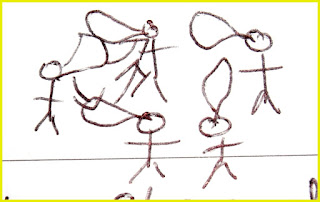
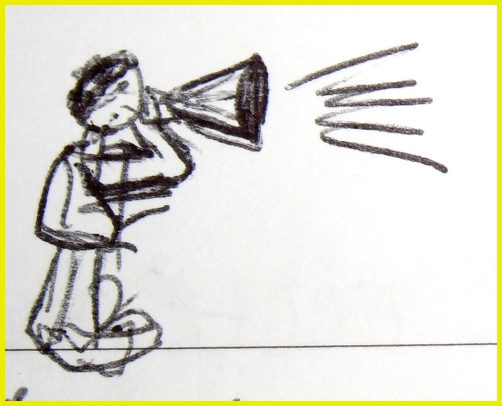
I went to two sessions in the Big Society stream, and one in the Technologies and Access stream. Inspired by Joseph Norwood, I tried drawing a few pictures to sum up ideas and themes from the sessions. My drawing skills are no match for his, but looking back at my notes after a couple of weeks, I find that they're rather handy as short-hand ways of recollecting what I was thinking.Big Society, Big Opportunity: the response of government information professionals to the Coalition's agenda for the public sector - a panel discussion


This was a panel discussion between three government librarians, working in the Departments for Work and Pensions, Communities and Local Government, and Education. The three speakers all asserted that they don't really know what the Big Society actually is, but they also agreed, which is no surprise, that it means change. For government departments it means both the devolution of powers and responsibilities--as quangos and other bodies are disbanded and more work is done locally/by communities--but also having to take on more responsibilities as intermediary layers of bureaucracy are removed (some quango business will be taken over higher up the hierarchy, and, for example, 'independent' community ventures such as Free Schools don't report locally but straight to the top). So the first primary challenge they face is that roles and responsibilities across departments are changing, and information services need to prove their worth in straightened times. As in many other fields, they can do this by moving into non-traditional, but library-allied, roles, such as the linked tasks of records and knowledge management and managing Freedom of Information requests (and other related compliance issues).
The second area of particular interest that was discussed several times was the Transparency Agenda: the government desire to make information and data freely available to the public, via data.gov.uk and similar means. It was pointed out that civil servants aren't traditionally keen on letting go of information, but also, and more significantly, that maybe just letting a lot of poorly ordered and managed data out into the public domain isn't really useful for anyone. The problem is - are there the resources to sort it out?
Gilding the Lily: Images and objects need useful metadata!

This session presented three case-studies of non-printed-book cataloguing. Two were image collections in single institutions (the George Washington Wilson collection at the University of Aberdeen and the photographic collections of Frank Ludlow and George Sheriff at the Natural History Museum), one a mixed bag of archives and museum objects from a variety of institutions (Suffolk Heritage Direct). The overriding message from the three was that whatever you, as the first cataloguer, put into the system will definitely not be the last word on the form that the data will take in years to come, either because systems will change over time, or because your one-institution-dataset will ultimately be brought together with data from other places. In the absence of a perfect world, it's probably therefore more important to get something into a system, than to worry and fret over every last word and comma and not get so much done. As someone managing a cataloguing project - consider in your decisions what will make the data flexible in the future.
Librarians as Citizen Reporters

I had no real idea what to expect from this session. It turned out to be about local community websites and journalism endeavours, and that part(s) that libraries can play in these. Some of the example sites mentioned were:
These sites enable people to help each other out locally - by sharing information, answering questions, raising issues. They positive impacts on' real life' community--people coming out onto the streets to help clear snow, for example--and can improve community opinions of institutions such as the police or the council, when such institutions engage with them in a sensible and helpful way.
The implications for libraries of this are twofold:
- Libraries can support the necessary training and technology requirements for people to be involved in these endeavours. Providing space, equipment and training is a way of showing that libraries are needed, useful, relevant, etc. As a non-core activity, it's also something that could potentially use volunteers, without that volunteer involvement threatening current professional roles. Perhaps.
- Librarians could get involved with these communities, in the manner that some councillors have done, to offer information to people who need it. Either on a formal basis (an 'ask the librarian' thread) or informally - quietly lurking in the community and speaking up when they think can help. Either of these models strike me as being similar to the 'embedded librarian' which is growing in prominence in the academic/subject librarian world. This would, again, prove the usefulness of librarians, and hopefully raise the profile of the library and its services.
Conclusions/Action Points/What Next?
I have few definite conclusions to draw from the conference, except perhaps 'just get on and act on your ideas'. Times are hard, but sitting around whinging won't make them any better. Everyone can do something to improve attitudes or services. So get on with it.Monday, 16 May 2011
Threat of library closure at the British Museum
Oh dear. Very worrying news has trickled out from the British Museum. It seems that the Museum is considering closing its Paul Hamlyn Library.
This library is open to the public, to all visitors to the Museum. It brings together resources relating to all of the cultures present in the Museum, to support both visitors' and curators' understanding of Museum artefacts. The Library has a significant outreach role: it provides a children's library, school sessions, and lends out resource packs for families. It also houses unique special collections and archival material: Museum guidebooks dating back to 1762, copies of Museum publications and exhibition ephemera, and a poster archive.
The Paul Hamlyn library moved into the famous round Reading Room in the centre of the Museum's main court after the British Library opened in the 1990s. For the last few years it's been moved elsewhere as the Reading Room has been turned over to blockbuster exhibitions. New exhibition space is due to open fairly soon, and it had been planned for the Paul Hamlyn Library to move back in when the exhibitions moved out. With no Library to live in it, one worries about what might happen to the Reading Room in the long term.
There is little concrete information available about this threat. There has been no public statement from the Museum, despite the apparent existence of a 90-day consultation period. Everything I know about this I've heard from the Historic Libraries Forum (who are a great organisation, by the way, and you can be a member for free!). Worryingly, it seems as though the Museum is trying to slip through this closure without many people noticing. No-one seems to know, for example, when the 90-day consultation period actually started!
The HLF is trying to raise awareness of this threat as widely as posisble, and is asking you to write to the Director and Deputy Director of the Museum to express your concern about the loss of the library. Closing the Paul Hamlyn Library would mean: the loss of services to the public, families and schools; the possible break up of a unique collection relating to the Museum and the collection it holds (including unique material), the loss of staff expertise; and an uncertain future for the iconic British Museum Reading Room.
 |
| British Museum Great Court |
This library is open to the public, to all visitors to the Museum. It brings together resources relating to all of the cultures present in the Museum, to support both visitors' and curators' understanding of Museum artefacts. The Library has a significant outreach role: it provides a children's library, school sessions, and lends out resource packs for families. It also houses unique special collections and archival material: Museum guidebooks dating back to 1762, copies of Museum publications and exhibition ephemera, and a poster archive.
The Paul Hamlyn library moved into the famous round Reading Room in the centre of the Museum's main court after the British Library opened in the 1990s. For the last few years it's been moved elsewhere as the Reading Room has been turned over to blockbuster exhibitions. New exhibition space is due to open fairly soon, and it had been planned for the Paul Hamlyn Library to move back in when the exhibitions moved out. With no Library to live in it, one worries about what might happen to the Reading Room in the long term.
There is little concrete information available about this threat. There has been no public statement from the Museum, despite the apparent existence of a 90-day consultation period. Everything I know about this I've heard from the Historic Libraries Forum (who are a great organisation, by the way, and you can be a member for free!). Worryingly, it seems as though the Museum is trying to slip through this closure without many people noticing. No-one seems to know, for example, when the 90-day consultation period actually started!
The HLF is trying to raise awareness of this threat as widely as posisble, and is asking you to write to the Director and Deputy Director of the Museum to express your concern about the loss of the library. Closing the Paul Hamlyn Library would mean: the loss of services to the public, families and schools; the possible break up of a unique collection relating to the Museum and the collection it holds (including unique material), the loss of staff expertise; and an uncertain future for the iconic British Museum Reading Room.
| Neil MacGregor, OM, FSA Director of the British Museum Great Russell Street LONDON WC1B 3DG | Dr Andrew Burnett Deputy Director of the British Museum Great Russell Street LONDON WC1B 3DG |
Sunday, 13 March 2011
A letter to my MP
Further to my previous post about the government's review of the statutory duties
placed on local authorities by central government, here's my letter to my local MP, Julian Huppert. Do use it for inspiration for your own letter to your MP if you so desire.
placed on local authorities by central government, here's my letter to my local MP, Julian Huppert. Do use it for inspiration for your own letter to your MP if you so desire.
Dear Dr Huppert,
I was very pleased to see that you support the campaign to save
libraries, and to see that you went to the read-in at Arbury Court
Library on 5 February 2011.
I'm writing to you today because I've recently learnt of the Department
for Communities and Local Government's review of the statutory duties
placed on local authorities by central government
(http://www.communities.gov.uk/localgovernment/decentralisation/tacklingburdens/reviewstatutoryduties/).
I note that three of the duties under review (DCMS_026, DCMS_027 and
DCMS_028) are duties created by the Public Libraries and Museums Act
1964, which requires local authorities to provide a 'comprehensive and
efficient' library service. I am very concerned that these duties might
be rescinded, as this would allow councils to impose drastic cuts to
library services with no recourse for this to be challenged in law. I
am also concerned that such changes to local authorities' duties could
be made with little parliamentary or public scrutiny.
I urge you to voice an opinion in favour of retaining these legal
obligations, and to speak to Mr Greg Clark MP, Minister of State for
Decentralisation, to express your concerns about this serious threat to
public libraries.
Yours sincerely,
Katie Birkwood
Protect the legal duty to provide public libraries
This is a two-part post. We start off with a new, and important, way that you can help defend public libraries, and then we move on to a rant. I recommend that you read, and act on, the first bit, and read the second bit at your own peril.
Practical Action You
Last week, on 7 March, Greg Clark MP, Minister of State for Decentralisation (seriously) announced that the Government is carrying out a review of statutory duties placed on local authorities by central government. It wasn't a very loud announcement, I don't think - it had certainly slipped under my radar until yesterday, when Voices for the Library, Alan Gibbons, Katy Wrathwall (one of the CILIP Trustees), Public Libraries News, and others drew attention to it. ETA: a CILIP press release about this was issued on Monday 14 March.
The Dept for Communities and Local Government has drawn up a list of 1,200+ statutory duties that central government currently places on local authorities, the majority of which, they say, arise from primary legislation. They are asking us, the general public, to comment on these or other statutory duties, and to say which should be kept, and which should be lost.
Three of the 1,200+ duties relate directly to public libraries. Local authorities are currently required by law (the Public Libraries and Museums Act 1964) to provide a 'comprehensive and efficient' library service. Three duties imposed by this legislation are included in this review. Removing the legal obligation to provide decent library services could have really serious consequences given the pressure that libraries are facing now when council could, and are, being held to account through legal challenges to their plans.
You can comment on this review via this form. Information about the review, including spreadsheets of all the identified duties (libraries are mentioned in the Excel second file), is available on this DCLG page. These are the three duties affecting libraries are DCMS:
But the way I see it, we have government and councils precisely so that we can lumber them with 'burdens'. Healthcare, schooling, social care, policing, libraries, museums, the fire service are all difficult and expensive to provide: in stark terms, they're burdens to those entrusted with providing them. But just because they're difficult to do it doesn't mean that government (local or national) shouldn't have to do them. Because they are by their nature burdensome, handing them over to the masses is surely unlikely end well. The masses are unlikely to rush round to do them instead (either commercially (commerce might want to cherry pick the profitable bits, but is unlikely to want to have to so *all* of it) or as volunteers), and even if they did, they'd be unlikely to be able to do them very well. I want my local authority to be emburdened with the duty to do the stuff that makes us civilised.
/rant
Practical Action You Can Should Take
Last week, on 7 March, Greg Clark MP, Minister of State for Decentralisation (seriously) announced that the Government is carrying out a review of statutory duties placed on local authorities by central government. It wasn't a very loud announcement, I don't think - it had certainly slipped under my radar until yesterday, when Voices for the Library, Alan Gibbons, Katy Wrathwall (one of the CILIP Trustees), Public Libraries News, and others drew attention to it. ETA: a CILIP press release about this was issued on Monday 14 March.The Dept for Communities and Local Government has drawn up a list of 1,200+ statutory duties that central government currently places on local authorities, the majority of which, they say, arise from primary legislation. They are asking us, the general public, to comment on these or other statutory duties, and to say which should be kept, and which should be lost.
Three of the 1,200+ duties relate directly to public libraries. Local authorities are currently required by law (the Public Libraries and Museums Act 1964) to provide a 'comprehensive and efficient' library service. Three duties imposed by this legislation are included in this review. Removing the legal obligation to provide decent library services could have really serious consequences given the pressure that libraries are facing now when council could, and are, being held to account through legal challenges to their plans.
You can comment on this review via this form. Information about the review, including spreadsheets of all the identified duties (libraries are mentioned in the Excel second file), is available on this DCLG page. These are the three duties affecting libraries are DCMS:
DCMS_026: Public Libraries and Museums Act 1964 Section 1(2)Once you've filled in the form, you can also write to your local MP (find him or her here) (ETA: here's my letter) to voice your opinion on the subject.
Duty: To provide information and facilities for the inspection of library premises, stocks, records, as the Secretary of State requires.
Function: Necessary for Secretary of State to fulfil (requirement) to superintend library service (see s1 of PLAMA 1964)
DCMS_027: Public Libraries and Museums Act 1964 Section 7
Duty: To provide a comprehensive and efficient library service. In fulfilling this duty, must have particular regard to the matters in s7(2)
Function: Secure provision of local library services
DCMS_028: Public Libraries and Museums Act 1964 Section 11
Duty: Supplemental provisions as to transfers of officers, assets and liabilities
Function: Provisions provide, for example, continuity of employment for transferring employees. This secures consistency across library transfers etc and in line with other local authority employment legislation
(This summary copied from the Voices for the Library post
The rant
The questionnaire is framed almost entirely in terms of 'burdens' (this review, is in fact part of a 'Tackling burdens: Reducing burdens on local government' initiative). The use of this term sums up for me everything that I think is wrong with this whole Big Society business. It's clear that by 'burden' we're supposed to think of something that we (or, in this case) local councils would be better without. When I'm asked if a particular duty is a burden, an answer in the affirmative will be taken to mean that I think that duty can be dispensed with.But the way I see it, we have government and councils precisely so that we can lumber them with 'burdens'. Healthcare, schooling, social care, policing, libraries, museums, the fire service are all difficult and expensive to provide: in stark terms, they're burdens to those entrusted with providing them. But just because they're difficult to do it doesn't mean that government (local or national) shouldn't have to do them. Because they are by their nature burdensome, handing them over to the masses is surely unlikely end well. The masses are unlikely to rush round to do them instead (either commercially (commerce might want to cherry pick the profitable bits, but is unlikely to want to have to so *all* of it) or as volunteers), and even if they did, they'd be unlikely to be able to do them very well. I want my local authority to be emburdened with the duty to do the stuff that makes us civilised.
/rant
Friday, 11 June 2010
Cambridgeshire Libraries, Archives and Information Service Review
Further to this week's discussions of the future of public library funding, here's some news from close to home. As reported in this month's Libraries Newsletter (sign up for the newsletter yourself using the link at the bottom of the left-hand panel), Cambs Libraries, Archives and Information Service are being required to reduce their budget by 25% (c. £2 million) over the next 3 years. Details of council savings are given in the County Council's Integrated Planning Process.
Tuesday, 8 June 2010
Q: How is a library like a charity shop?

Or so said Alan Downey, one of the authors of the KPMG report 'Payment for Success - How to shift power from Whitehall to public service customers', on this morning's Today Programme.
Now, I'm not a public librarian, and I haven't the time or the intellectual capabilities to write the cutting analysis this deserves, but I would like to make few points in a slightly ranty fashion:
1. Mr Downey makes running a charity shop sound like a piece of cake. I doubt that it actually is.
2. People aren't falling over themselves to run charity shops as he suggests - several in the neighbourhood in which I live (not the classiest end of Cambridge) have recently closed, or are open only restricted hours.
3. Even given that running a charity shop isn't simple, running a successful library, especially in the areas where they are currently undervalued, is probably significantly more difficult.
4. If libraries (and other currently public-sector services) are going to be run in volunteers in the future, where are the skilled volunteers going to come from once the current crop of probably retired trained former-librarians has run out?
So, what to do? Many people are tweeting about this, which I suppose engenders a feeling of collective dismay (much better than being miserable alone). I suppose I'd like someone (CILIP? the MLA?) to make a hard-hitting statement about the value of libraries and the importance of professional librarians, but I'm not so hopeful. Maybe I'll contribute to the CILIP Conversation ('Defining our professional future') on this topic once I'm feeling a bit more coherent.
Edited to add: Better rants have been written by Elspeth Hyams and Bethan - go and check them out.
Further addition: There's a post and discussion about this on the CILIP Information and Advice Blog and at Optimus Librarian.
Subscribe to:
Posts (Atom)