Showing posts with label public libraries. Show all posts

Thursday, 19 March 2015

Cambridge Library innovation and enterprise Centre

It's come to light today that Cambridgeshire Council has Big Plans for Cambridge Central Library. These plans were agreed at Tuesday's meeting of the Highways and Community Infrastructure Committee.

The report presented to the committee and the summary of decisions are both available online. I've had a very quick read through, and these are some of what I think are the salient points:
  • '1.4 The Council was approached by Kora to create a Cambridge Library innovation and enterprise Centre (CLEC)'
Kora are these folks, I think.
  • '1.5 Services are aimed at students, young people and adult career changers, those returning to work or growing their business, entrepreneurs, start-ups, corporations, individuals and groups.'
  • '1.6 The creation of CLEC is envisaged as an enhanced offer for customers, creating an opportunity to re-position the Adult Learning and Skills, Careers and Youth Support Services to more prominence' 
OK, so services for people who might want services from a library, and making those services visible...
  • '2.3 Kora would manage a large proportion of this floor, charging for the use of the entrepreneurs lounge, co-working and individual workspaces, and some events.'
Mmm-hmm. Private company managing part of the library space, and charging for it's use? Not so fond of that.
  • '2.4 ... current café would be replaced with a small, high quality coffee-bar style refreshment service' and in 2.9 'tailored to the needs of business users'
Current café is cheap, friendly, welcoming, sort of place parents can take squalling children, or older people can sit all morning, or people without anywhere much else to go can stretch out a cuppa.
  • '2.10 ... it would take 8 weeks to install the enterprise centre on the third floor and require at least one week closure of the whole library (three weeks maximum).'
Unless they find more structural problems like with the major refurb, I guess...
  • '5.1    Resource Implications
  • The Business Plan assumes returns from CLEC or a similar venture.  If it is not developed, further savings in the business plan will be required to make up the shortfall.'
The council's relying on the money from this, so if it doesn't bring in returns that's not good. But private collaborations like this always turn out fine, eh?

Anyway, I'm not perfectly sure what I think, but it seems to have sprung from nowhere rather quickly, which isn't great. And I don't like the idea of private running of library spaces, or of serious charging for space use.

There's a protest organised by the local MP and a  petition.

Sunday, 3 March 2013

#libcampldn: finding practical solutions

I managed to snag a last-minute ticket for the Library Camp London unconference held at Senate House Library on Saturday 2 March. Despite my early-morning wobble--did I really want to spend a day talking to people about difficult stuff?--I had a really good time, and am glad I went.  Big thanks to Andrew Preater, David Clover and Gary Green for organising it.

With such a wide spread of sessions to choose from, it was necessary to have a method for choosing what to attend.  I decided not to try and be worthy or hard-thinking, but to go to what sounded like the most practically useful and/or the most fun sessions. So I steered clear of the Future of the Library, DRM, Open Access, Librarian Personalities, and even Radical Libraries (although I eagerly await write-ups of that one), and instead, apart from my fairly worthy hidden collections session, went with fun, low-stress and useful.

Hidden Collections

I pitched this session as a forum for discussing the problems described in the 2012 RLUK Hidden Collections report (and touched on in the OCLC Survey of Special Collections), and hopefully to share ideas and strategies for dealing with the problem.
The Problem
There are millions of uncatalogued, or insufficiently well-catalogued books, files, manuscripts, recordings, maps, pieces of sheet music, etc. etc. etc. in libraries of all kinds across the country.  Getting this stuff catalogued is hard because good cataloguing takes time and skilled staff.  In an environment where more and more new stock comes 'shelf-ready' (i.e. ready-catalogued by the company that supplies it, often not very well), the number of in-house cataloguers, especially in public libraries, is declining.  This means that there's no-one available in the institution who could possibly take on the cataloguing backlog.  Even in institutions no buying shelf-ready stock there are serious and worrying pressures on cataloguer numbers, and cataloguing projects don't seem to be sexy enough to attract much outside funding.

Apart from the obvious reasons (no record = no-one can use it because no-one knows it's there ), hidden collections are bad because they are far more likely than visible collections to be left languishing in poor environments leading to serious preservation problems, or to be inappropriately disposed of by penny-pinching managers (especially in public libraries, sadly).  Their mere existence is also psychologically wearing on those who know they should be dealt with but don't have the resources to complete such work.

Convincing the powers-that-be to fund cataloguing work can be difficult.  Reference libraries can struggle to prove their worth as they don't have circulation data to show usage levels.  Trial projects putting a small number of new records into the catalogue can demonstrate a sharp uptake in use of a particular set of material, but this isn't always what happens.

Some digitisation projects aimed to deal with a large quantity of unavailable archive data have returned data that's so poor as to be almost useless.  There's a fear about spending money on such projects in case they're not worth the effort.

It can be difficult to know where to start when addressing your hidden collections problem.  Obviously it's best to start with what users want the most, but how can they know they want something that's hidden?  It's a worry to some that previous projects haven't focussed on the right stuff: maybe we should concentrate on more modern collections rather than the traditional blue-chip items such as early-printed books?

Knowledge about collections and projects is very often only recorded in people's heads.  Once that person goes, all the information is lost.  This happens time and time again.

Solutions
Using our usersA project at the Institute of Education has engaged the help of specialists to improve the metatdata on newly-created brief catalogue records for historic textbooks. The discussion acknowledged that user-tagging facilities in catalogues often don't elicit many responses (even on Amazon!), but we agreed that maybe actively asking for specialist help might be much more successful than passively including 'tag this' buttons without explaining why users would want to bother.  Rare books users often, for example, notice that ESTC numbers in catalogues are incorrect.  We should have 'Is this record wrong? Please let us know!' buttons on records, just like COPAC does.  You can also let users tag based on a fixed vocabulary, rather than free text.  I was inspired with the idea of letting users tag rare book records with a selection from the RBMS Controlled Vocabularies, such as binding types and illustration terms.  I'd love to hear if anyone thinks this is possible, feasible, sensible...?

What do they want?  We should be formalising a link between enquiry and reference work on one side and cataloguing and digitisation on the other: the enquiry people know what people are asking about.  In a small library it'll be the same people doing both, but in a large library a formal reporting mechanism would be very useful.  You can use your catalogue data to see what people want and can't find: look at which searches are turning up no (or very few) results, and then use this as a basis for choosing what to catalogue (or how to improve the cataloguing), what to digitise, or what to acquire.

Publicity.  We need to publicise the material that we have catalogued so that the work can be shown to be a success.  This means talking to researchers, to people who write research grants, to our other users (such as people looking for dissertation topics), blogging our collections, holding events around them, etc. etc.

Get the issue up the agenda.  We all appreciate the problem of and with hidden collections, but we mustn't assume that people higher up in our organisations either know that the problem is there, or why it is a serious problem.  The RLUK presents a opportunity to raise awareness, for example by including it on the agenda at a library committee meeting.  Summarise the findings, explain the local context, and maybe (just maybe) someone will take it up higher in the hierarchy. 

Know your collections.  There is nothing more important in librarianship than knowing your collections.  It's not necessarily easy to do, of course, but when you start somewhere new it's important to ask questions about the shelves/boxes/collections that seem overlooked. What is it? Where did it come from? What's the plan?  And then document this information so that it isn't lost all over again in the future.  It's important to your users that you also know what else roundabouts is relevant to them - we can cross-publicise collections in other libraries.

I was really pleased with how the session went.  A high proportion of the attendees spoke up, and shared perspectives from a range of different types of library and collection.  There were some keen 'amplifiers' (i.e. tweeter) and this facilitated some useful back-channel comments. As well as voicing concerns and problems, the conversation developed naturally into what we can actually do.. 

Library Displays
Pitched by a school librarian looking for inspiration, I found that this session really helped me clarify some of my own marketing plans, even though I don't do 'displays' in the traditional sense.  Ideas that Ill be thinking about using at work include:
  • investigating the non-fiction/science book prizes, and science prizes (e.g. Ignoble, Nobel, Darwin) to base publicity on the shortlists/winners.
  • making a note of national/international book days and events (e.g. World Book Day, World Poetry Day) and national/international history weeks and months (e.g. black history month, LGBT history month) to do things that tie in.  Although we're not primarily a book-ish institution, it might be effective to tie in library things with events that staff might have heard about on the radio/TV.
  • would blind date with a book work in a professional library context?
  • make an annual list of all this stuff, and--when something crops up that I'd forgotten about (it's usually small things, like Christmas...)--make sure to include them for next year.
  • make sure to record what was done this year in order not to repeat too closely next year, but also to build on success.
Speed Networking
I turned up late for this because I was distracted by The Itinerant Poetry Library (which is marvellous and must be seen to be believed) and therefore set a cat amongst the neatly-organised pigeons. A school librarian, Dominique, kindly let me circle round with her, and a met a selection of people familiar and new. I was very impressed by the way Liz Jolly facilitated an evaluation of how the session had gone, and how it might be improved at future library camps.  This was followed by a general discussion about networking methods.  Some familiar views about the value (or not) of Twitter and other online networks were raised, as well as a salient point from @Schopflin that an effective networker needs to use many different methods in order to meet lots of different people.  My opinion is that if you think you're meeting the people you want to meet and finding out the news you want to find using your current networks, then maybe you don't 'need' Twitter.  But if you feel you could or should be trying to do more then it's worth looking around to find your Twitter (or Linkedin, or whatever) niche.

Rhyme Time
Linsey Chrisman and Jody, both experienced children's librarians, led a participatory rhyme-time (or, rather, read-and-rhyme, which is for toddlers rather and babies, and they determined that a bunch of over-excited librarians are closer to the former than the latter) session.  Standing and sitting in a circle, we sang, signed and danced our way through several songs, and had enormous fun flinging toys into the air with a colourful parachute. It was really good fun to let our hair down, wave our arms about, and participate in something communal. There's definitely something in the idea that singing together with other people makes you happy.  Though how you can incorporate that into more of life successfully, I'm not sure - it only works if the people involved are willing...

We also discussed some of the whys and wherefores of public library rhyme-times, such as how to balance holding them in spaces that are suitable (encourage parent participation by not being too public and prevent too many toddlers absconding) but still emphasise that this is a library thing (have the books nearby).  Absolutely top tip: if you're organising something like this, think about where you'll get people to park their buggies!

And... rest
It was a hard-work day, but very rewarding.  Fortunately there was plentiful coffee, lunch and cake to keep us going.

Sunday, 9 December 2012

Wigan redux, or how CILIP got my goat this week

I finally got round to opening and reading an issue of CILIP Update this week, and almost immediately had to put to down again because it made me cross.

At the foot of page 12 appears a small two-column news piece on the sale of rare books from Wigan public libraries (as mentioned previously on this blog). Unfortunately, the whole tenor of this short news piece is that selling off rare books is a perfectly sound way to raise money for public libraries.  The headline is 'Rare books raise cash for service', which makes it sound like this is all a jolly good idea, and possibly something other libraries should be thinking of, too.  Well done, those rare books...

The text just repeats the council's line that the books had "no intrinsic connection to Wigan".  Which is likely true, but doesn't represent the whole picture: "intrinsic connection" is not the only way books can be relevant to a place or institution. 

It notes that "at least some of the proceeds [are] set to be ploughed back into the library services": maybe that headline should read "Rare books possibly raise cash for service" then, eh?  And "ploughed back" sounds awfully like it's been copied straight from a council news release.

That's really my whole gripe with this short piece.  I appreciate that it's a news item, not an opinion column, but it very much feels like lazy journalism - repeating a release from a particular source without giving sufficient thought (or research) to what other opinions there might be.  There's no mention of opposition to the sale from the Historic Libraries Forum (who do get a mention in this local paper piece from October), nor any nuance to the writing to suggest that the relevance or value to Wigan of the books as stated is the opinion of the council and not necessarily a fact.

I know that CILIP can't campaign on everything, and I'm not asking them to.  But I don't think it's asking to much to expect a professional body to recognise a professionally controversial event and to report on it carefully, accurately and with a bit of subtlety.  I wonder now how much I can trust the Update news on sectors and issues with which I'm not so familiar.  And I do hope that no heads of service or councillors read this nugget and took away from it the idea that they can sell their old books to make a fast buck, too...

Of course, public libraries are not necessarily the best place for rare books to be, given that there's often little or no resources for cataloguing, preservation and conservation, or access and outreach (Brooke Palmieri comments very interestingly on this point on my first post about Wigan - I recommend a read).  But I really think we as professionals, and our professional body, should be trying to make these resources exist, rather than just to report blandly on collection dispersal.

Sunday, 7 October 2012

Yet another sale of historic books (Wigan edition)

An article from the local press has drawn attention to the sale of five early printed books belonging to Wigan Public Libraries. According the article these include incunabula and other rare books, including the eight-leaf Conradus' Brevis annotatio in errores scribentium S. Augustinum fuisse eremitam ([Rome: Johannes Schoemberger, not before 15 Nov. 1483]), which sold for £5,000 and was the known copy in the British Isles (I don't who has bought it, so it may yet still be available here, but then, it may not be).*

The saddest thing about this story is the quotation from Pete Gascoigne, executive director of culture on Wigan council, which demonstrates a disappointing (but sadly not necessarily unexpected in a council official) lack of understanding of the issues at hand.  I'm cross enough about it that I'm going to look at a couple of his points in detail.

Gascoigne states:
[A] decision was taken to sell some antiquarian books that are have received little or no public interest since they were acquired and are not intrinsically linked to the borough’s heritage, in that, they contain no information relating to Wigan or its people.

This sale will mean Wigan and Leigh retain a relevant modern library service for the people of this borough - not one where books sit on shelves gathering dust because they are of no relevance or interest to the majority of its people.
It's very narrow-minded to believe that a collection of books is "not intrinsically linked to the borough's heritage" simply because their content is not related to the area.  The ISTC records 82 incunables (pre-1501 printed books) in Wigan public libraries, and the ESTC a further 83 early printed books from the UK (or other English-speaking countries) or in English.  This isn't a bad haul, especially of incunables: one wonders what the story is behind their arrival in the Wigan public library service.  There's quite likely a story behind their ending up with this library, and that story might well demonstrate that they are, in fact, "intrinsically linked".  What if, for example, an important local businessman collected them and donated them to the town? That would surely demonstrate a link.

I say "what if" as it's not straightforward to find out much about these books.  A quick look at the library catalogue doesn't reveal any records for early printed books, the ESTC records don't include any provenance information, and I haven't tracked down a printed catalogue either. One fears that there's no good record of what's held at all. 

This lack of documentation might just explain why the books are (or were) "have received little or no public interest since they were acquired".  It doesn't take a genius to realise that if no-one knows that something is in a library, no-one will access it.  The onus is on the library service to promote its collections.  Yes, records on ESTC may attract the attention of a few serious scholars, but that's only one rather small segment of a much larger potential audience, and even they might not make the effort if you've no information at all on your library webpages.

Promoting collections take time, expertise, an understanding of what you've got.  But it's enormously worthwhile in the long-run, and provides benefit to institutions and communities far beyond the special collections corner of the library. 

Other public libraries (Manchester springs to mind) are doing great things in using their special collections in exciting ways as part of " a relevant modern library service". Yes, Manchester library is bigger and more obviously historic than Wigan. Dustiness and neglect isn't the natural state of old books: the responsibility to sweep away the dust lies with councils and library managements.


*It's worth nothing that £5,000 is quite a lot of money for a 16-page book, but it's not necessarily all that much money for a 500+-year-old book, and it's only a drop in the ocean of money required to implement self-service machines in one or more libraries.

Saturday, 30 July 2011

A day at umbrella (#ub11)

A couple of weeks ago I went down to Hatfield for CILIP's major conference, Umbrella. It was my first time at Umbrella, and it was the biggest conference I've been too so far in my career. I had two reasons for going: 1) to find out more about the library profession outside academia/special collections; 2) to present a poster about Library TeachMeets.

Reactions

'Stormy Weather' by JD Hancock on Flickr
I must confess that I wasn't sure whether I'd enjoy it or not. I didn't have a lot of time available to prepare myself in advance: I wasn't sure which sessions I'd go to, I didn't know who the keynote speaker was, I wasn't really sure who else I knew was going. I wasn't really looking forward to spending time in a place with hundreds of other people, feeling bewildered...

But the thing is, I had a really brilliant time there. There are various reasons for that:
  1. Plentiful coffee supplies, starting with coffee at registration. I am just a nicer person when properly caffeinated.
  2. With just three sessions of papers/panels in the day it felt like there was more time to breathe than at some other conferences I've been to. It felt like there was space to keep talking to people from the previous session, and to meet someone in the break, and then to move onto the next thing without feeling unduly harried.  Mentally, too, three main themes in a day left time to think and reflect.
  3. The sessions I attended were all brilliant (see below).  The speakers were articulate and interesting, the topics were covered well, I learnt new things and started to think about things I already knew in new ways.
  4. Everyone I met there was really friendly.  This went for people I already knew either in person or online, and people I met for the very first time.  I really noticed that having a few online contacts already made me much more willing and able to strike up conversation with people I'd never met before, which was an unexpected but very welcome discovery!
  5. My poster was well received, I thought, and the 23 Things Professional Development poster (presented by Claire Sewell, designed by me) was very well received, and won the judges' first prize and attendee vote runner-up prize (for which thank you!).
So, how can I replicate this great conference experience elsewhere? That bit's hard to answer. Maybe the key is to just accept the event for whatever it is - not to try and wring out everything possible from it, and not to wish I was chatting with the 'right' people, but just to interact with who's there and see what I learn.

Sessions

I went to two sessions in the Big Society stream, and one in the Technologies and Access stream.  Inspired by Joseph Norwood, I tried drawing a few pictures to sum up ideas and themes from the sessions.  My drawing skills are no match for his, but looking back at my notes after a couple of weeks, I find that they're rather handy as short-hand ways of recollecting what I was thinking.

Big Society, Big Opportunity: the response of government information professionals to the Coalition's agenda for the public sector - a panel discussion

Sketch of a train marked 'change'Sketch of a civil servant who doesn't want to let go of any informationSketch of a member of the public bewildered by the available information

This was a panel discussion between three government librarians, working in the Departments for Work and Pensions, Communities and Local Government, and Education. The three speakers all asserted that they don't really know what the Big Society actually is, but they also agreed, which is no surprise, that it means change.  For government departments it means both the devolution of powers and responsibilities--as quangos and other bodies are disbanded and more work is done locally/by communities--but also having to take on more responsibilities as intermediary layers of bureaucracy are removed (some quango business will be taken over higher up the hierarchy, and, for example, 'independent' community ventures such as Free Schools don't report locally but straight to the top).  So the first primary challenge they face is that roles and responsibilities across departments are changing, and information services need to prove their worth in straightened times. As in many other fields, they can do this by moving into non-traditional, but library-allied, roles, such as the linked tasks of records and knowledge management and managing Freedom of Information requests (and other related compliance issues).

The second area of particular interest that was discussed several times was the Transparency Agenda: the government desire to make information and data freely available to the public, via data.gov.uk and similar means. It was pointed out that civil servants aren't traditionally keen on letting go of information, but also, and more significantly, that maybe just letting a lot of poorly ordered and managed data out into the public domain isn't really useful for anyone.  The problem is - are there the resources to sort it out?

Gilding the Lily: Images and objects need useful metadata!

Sketch of a photograph

This session presented three case-studies of non-printed-book cataloguing.  Two were image collections in single institutions (the George Washington Wilson collection at the University of Aberdeen and the photographic collections of Frank Ludlow and George Sheriff at the Natural History Museum), one a mixed bag of archives and museum objects from a variety of institutions (Suffolk Heritage Direct).  The overriding message from the three was that whatever you, as the first cataloguer, put into the system will definitely not be the last word on the form that the data will take in years to come, either because systems will change over time, or because your one-institution-dataset will ultimately be brought together with data from other places.  In the absence of a perfect world, it's probably therefore more important to get something into a system, than to worry and fret over every last word and comma and not get so much done.  As someone managing a cataloguing project - consider in your decisions what will make the data flexible in the future.

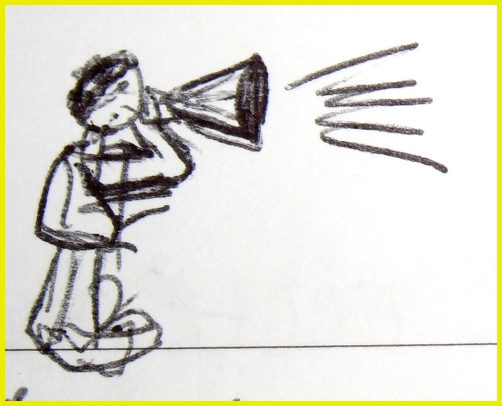
Librarians as Citizen Reporters

Sketch of a person with a megaphoneSketch of people talking to each other

I had no real idea what to expect from this session.  It turned out to be about local community websites and journalism endeavours, and that part(s) that libraries can play in these.  Some of the example sites mentioned were:
These sites enable people to help each other out locally - by sharing information, answering questions, raising issues.  They positive impacts on' real life' community--people coming out onto the streets to help clear snow, for example--and can improve community opinions of institutions such as the police or the council, when such institutions engage with them in a sensible and helpful way.

The implications for libraries of this are twofold:
  1. Libraries can support the necessary training and technology requirements for people to be involved in these endeavours.  Providing space, equipment and training is a way of showing that libraries are needed, useful, relevant, etc.  As a non-core activity, it's also something that could potentially use volunteers, without that volunteer involvement threatening current professional roles.  Perhaps.
  2. Librarians could get involved with these communities, in the manner that some councillors have done, to offer information to people who need it.  Either on a formal basis (an 'ask the librarian' thread) or informally - quietly lurking in the community and speaking up when they think can help. Either of these models strike me as being similar to the 'embedded librarian' which is growing in prominence in the academic/subject librarian world. This would, again, prove the usefulness of librarians, and hopefully raise the profile of the library and its services.
There's information about research done into these communities on the Networked Neighbourhoods site.

    Conclusions/Action Points/What Next?

    I have few definite conclusions to draw from the conference, except perhaps 'just get on and act on your ideas'. Times are hard, but sitting around whinging won't make them any better. Everyone can do something to improve attitudes or services. So get on with it.

    Sunday, 13 March 2011

    A letter to my MP

    Further to my previous post about the government's review of the statutory duties
    placed on local authorities by central government, here's my letter to my local MP, Julian Huppert.  Do use it for inspiration for your own letter to your MP if you so desire.

    Dear Dr Huppert,

    I was very pleased to see that you support the campaign to save
    libraries, and to see that you went to the read-in at Arbury Court
    Library on 5 February 2011.

    I'm writing to you today because I've recently learnt of the Department
    for Communities and Local Government's review of the statutory duties
    placed on local authorities by central government
    (http://www.communities.gov.uk/localgovernment/decentralisation/tacklingburdens/reviewstatutoryduties/).

    I note that three of the duties under review (DCMS_026, DCMS_027 and
    DCMS_028) are duties created by the Public Libraries and Museums Act
    1964, which requires local authorities to provide a 'comprehensive and
    efficient' library service. I am very concerned that these duties might
    be rescinded, as this would allow councils to impose drastic cuts to
    library services with no recourse for this to be challenged in law. I
    am also concerned that such changes to local authorities' duties could
    be made with little parliamentary or public scrutiny.

    I urge you to voice an opinion in favour of retaining these legal
    obligations, and to speak to Mr Greg Clark MP, Minister of State for
    Decentralisation, to express your concerns about this serious threat to
    public libraries.

    Yours sincerely,

    Katie Birkwood

    Protect the legal duty to provide public libraries

    This is a two-part post. We start off with a new, and important, way that you can help defend public libraries, and then we move on to a rant. I recommend that you read, and act on, the first bit, and read the second bit at your own peril.

    Practical Action You Can Should Take

    Last week, on 7 March, Greg Clark MP, Minister of State for Decentralisation (seriously) announced that the Government is carrying out a review of statutory duties placed on local authorities by central government.  It wasn't a very loud announcement, I don't think - it had certainly slipped under my radar until yesterday, when Voices for the Library, Alan Gibbons, Katy Wrathwall (one of the CILIP Trustees), Public Libraries News, and others drew attention to it. ETA: a CILIP press release about this was issued on Monday 14 March.

    The Dept for Communities and Local Government has drawn up a list of 1,200+ statutory duties that central government currently places on local authorities, the majority of which, they say, arise from primary legislation.  They are asking us, the general public, to comment on these or other statutory duties, and to say which should be kept, and which should be lost.

    Three of the 1,200+ duties relate directly to public libraries.  Local authorities are currently required by law (the Public Libraries and Museums Act 1964) to provide a 'comprehensive and efficient' library service.  Three duties imposed by this legislation are included in this review.  Removing the legal obligation to provide decent library services could have really serious consequences given the pressure that libraries are facing now when council could, and are, being held to account through legal challenges to their plans.

    You can comment on this review via this form. Information about the review, including spreadsheets of all the identified duties (libraries are mentioned in the Excel second file), is available on this DCLG page.  These are the three duties affecting libraries are DCMS:
    DCMS_026: Public Libraries and Museums Act 1964 Section 1(2)

    Duty: To provide information and facilities for the inspection of library premises, stocks, records, as the Secretary of State requires.

    Function: Necessary for Secretary of State to fulfil (requirement) to superintend library service (see s1 of PLAMA 1964)

    DCMS_027: Public Libraries and Museums Act 1964 Section 7

    Duty: To provide a comprehensive and efficient library service. In fulfilling this duty, must have particular regard to the matters in s7(2)

    Function: Secure provision of local library services

    DCMS_028: Public Libraries and Museums Act 1964 Section 11

    Duty: Supplemental provisions as to transfers of officers, assets and liabilities

    Function: Provisions provide, for example, continuity of employment for transferring employees. This secures consistency across library transfers etc and in line with other local authority employment legislation

    (This summary copied from the Voices for the Library post
    Once you've filled in the form, you can also write to your local MP (find him or her here) (ETA: here's my letter) to voice your opinion on the subject.

    The rant

    The questionnaire is framed almost entirely in terms of 'burdens' (this review, is in fact part of a 'Tackling burdens: Reducing burdens on local government' initiative).  The use of this term sums up for me everything that I think is wrong with this whole Big Society business.  It's clear that by 'burden' we're supposed to think of something that we (or, in this case) local councils would be better without.  When I'm asked if a particular duty is a burden, an answer in the affirmative will be taken to mean that I think that duty can be dispensed with.

    But the way I see it, we have government and councils precisely so that we can lumber them with 'burdens'. Healthcare, schooling, social care, policing, libraries, museums, the fire service are all difficult and expensive to provide: in stark terms, they're burdens to those entrusted with providing them.  But just because they're difficult to do it doesn't mean that government (local or national) shouldn't have to do them.  Because they are by their nature burdensome, handing them over to the masses is surely unlikely end well. The masses are unlikely to rush round to do them instead (either commercially (commerce might want to cherry pick the profitable bits, but is unlikely to want to have to so *all* of it) or as volunteers), and even if they did, they'd be unlikely to be able to do them very well.  I want my local authority to be emburdened with the duty to do the stuff that makes us civilised.

    /rant

    Monday, 7 March 2011

    A reply from the PM

    'Letters from Friends' by D. Sharon Pruitt on Flickr

    At Prime Minister's Question Time on 9th Feb, David Cameron answered a question from Ed Miliband by saying:
    We all know a truth about libraries, which is that those which will succeed are those that wake up to the world of new technology, the internet and everything else, and investment goes in. That is what needs to happen. Should councils look at community solutions for other libraries? I believe that they should. Instead of sniping and jumping on every bandwagon, the right hon. Gentleman should get behind the big society.
    (Hansard, 9 Feb. 2011, around Column 293)

    I thought this was a pretty silly thing to have said, and so I wrote to him to say so (the Contact Number 10 webpage suggests that a posted letter is more likely to receive a response than an email).  I listed a few of the ways in which public libraries have been embracing technological changes - reforming the way they operate, educating their readers, making the internet available to all - and even suggested that I'd be happy to show Mr Cameron one of my local libraries so that he could see what's already going on.

    Today I had a reply from the Prime Minister's office. Needless to say, my offer of a library tour has not been accepted.  In fact, given the response, it's hard to determine whether my letter was actually read at all:
    From the Direct Communications Unit

    I am writing on behalf of the Prime Minister to thank you for your letter of 11 February.

    Mr Cameron appreciates all the feedback he receives, so it is good of you to have taken the time and trouble to get in touch and to let him have your thoughts.

    Once again, thank you for writing to the Prime Minister.
    I suppose that this is the nature of campaigning about something.  Most of the time, efforts look like they might be in vain - it's easy to feel like you're shouting into a gale, and that no-one will hear what you're saying.  When out on the street on Save Libraries Day (5th Feb) I got to thinking more or less the same thing: 'how many people can I possibly be influencing?' 

    But equally, when out on the street I did have conversations with a good few people who really were interested to know what was under threat and how they could help.  And all the others who scurried by trying to ignore us will still probably have heard the word 'library' a few times; if drip-drip marketing is good enough for commercial products, then it's good enough for my library campaigning.  At the very least, people have been reminded of the existence of libraries, and Mr Cameron (or someone on his staff, at least) has been shown that there's one more person who's watching what he says and does.

    I know that some other library folk also wrote to the PM around that time.  Has anyone else heard anything back?

    Friday, 4 February 2011

    Save Libraries: Cambridge Action

    Two Save Libraries events are happening in Cambridge tomorrow:
    Save our libraries day, Saturday 5 Febraury 2011

    Both events are family-friendly ways of showing that we value libraries.  The flashmob is the brainchild of Emma Coonan, who's put together a list of resources, general and specific.

    If you can't make it to either of those, remember that you can still show you support for libraries by:
    1. Going to your local library. If you're not already a member take some ID with your name and address on it so that you can join up. Borrow some books or CDs or DVDs, or read the newspapers and magazines, or use the PCs and/or wifi there.
    2. Visiting your library webpages and use the online resources - you can look things up in the OED, for example.
    ETA: Here are two write-ups of the Cambridge event, by Andy Priestner and Annie Johnson.

      Wednesday, 2 February 2011

      News roundup, including savelibraries

      Savelibraries

      Campaigns to defend public libraries across the country against cuts are gathering strength, and this Saturday, 5th February, will see a day of action to show our support.  John Kirriemuir has written up a summary of what's what, including links to resources, so I won't repeat all of that here.  What you need to know is the following:
      Save our libraries day, Saturday 5 Febraury 2011

      1. Check this list to see if a library near you is having an event. If is is, go to it.
      2. If there's no event near you, go to your library anyway. If you're not already a member take some ID with your name and address on it so that you can join up. Borrow some books or CDs or DVDs, or read the newspapers and magazines, or use the PCs and/or wifi there.
      3. If you can't get to your library, visit its webpages and use the online resources - you can look things up in the OED, for example.
      4. If you're a Facebook user, show that you're taking part by RSVPing to this event. Then invite all your friends.
      5. If you're on Twitter, tweet a reason why libraries are important, using the #savelibraries hashtag.
      6. Pass this message on, using some of these posters to help you.

      Echo-chamber breakout

      Back last June, during Library Day in the Life 5, a post by Emma Cragg inspired me to think that the Library Day in the Life Project (which was started and is maintained by Bobbi L. Newman) could be used to advocate for libraries outside of the 'echo chamber'.  Emma and I teamed up, and wrote a pitch about 'what librarians really do' that we sent to The Guardian and to Radio 4.  Some time later, we heard back from The Guardian, who were interested in using the idea in their 'Behind the Job Title' series.  We wrote up an article about the various roles of, and skills needed by, a modern librarian, sent it off, and heard nothing for a while longer.  But lo, after Christmas we were asked for some revisions, which we supplied, and the article was published on Monday in GuardianCareers:

      'Beyond books: what it takes to be a 21st-century librarian'

      There was a little excitement in the comments and on Twitter in response to the decision to swap the picture of a brain for a picture of some stereotypically dressed female librarians carrying books on their heads and with their fingers on their lips in the international gesture for 'shh!'.  Comments from some upstanding librarians have now set that to rights, which is very pleasing indeed.

      At this point I have to say an enormous thank you to Emma. She did all the hard work with the article, including writing all the best bits, thinking up whom to use for case studies, and corresponding with the paper.  She's been a pleasure to work with, and is clearly pretty busy as she has another article out this week in the ORG (Open Rights Group) Zine also out this week!

      Also a thank you to Ned Potter for being so loudly pleased about the article.  He's chuffed to be mentioned in a Guardian article, and I'm chuffed that he liked it. Smiles all round.

      And finally...

      This isn't about libraries, but it is about making the world a better place. A friend of my has written a truly brilliant blog post. I've tried to summarise it, but I can't manage it. Just read it and be inspired to be a better person. Or something.

      Sunday, 21 November 2010

      Passion, Persuasion and Persistence

      Last Tuesday I went to an 'intensive session' organised by the CILIP East of England branch on the subject of word-of-mouth marketing in libraries.  Annie has already written-up a summary of the day, so I'll restrict myself here to a few thoughts about some of the issues raised.

      The one sentence that stuck with me the most came from Jenny Salisbury's introduction to her presentation 'Frontline advocacy: making it happen':
      It's not all about how the customer fits into our services but rather about what the customer needs and how we meet those needs.
      Like much good advice, this statement seems at first glance to be almost redundantly self-evident.  But when you start to think about your day-to-day working life, can you honestly say that this is an attitude that's always maintained (another theme from the afternoon session was the difficulty of evaluating customer service levels: people might say, and indeed think, that they're giving excellent service, but that's not always how an objective observer might see it)?  When new staff join a service, does their induction focus mainly on *what* you do, or does it look at *why* you do it like that and what it is that users/readers/customers/members use you for?  How often to do hear someone expressing mild annoyance at a customer request that's above and beyond the standard service you offer, rather than view it as an opportunity to modify the service to include this sort of request?
      'death metal monkeys' by brum d on Flickr
      'death metal monkeys' by brum d on Flickr

      This isn't intended as a criticism of any person or service in particular, but as an illustration of what hard work it is to keep service levels high.  To prevent the development and spread of bad habits, everyone needs to understand the reasons for the required standards of service, and new staff need to be thoroughly trained.

      We also need to keep re-evaluating what it is that our customers need.  In academic libraries (certainly in Cambridge Colleges) it's easy to slip into mindset that we know what we're there for, and therefore not to think about developing new services, or new ways of delivering traditional services.  It's also tempting to think that 'they (the readers) should know/be able to work out how to do that', whether 'that' is using the catalogue/the photocopier/the printers, or finding a book on the shelf, or searching Jstor, or whatever.  This is an obviously silly attitude, and, while it's not always easy (or flattering), the best way to improve everyone's experience is to try to work out *why* they find it difficult, and then try to make it easier.

      The main thread of the day is that people are naturally inclined to tell others about bad service much more readily, and that we need to make sure that we're giving them fuel for good word-of-mouth publicity.  This is clearly a laudible aim.  There was a subtext that this would also help as an advocacy, not just marketing, tool.  It's not necessarily the case that good customer service will make our customers into advocates for our service, although focussing service on the most important statekholders can at least raise the profile of the library, and may help make an impression on Those Who Make The Decisions.

      Wednesday, 23 June 2010

      Cambridge Conversation (1)

      This is the first part of my report about a discussion between health, academic, business and school librarians held in Cambridge on Tuesday 22 June as part of the CILIP Conversation. Part 1 is all about CILIP and part 2 is about the future of libraries.

      Lots of the other participants have also reported: Anna, Anne, Isla, Niamh, Sheila, and Jenni.

      What do we think about the Conversation?
      CILIP asked us to say what we think will happen in 10 years time, but we really can’t do that; it’s a job for futurists. What we can do is to evaluate what has changed in the last few years, and how this might develop in the next 1, 3, or 5 years, and we could have been asked about this in more detail in the survey.

      We really didn’t like the CILIP survey much ; it felt irrelevant and lacking in detail. Some of the questions just didn’t even make any sense at all, such as ‘do you think that expectations of your role are increasing’. We also wanted more detailed questions about what we want from CILIP.

      What do we think about CILIP?
      CILIP feels distant, remote and irrelevant to many - particularly those working in business, school and health libraries – it seems like Update and Gazette have little that reflects our working lives.

      The principal of chartership is worthwhile, but there was opposition to having to remain a member of CILIP for life to retain it. Personally, I understand this objection, but I suspect that this is the case for most professional bodies and that it isn’t just a CILIP issue.

      CILIP CPD courses are expensive. Many people were very impressed with the courses organised by special interest groups, at very reasonable prices, although it was noted that speakers for these courses are often only paid travel expenses. CILIP courses are much more expensive than those from other similar professional bodies such as the Museums Association, and they’re not reliably good enough for people to want to risk spending £400 to attend them.

      CILIP’s building in London is very unpopular; issues regarding its costs and value have been addressed elsewhere.

      We read Update and Gazette for the job advertisements, and some people (those training and chartering) try to read it all, but we don’t find much that is relevant or interesting to us. The job advertisements are sometimes for such poorly paid jobs that we wonder whether CILIP should be advertising them at all. It was also noted that it’s so expensive to advertise in Update and Gazette that many jobs are missing.

      It was thought that there could just be one CILIP magazine, possibly delivered online only. (I have a lot of thoughts about the online magazines, and the CILIP website in general, but I’m saving them up for another post.) It was even suggested that the magazine format could be dispensed with in favour of personalised news bulletins. There is an e-bulletin feature already, but there’s not a lot of refinement to it.

      So why do people continue to pay for membership? Some jobs do need chartered status, and for professionals without an LIS degree, chartered status is important evidence of competence. People couldn’t praise the special interest groups enough – they seem to make membership worthwhile.

      We do want a professional body
      We want it to advocate for us, and to have good PR abilities and a strong public and media profile. The Royal Institute of Chartered Surveyors was mentioned; we’d all heard spokesmen from it on the TV and radio. We really want CILIP to have someone whose job it is to appear on Newsnight, instead of making excuses about how hard it is to face up to Jeremy Paxman.

      We approved of Phil Bradley’s idea that it would good to see a proactive CILIP that gets things wrong sometimes, instead of seeming to sit back and let us get on with it.

      The example of Micahel Rose advocating for children reading was made. Andrew Motion (chairman of the MLA) wrote in 2008 about libraries in a way that suggested he hadn’t been in many recently, but he has been speaking up for them in the last few weeks. His opinions may not be nuanced enough to capture all the issues that concern librarians and information professionals, but CILIP could benefit from having someone similar to make a public impact.

      Cambridge Conversation (2)

      This is the second part of my report about a discussion between health, academic, business and school librarians held in Cambridge on Tuesday 22 June as part of the CILIP Conversation. Part 1 was all about CILIP and part 2 is about the future of libraries.

      Other peoples' reports are also available:  Anna, Anne, Isla, Niamh, Sheila, and Jenni.

      What is ‘librarianship’?
      There was some debate about whether libraries and librarians need to rebrand as ‘Learning Resource Providers’ or something similar, but this term seemed far too narrow. Maybe there’s something else we could call ourselves, or maybe we just need to be clearer about what librarians do.

      One good summary of librarianship (or information professionalism, if you like) that we thrashed out was:
      Librarianship is helping people to work what question they’re really asking.

      The emphasis was very much on personal interaction and support. The organisation of data can happen from anywhere, but user support and training is best done face-to-face, and one-to-one. This 1947 promotional film emphasises personal interaction in the role of the librarian. Why are we having to work to re-emphasise this now, when it’s surely never stopped being true?


      This level of personal interaction and help needs professional staff. There’s definite concern about the de-professionalization of public libraries, and in a similar way about also the closure of government libraries: what impact will this have in the long term?

      We discussed some of the ACRL predictions for future of academic libraries, in particular the idea that in 2025 there will be ‘no need to search’ (link to pdf page 16, item number 17 ). This ‘no search’ environment (we wondered if it would be something like foursquare, about which I know nothing) will surely require a lot of unseen work in the background, and it will need common languages and standards across all sources and platforms, and not continual re-invention of standards as we see today (apparently the Europeana project isn’t using Dublin Core standards for metadata but inventing some different standards [I've been corrected in the comments - Europeana are tweaking Dublin Core instead of using it straight, which is clearly better but still not ideal]).  Librarians will have to keep interpreting what people say and want until the semantic web is very, very good indeed, and that won’t be soon! Users expect intuitive interfaces, and need to be shown that there are benefits to learning more complex search techniques.

      In 5 years time...
      We ended the discussion by trying to imagine the future of libraries and information services on a more manageable timescale than the 10 years asked about by CILIP. If you have thoughts about what your library or service will look like in 5 years (both best and worst case scenarios!), then please continue the discussion in the comments.

      School Libraries
      School librarians can be very isolated. They rely on local networks, feel distant from CILIP, and unrecognised by teachers. School budget cuts means that there may be no money at all for CPD.
      School libraries will have to adapt to match evolving teaching methods and to provide tools to help students find what they need outside the physical library, as well as providing project collections of books for use in the classroom.
      There are currently not enough computer resources, but this might change as increasing numbers have their own laptops. Even with their own computers they will need help to locate resources online, and in the physical library.

      Academic/Faculty/Subject Libraries
      Subject librarians will have to know their subject more so as to be able to provide tailored search and indexing services. They might not need to be the academic, or doctor, but will need to speak enough of their language not to sound stupid, but to sound reliable and useful instead.

      Business Libraries
      Publications need more detailed metadata, for example about the precise materials used in engineering. This has to be added somewhere in the process, but it will be a lot of work, and it’s unlikely that author or user tagging is the answer.

      A Cambridge College Library
      In five year’s time the physical library with books in it will still be here. Students are currently very clear that they want to have the physical space to work in, and not even all new academic books will be available as e-books by then, never mind the older texts that are still needed.
      Special collections are being digitised, but this can’t replace the importance of the books and manuscripts themselves, and will often lead to increased reader numbers through improved publicity. Digitisation also isn’t futureproof.

      What can we do to improve the situation?
      • Collect evidence of what we do in order to prove our worth.
      • Ask our readers and researchers what they want from libraries: this might include help with copyright, and with getting published, more detailed enquiry answering about specific items (see Greening the material text).

      Friday, 11 June 2010

      Cambridgeshire Libraries, Archives and Information Service Review

      Further to this week's discussions of the future of public library funding, here's some news from close to home. As reported in this month's Libraries Newsletter (sign up for the newsletter yourself using the link at the bottom of the left-hand panel), Cambs Libraries, Archives and Information Service are being required to reduce their budget by 25% (c. £2 million) over the next 3 years.  Details of council savings are given in the County Council's Integrated Planning Process.

      Tuesday, 8 June 2010

      Q: How is a library like a charity shop?

      Photograph of a radio alarm clock by Jarlhelm on Wikimedia Commons
      A: Both can easily be run by volunteers!

      Or so said Alan Downey, one of the authors of the KPMG report 'Payment for Success - How to shift power from Whitehall to public service customers', on this morning's Today Programme.

      Now, I'm not a public librarian, and I haven't the time or the intellectual capabilities to write the cutting analysis this deserves, but I would like to make few points in a slightly ranty fashion:

      1. Mr Downey makes running a charity shop sound like a piece of cake.  I doubt that it actually is.

      2. People aren't falling over themselves to run charity shops as he suggests - several in the neighbourhood in which I live (not the classiest end of Cambridge) have recently closed, or are open only restricted hours.

      3. Even given that running a charity shop isn't simple, running a successful library, especially in the areas where they are currently undervalued, is probably significantly more difficult.

      4. If libraries (and other currently public-sector services) are going to be run in volunteers in the future, where are the skilled volunteers going to come from once the current crop of probably retired trained former-librarians has run out?

      So, what to do? Many people are tweeting about this, which I suppose engenders a feeling of collective dismay (much better than being miserable alone). I suppose I'd like someone (CILIP? the MLA?) to make a hard-hitting statement about the value of libraries and the importance of professional librarians, but I'm not so hopeful.  Maybe I'll contribute to the CILIP Conversation ('Defining our professional future') on this topic once I'm feeling a bit more coherent.

      Edited to add: Better rants have been written by Elspeth Hyams and Bethan - go and check them out.

      Further addition: There's a post and discussion about this on the CILIP Information and Advice Blog and at Optimus Librarian.