Showing posts with label brand. Show all posts

Tuesday, 15 May 2012

Some thoughts on brand #cilipnpd12 #cpd23

At the CILIP New Professionals Day last Friday the always-super Ned Potter gave a great keynote about personal brand: You already have a brand: here are five ways to influence it.

Ned emphasised that personal brand is more about what you do than about working out what colour your business cards should be: action not appearance.  He covered a lot of ways to influence personal brand, all of them useful, but the part that most caught my attention was the section on blogging.  Little of what was said was 100% new to me, but Ned somehow brought it all together and into focus, so now I have a much better idea of what I should be trying to do.

My efforts to brand myself as an interested, enthusiastic and competent special collections new professional can't have been doing too badly, as I was asked to lead a workshop at the New Professionals Day, but I'm always keen to improve. I've been wondering for a while quite what it is I'm doing with this blog: I use it to record some of the things I do and what I think about them, and to put out information about things I hear about, and sometimes how to explain to do things.

Ned suggested that to be successful for promoting a personal brand*, blogs need to offer one of the following characteristics: usefulness, helpfulness, silliness, style, honesty or provocation. When I first started, as part of 23 Things Cambridge in summer 2010, the other participants voted me most helpful blogger both, I think, for some of the how-to posts I wrote as well as my comments on other blogs.  Since I finished that course I've not been so consciously helpful: I've been focussing a lot more on reflective writing, which is rarely of such great interest to other people. Looking through my blog stats, my most popular posts are as follows.

By views
By comments
Useful posts score pretty highly here, but I don't write as many useful posts as I'd like to. Lots of them are lurking in my mind, but to be useful to other people (and useful to my brand) they need to be well-written and/or the resources they offer need to be well put together.  (You would not believe how long it took to put together the Why Libraries Are Great Slides, or the Special Collections Librarianship prezi.)

So I'm going to make an effort to write-up more useful and helpful posts.  This is something I know I can do, and comes much more naturally than being provocative (well, most of the time - I'm not always a shrinking violet), or silly, or stylish.  To start with, I'll compile a weekly list of useful special collections links I see and retweet on Twitter: not everyone's on Twitter, and even those who are can't catch everything.  I think it could be useful to record them somewhere less fleeting.  Unless anyone knows of somewhere else doing the same thing already?  I'll also pull my finger out and try and write up some of the how-to posts that have been languishing in my to-do list for too long.

Thanks Ned for inspiring me into action!

*Edited to express what I meant to express first time round, 15 May 2012.

Tuesday, 30 August 2011

#cpd23, Thing 10: Routes into librarianship

Well, I really enjoyed the elephants in the last post. 'Graduate traineeships, Masters Degrees, Chartership, Accreditation' is rather hard to illustrate with animals, though. But maybe there's something I can do with it. It's all about our 'journey' (cue slushy music) as librarians, isn't it? And when I think of journeys, I think of nothing so much as the majestic bison wending its way across the plains (cue David Attenborough)...

'Bison herd' by Alan Vernon on Flickr
"Here, in the Hayden valley, Wyoming..."

Now, I've talked about my route into librarianship fairly recently, so if you want to know all the ins and outs I'll point you over here, and those that have already read the tale won't end up like this fellow:

'Sleeping bison' by Carl Wainwright on Flickr
What do bison dream about?

In this instalment of the story, I really ought to talk about Chartership, and my progress (or lack thereof) towards it. Having completed my part-time LIS MA in September 2008, by early 2010 I had pretty much got used to my not having essays to write in every spare moment, and thought I was ready for a new challenge. I also new that the job hunt would be looming in a year's time. These two factors combined to convince me to register for Chartership.  I'd been engaging in a fair amount of professional development since graduation (the nature of my job demanded it), so I felt that I had the material for a good portfolio.  I found a mentor, went to some Chartership course, and got involved in things to add to the portfolio evidence.  I set myself an ambitious deadline for completion. So far, so good.  But things have a habit of not turning out how you think they will.

'starting my qiviut lace scarf' by andreakw on Flickr
Did you know that you can turn bison into knitting?

The trouble is, that I got so involved with so many great things, that Chartership has fallen by the wayside. I made six months' decent progress: drawing up necessary development plan, meeting my mentor, writing up some of my experiences, and creating a beautiful portfolio template that just requires me to fill in all the blanks. Around about Christmas and shortly afterwards the job situation resolved itself (at least temporarily), my extra-curricular involvement stepped itself up another notch or too and Chartership really hasn't had a look in since.  Dear mentor, if you are reading this, sorry.

It's time I faced facts: I need to sort myself and get on and finish this.

'~ buff1 ~' by ViaMoi on Flickr
A face you can't ignore. (I should point out that my mentor looks nothing like this. This is mor a representation of my inner annoyance at letting Chartership drag on.)

Probably the first step should be to contact my mentor.  I've been putting that off and off and off not least because I feel I should have done some work first. So maybe I should do some work - draw up a plan, at least - and then get in touch.

Hopefully this public self-shaming will encourage me into doing something, anything. All encouragement gratefully received. Is anyone else in a similar position? Want to team up, and motivate each other together?

Yours, abjectly,

Katie.

Saturday, 9 July 2011

#cpd23, Thing 3: does my brand look big in this?

It's taken me a long time to get round to writing this post.  Unlike many others, I'm not too uncomfortable with having a 'personal brand' that I take into account when presenting myself online.  But I am fairly uncertain of quite what my brand is, what is should be, and how I should best be communicating that.
'Luna navideña' by nomenombres on Flickr'
What do you think about the Girl in the Moon?

Name
I've written before about my changing opinions regarding my own anonymity (or otherwise) online. When I started this blog and first signed up to Twitter, I was only using a pseudonym.  I'd vaguely thought of having 'The Man in the Moon' as a stand-by pseudonym for a while - based on an in-joke from years ago - but when it came down to it, I thought I ought to at least have something that reflected by actual gender.  Thus Girl in the Moon.  I don't know what I'll do if I ever decide I want to sound more grown up than a girl...  And I really have no idea what sort of image that the name projects. Whimsical? Astronomical? Probably, I fear, astrological, even though I don't hold with that bunkum at all.  It doesn't overtly link to libraries, but I don't know if that matters.  I've tried for consistently across platforms, but girlinthemoon is fairly popular as a username, so often I've used maedchenimmond (German for Girl in the Moon) with the English as a display name.  I like to hope that isn't confusing - I do try to use other means to unify all my presences.

Photograph
I'm a bit squeamish about using a photograph of me, even though I well recognise the benefits of being identifiable.  It's not because I'm particularly concerned about privacy, I think I honestly think a picture of something else is probably more aesthetically pleasing and distinctive.  If you really want to know what I look like, most of the first image results for my name are pictures of me (except the ones that are my avatar!).  As I've changed the design of various profiles and of this blog over time, I've retained the same avatar so that there is some consistency.  I worry (probably unduly) about changing things too much and people being confused.  Equally, I am starting to wonder whether I shouldn't more often include an actual photograph of me so that finding people at conferences would be easier.

Profersonal identity
I don't worry unduly about this.  I do tend to think before I tweet - generally I don't talk about personal stuff, anniversaries, domestic disasters, what I'm having for dinner.  But I do talk about hobbies - music and knitting - not least because a lot of the library folk I interact with professionally online also share these interests.  I'm comfortable with that, and I think my general rule is that I don't talk about online things that I wouldn't talk about to general colleagues (not friends) in the office at work.

Visual brand
I'm definitely someone who's interested in design, although you could be forgiven for thinking otherwise when considering the various iterations of this blog.  I do try to maintain a consistent, though not slavishly identical, design (colours, images) across various platforms.  I wonder if my avatar image is a wise choice - it's a book (what a stereotype!), it's brown-ish (pretty dull), it's not very striking.  But ultimately I am a slightly dull lass, who is interested in physical books, so maybe it's OK?

The Google/Bing/search engine of choice Challenge
I opened a difference browser (yes, yes, it's IE, I only use it for emergencies!) and checked I was logged out from everything.  Here are some results pages:

Screenshot of a Google search for Katie Birkwood.

Firstly, Google. This is all pretty good.  I have a very distinctive name, so there's little question of it not being about me. It's just about which bits of me turn up. Google does well: Twitter and this blog are the first two, then references to various things I've presented at and written about professionally and recently.  A profile page from an online network, and my Guardian article. Hurrah!

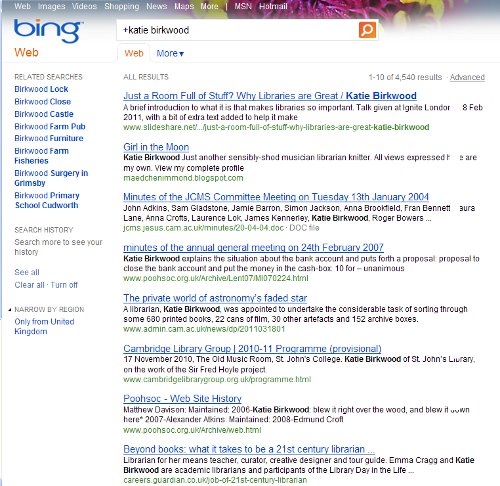
Screenshot of a Bing search for Katie Birkwood

Bing is a little less satisfactory.  The first two results are fine: my Ignite London talk and this blog.  But then lots of minutes from committees I was on as a student.  Oh dear.  I wonder how to make this better?  It's not as if my names isn't all over the place for library things these days.  And I can't imagine that College Music Society minutes are frequently linked to.

Overall, there's nothing too alarming there. Phew. But I'm not sure that any of the above actually comes together to form a cohesive image.  I worry that I rely on design because I haven't got anything more substantial to fall back on - I don't talk either mainly or knowledgeably about any particular topics, I'm not sure I have a distinctive writing style... These I things I notice about other people's brands, but fear they may be lacking from how I present myself?  Tom Roper has indeed already commented that he thinks my brand is design-based, though I don't know that he meant that as a criticism (and he did say some other nice things, phew).

A second opinion
If, dear reader, you aren't exhausted from doing this for all the other CPD23 participants already, I'd like to hear your views.
  • What does 'Girl in the Moon' say to you?
  • Do you think I have a 'brand'? If yes, what does it say about me? If no, what am I doing wrong?
  • Should I be using a photograph of myself instead of an anonymous avatar?
  • Am I all style and no substance? Should I be focussing my efforts more narrowly (in terms of topic)?
  • Any other thoughts?
I've a thick skin, so don't hold back if there's something you've been dying to point out...


P.S. Multicolor Search Lab is a really cool search tool that lets you find Creative Commons images of Flickr based on their colour(s).  That's where I found the lovely purple moon (above) for this post.

Wednesday, 2 February 2011

News roundup, including savelibraries

Savelibraries

Campaigns to defend public libraries across the country against cuts are gathering strength, and this Saturday, 5th February, will see a day of action to show our support.  John Kirriemuir has written up a summary of what's what, including links to resources, so I won't repeat all of that here.  What you need to know is the following:
Save our libraries day, Saturday 5 Febraury 2011

  1. Check this list to see if a library near you is having an event. If is is, go to it.
  2. If there's no event near you, go to your library anyway. If you're not already a member take some ID with your name and address on it so that you can join up. Borrow some books or CDs or DVDs, or read the newspapers and magazines, or use the PCs and/or wifi there.
  3. If you can't get to your library, visit its webpages and use the online resources - you can look things up in the OED, for example.
  4. If you're a Facebook user, show that you're taking part by RSVPing to this event. Then invite all your friends.
  5. If you're on Twitter, tweet a reason why libraries are important, using the #savelibraries hashtag.
  6. Pass this message on, using some of these posters to help you.

Echo-chamber breakout

Back last June, during Library Day in the Life 5, a post by Emma Cragg inspired me to think that the Library Day in the Life Project (which was started and is maintained by Bobbi L. Newman) could be used to advocate for libraries outside of the 'echo chamber'.  Emma and I teamed up, and wrote a pitch about 'what librarians really do' that we sent to The Guardian and to Radio 4.  Some time later, we heard back from The Guardian, who were interested in using the idea in their 'Behind the Job Title' series.  We wrote up an article about the various roles of, and skills needed by, a modern librarian, sent it off, and heard nothing for a while longer.  But lo, after Christmas we were asked for some revisions, which we supplied, and the article was published on Monday in GuardianCareers:

'Beyond books: what it takes to be a 21st-century librarian'

There was a little excitement in the comments and on Twitter in response to the decision to swap the picture of a brain for a picture of some stereotypically dressed female librarians carrying books on their heads and with their fingers on their lips in the international gesture for 'shh!'.  Comments from some upstanding librarians have now set that to rights, which is very pleasing indeed.

At this point I have to say an enormous thank you to Emma. She did all the hard work with the article, including writing all the best bits, thinking up whom to use for case studies, and corresponding with the paper.  She's been a pleasure to work with, and is clearly pretty busy as she has another article out this week in the ORG (Open Rights Group) Zine also out this week!

Also a thank you to Ned Potter for being so loudly pleased about the article.  He's chuffed to be mentioned in a Guardian article, and I'm chuffed that he liked it. Smiles all round.

And finally...

This isn't about libraries, but it is about making the world a better place. A friend of my has written a truly brilliant blog post. I've tried to summarise it, but I can't manage it. Just read it and be inspired to be a better person. Or something.

Wednesday, 26 January 2011

Library Day in the Life: Round 6, Day 3

[The sixth round of Library Day in the Life is running from Monday 24 to Friday 28 January. You can find the other participants, and sign up yourself, on the project wiki, and watch the #libday6 hashtag on Twitter. This is the second time I've taken part. You can find my Round 5 posts tagged with libday5, including my introduction to what I do for a living.]

Today in bulleted lists...

Ego boosts

Accounting
  • Tomorrow is pay day, so our pay slips came round today and I added this months pay expenses to my spreadsheet of project expenses, and photocopied the slip as evidence for the funding body.
  • While I had the spreadsheet open I also added other recent expenditure, including the cost of having publicity flyers printed and the price of an advertisement in an amateur astronomy magazine. Then I had a look over all the numbers, to work out how extravagant, or otherwise, I can be in preparing for the final events in the project.
Everyday Library Life

Extra-curricular
  • A lunchtime talk about social networking tools for academic libraries, and further work on a bursary application to attend, and present at, LILAC 2011.

    Library Day in the Life: Round 6, Day 2...

    [The sixth round of Library Day in the Life is running from Monday 24 to Friday 28 January. You can find the other participants, and sign up yourself, on the project wiki, and watch the #libday6 hashtag on Twitter. This is the second time I've taken part. You can find my Round 5 posts tagged with libday5, including my introduction to what I do for a living.]

    No blow-by-blow rundown of the day's activities today (mainly cataloguing). Instead, some very brief thoughts on staffing a reading room.

    ...or, The clueless reader: what should we do?


    I work in a rare books reading room.  Standard reader interaction goes something along the lines of 'Can I see MS K.31, please?' 'Yes, certainly, fill in this form, take a seat, and I'll fetch it for you'.  Or perhaps, 'Can you tell me where Glover's papers are catalogued?' 'Yes, they're available on Janus'.  Every now and again someone comes in and asks broad, open ended questions like 'Can I see what you have about slavery', or 'Can I see some medieval manuscripts', which we, frankly, find difficult to answer.

    The difficulty arises not because the questions aren't 'valid': it's certainly reasonable to want to look for material on slavery in our library because we hold papers connected with the abolitionists Wilberforce and Clarkson, and we have 300+ medieval manuscripts, so that's also something you can easily find here.  The difficult in these reader interactions arises because we're used to our readers having done plenty of research in advance of their visit.  Being a special collections reader is quite a specialised business--in terms of handling material, reading room etiquette and 'resource discovery'--and most of our readers are already fairly well 'trained'.  Indeed, most readers are so 'good' that we, as library staff, are quite out of practice at helping the ones that aren't.

    There's sometimes the feeling that it's 'not our job' to teach new/inexperienced/clueless readers how to read up on the topic first, research their particular interest, and search catalogues and listings for relevant items.  We might feel that this is the job of their supervisor or course tutor, and that our role is just to produce the material once they know more-or-less exactly what it is they want to see.  When readers come to us very early in their research, it's easy to feel like they're looking for us to do their research for them.

    I don't generally find it very easy to turn these interactions round from something slightly antangonistic ('what are they doing here when they don't know what they're doing?') to something positive ('here's an opportunity to show somebody what we do and what we can offer them').  Partly this is because it's hard to tell someone that actually they need to put in more time and effort to what they're doing, and partly it's because this sort of work isn't really accounted for explicitly in procedures and policies.  Although we have information online about the special collections and the reading room, none of it is written from the 'new to special collections?' perspective.  We have no 'script' for how to induct the new reader.

    The obvious answer to all this is that we, as specialist librarians, need to recognise, value and assert our expertise: instead of grudgingly acquiescing to the poorly-thought-out research requests of the new reader, we should step in and educate them.  And to do this well, we'll need to develop planned ways of doing this, rather than relying on adhoc introductions, the quality of which will vary tremendously from day to day.

    Monday, 24 January 2011

    Library Day in the Life: Round 6, Day 1

    [The sixth round of Library Day in the Life is running from Monday 24 to Friday 28 January. You can find the other participants, and sign up yourself, on the project wiki, and watch the #libday6 hashtag on Twitter. This is the second time I've taken part. You can find my Round 5 posts tagged with libday5, including my introduction to what I do for a living.]

    'Exclamation' by Ian Boyd on Flickr
    'Exclamation' by Ian Boyd on Flickr
    Today has been quite exciting - I think the theme might be 'advertising' (Incidentally, there was a lovely exhibition of 19th and 20th advertisements in the University Library recently. Well done the Tower Project people who put it together.)

    The major excitement was the launch of booking for the second Cambridge Librarian Teachment being held on 29 March 2011.This kept me busy throughout the day, doing such things as:
    • Checking the drafts of the event page and blog post, updating all their links, and publishing them.
    • Setting up POP access in Gmail to the camlibtm email address (info at camlibtm dot info if you want to get in touch).
    • Emailing my designated email list to advertise the event and tweeting cheerfully about it.
    • Watching the bookings roll in.  At the time of writing we're pretty much full, but we're working on getting the waiting list working properly, so do sign up to that.
    I've also been working on the advertising for the grand finale of the Hoyle Project, which is happening on Saturday 19 March.
    • Having been issued with the official Science Festival logo for this year I managed to track down the high-res versions of the College's quincentenary logo.
    • With the logos in hand, I spent a very long time trying to incorporate them into the flyer design that I'd already drafted out.
    • Once settled on a design I added a bleed area to the edge of the flyer, resized it down to A5 and printed it to pdf, ready to...
    • ...place an order for professionally printed flyers.
    I've also been writing draft notes on various aspects of the day, mainly advice notes for the volunteers who'll be running the 'Build Your Own Astrolabe' sessions, but for the exhibition and talk.  I'm going to be speaking about Hoyle's life, his collection of papers and artefacts, and my work in cataloguing them.  That's a bit of a tough ask to squeeze into 1 hour, so I've decided to structure it along the lines of 'A History of Fred Hoyle in 10 objects' (inspired by the obvious and also '100 Objects Bradford'.  Trying to choose only 10 objects to use as jumping-off points is really tricky because I need to choose a range that will cover most aspects of Hoyle's life, but I also want them to be visually interesting and not to have been exhibited much or published extensively (and that includes in my online exhibition) previously.

    All sorts of other things happened throughout the day, too:
    • A blown fuse in the Old Library. 
    • A request for a short school visit on Thursday as part of a languages day organised by the people in College who work trying to widen access to the College and to university in general.  (I've written a bit before about access visits.)
    • Lots and lots of email.
    Now I'm heading off, to work on my Ignite talk and to start writing a bursary application to attend the LILAC conferece to talk about TeachMeet.

    Friday, 8 October 2010

    Library Roots and Route

    I have been meaning to write my own contribution to the Library Routes Project ever since I heard about it (which was, admittedly, only a couple of months ago).  I'd been putting it off because I wanted to have a proper read of some other people's (not least Emma's and Niamh's) before I committed my story to the screen. I have, however, received a request to write about my route into special collections work, so I'm forging ahead now, feeling somewhat under-prepared.
    Photograph of a library building and a large treewith extensive roots.
    'Library' by smastrong on Flickr

    Beginnings

    Yes, I was the child who spent a lot of her school days organising the books in the story area, and I'm the annoying adult who is forever jumping up from the dinner table to check dictionaries and encyclopedias for the answers to obscure queries.  But it took me a while to realise that librarianship was for me.

    After a school career in which many subjects interested me, I took a BA in music with no fixed idea of what I would do with it afterwards (my only stipulations being that music teaching *wouldn't* be for me), and by the Christmas of my third year I was starting to feel really quite alarmed about the vagueness of my future.

    Revelation

    For my BA I chose to study a few papers about the transcription of medieval music, which included consideration of the material texts through which the corpus is transmitted to us.  In plain English that means we occasionally got to look at real medieval manuscripts, and spent a good deal of time peering at photocopies of facsimiles of them.  I was hooked - palaeography enchanted me, transcription absorbed me, codicology fascinated me...

    But how to get more of it?  One answer would have been a career in academia, but that seemed like a lot of hard work and rather an insecure way to earn a crust.  I decided instead that a career *looking after* these wonderful old tomes was a better choice of activity.  And, I reasoned, I like organising information, and I like finding things out for people, so maybe librarianship was a good choice for me.*

    First steps

    Having hit upon libraries I tried to get as much work experience as I could fit in around sitting my finals.  I volunteered at my local home library in the Christmas and Easter vacations, and after the exams finished I spent a week helping with the Faculty's annual stock check.  I applied for some graduate trainee positions in Cambridge, and was interviewed for some, but not selected for any.  I suspect a lack of experience and awareness of current library issues may not have helped my applications.

    My first proper library job was as a book fetcher at the University Library.  Book fetchers collect readers' requests for closed-access materials and scurry around the behind-the-scenes maze to find it and bring it to the reading rooms.  It's not a glamorous job, it's not very well regarded by the other library staff, and it can be real hard physical work on the busy days fetching bound newspapers from the 1930s.  But working in a large library you do get to see, out of your peripheral vision at least, lots of different types of library work, and to learn how they all fit together.  I was lucky enough to be stationed in the manuscripts department for some of my term, which gave invaluable experience of handling rare material and of customer service helping readers interpret myraid catalogues and listings.

    I applied to, and got a place on the MA course in Library and Information Studies at UCL, because it had historical bibliography and manuscripts modules, and because there was the option to study part-time, which I intended to do while continuing to work in Cambridge.

    'library on route 66' by fabi_k on Flickr

    Onwards and Upwards

    In August 2006, after a year at the UL, and just about to start the MA course, I was appointed to a library assistant post for a collection of theological colleges in Cambridge. This role gave me experience of many different areas of library work including circulation, cataloguing and classification, user training, project work. There was also the opportunity to work on listing a small collection of early 19th-century letters held by one of the colleges.  Although relatively few institutions have dedicated special collections staff, very many do seem to have some special collections hidden away somewhere or other.

    Today

    I hadn't intended to change jobs again until after I'd completed my MA, but in late 2007 I saw a job advertised that really appealed to me.  I nearly didn't apply: I thought it wanted skills and experience that I didn't yet have.  A friend scoffed when I suggested letting it pass, and so I crafted my CV and application to make the most of the special collections and project experience that I already had, and made by bid to become Hoyle Project Associate.  Wonder of wonders, my application was successful, and I was appointed as the person responsible for bring the Hoyle Project into being.  (The moral of this tale is to always have a go, even if you think you won't get it.)

    The Hoyle Project is a Heritage-Lottery-funded, three-year project to catalogue and make accessible the papers of the astrophysicist and science-fiction author Fred Hoyle (1915-2001), which were given to the College in 2002.  The post requires archival cataloguing skills (using a locally-developed database), and a whole gamut of outreach, public engagement, communication, curatorial, imaginative, and project-management skills.  As part of the role, I have organised a number of public events, hands-on activities for families and schools, online exhibitions, and special interest group visits, all more and less explicitly linked to Fred Hoyle.  I've also helped with the day-today running of a historic library and reading room.  One of the joys has been uncovering items from elsewhere in the special collections that can be drawn together to illustrate particular topics (generally the history of astronomy), and also, hopefully, inspiring colleagues to continue with the library's programme of outreach work, including the subject areas I've been working in, after the end of the project.

    It's a great job to have (I only wish it weren't fixed-term), and still, 30 months in, I'm so pleased to have it.  The only downside is that far more could be done than I'll ever have time for.

    Future

    The Project is due to end at the end of March 2011, so I will soon be looking for a new post.  I'd definitely like, if possible, to stay in a special collections and/or outreach role, although I fear that there's no space for being fussy in the current climate.  In an effort to evaluate my skills, and to develop them further, I'm currently working towards Chartership.  As well as obtaining a further professional qualification, I hope that this will help the job hunt by improving my ability to analyse and match my skills to the requirements of advertised post, and just to have more experience to make me suitable for roles.

    Conclusion

    Five years ago I had very little idea where a career might take me.  I hoped that it would involve special collections in some way, but I was, frankly, scared of what the modern world might be bringing with it.  I would never have thought that I'd been working in outreach (sometime with school children, no less!), nevermind that I'd be enjoying it and looking to continue in the same area.  Now I can't imagine working in a special collections role that doesn't involve some element of outreach work.  What, after all, is the point of having lovely things if no-one ever gets to know of or see them?

    *I'm also fond of sensible shoes, tweed, have short hair, look grumpy, wear glasses and like cardigans, but I'm trying to shy away from stereotypes here.

    ETA 11 May 2012: You might also be interested in this slideshow, A Special Collections Career Path, and this prezi (or pdf), Special Collections Librarianship: A Brief Map of the Field.


    Friday, 30 July 2010

    A pleasure having you

    On Wednesday afternoon, a group of seven-or-so members of staff from Cambridge University Medical Library came on a visit, led by yours truly, to see St John's College Library. This all came about after I met Isla, Reader Services Librarian at the Medical Library, at the CILIP future conversation held in Cambridge in June. She mentioned that she'd never been to St John's, I said I'd never been to the Medical Library, and a library visit swap was born. 

    If you're interested in what we've got St John's, and what the visitors thought of it, then I highly recommend that you read Emma's, Anna's and Sheila's posts.  It's certainly been very intersting for me to read their impressions of the visit.  A library tour of this kind, in contrast to the tours I help to deliver to undergraduates in October, has no set goals.  I'm not trying impress anything in particular upon the audience - whether that's borrowing limits, fine rates, the friendliness of library staff, the usefulness of Newton, or the range of online resources available (although some of these might still interest the librarian visitor!) - but rather just to show what's here, and, hopefully to invite comments and reactions that can inform the way I introduce people to the library in the future, and also inform what we actually do as a library service.  It's something of an education to see which elements of the tour i must have been emphasising, and which stick with people enough to be repeated later.  It's not something one usually gets to find out, and is one of the features of Web 2.0 that is often commented upon: beware, reviews are instant and everywhere!

    Anna's comment that I said little about e-resources was definitely fair.  I'm not sure that I mentioned them at all, in fact!  This stemmed from two things: 1) I  little to do with user education or enquiries answering in my current role, and 2) I suppose that I didn't want to show up my own ignorance in front of a group which I imagine makes much greater use of e-resources than we do here.  I shall definitely use the return visit to find out what the Medical Library is doing with e-stuff, and shall try in future not to let a fear of showing myself up stand in the way of a good learning opportunity.

    Victorian staircase in St John's College Old Library by Wumpus on Flickr

    It's hard to argue with the general agreement that St John's is a beautiful library, although it isn't without its little idiosyncracies. It's lovely to hear other people say that, and although I haven't been working here for very long, I do feel proud when people are impressed.  And it's good to be reminded, now and again, of what a remarkable building it is, and what a range of services we provide: on cold February (or even chilly July) afternoons it's all too easy just to curse the deficiencies in the heating and wish I was somewhere else.

    So, medical librarians, thanks for coming. It was a pleasure having you!

    Thursday, 29 July 2010

    Day in the Life: broad-brush approach

    My 'Day in the Life' posts so far have been all about specifics.  Today I'll take the broader view and tell you a little about what a Hoyle Project Associate is, and why she does what she does.

    Fred Hoyle's childhood telescope on display in the Old Library
    Fred Hoyle's telescope
    Sir Fred Hoyle (1915-2001) was an astrophysicist, science fiction writer, Munro-bagger, frequent correspondent with The Times, Plumian Professor of Astronomy and Experimental Philosophy, radio star, and controversialist.  He invented the phrase 'Big Bang' although he didn't believe in the theory, wrote the soon-to-be-republished novel The Black Cloud (and much more including co-writing the BBC TV sci-fi series A for Andromeda), and suggested that life on earth might have been seeded from space.

    He was a Fellow of St John's College, Cambridge, and after his death, his family donated his collection of personal papers, books, and some artefacts to the existing special collections of the College Library, which include medieval manuscripts, early printed books, collections of personal papers and a range of artefacts.  The Hoyle Collection is immense, the largest in the library, and covers all aspects of Hoyle's life and work.

    Any collection (be it books, papers, objects, images, webpages or anything else) is no good to anyone unless 1) someone knows what's in it, and 2) people can access it.  These, to my mind, are the fundamental principals of librarianship: catalogue (i.e. work out what you've got) and make available (i.e. let people at it!).

    So the basic aim of the Hoyle Project is to catalogue the Hoyle Collection.  Eventually the catalogue will be made publically available on Janus (the Cambridge University archives catalogue), and through nationwide tools such as the Archives Hub and the National Register of Archives.  In the mean time, there's a summary listing on the Library website.

    But cataloguing is just the start.  The Hoyle Project aims to make the Hoyle Collection, and the Library collections more widely, known to as many people as possible, and to increase knowledge of Hoyle, astronomy, the history of science, and the Library.
    Cambridge Science Festival visitors in St John's College Library (photo by wumpus on Flickr)
    This means opening the Library door as often as we can manage:
    My daily work is therefore a mixture of cataloguing, events planning, resource building, photography, web editing, exhibition curating, caption writing and enquiry answering.  Thrown in is some everyday special collections work staffing the reading room where researchers consult books and papers, which involves fetching items from the shelves and storage areas, supervising researchers to make sure they treat everything with respect, answering queries about the collections, and providing information about reproduction rights.

    The work is definitely challenging, but also immensely rewarding.  There's nothing like the thrill of bringing to science or history to life by using some of the wonderful documents and books that I'm lucky enough to work with.

    The Hoyle Project is funded by the Heritage Lottery Fund, St John's College, and the Friends of the Center for the History of Physics, American Institute of Physics.

    Tuesday, 27 July 2010

    "I read the news today, oh boy"

    Lots of library-related news in the UK in the last 24 hours, as the Department for Culture Media and Sport announced a 'Review of arm's length bodies' including proposals to abolish the Museums Libraries and Archive Council, the UK Film Council, the Advisory Council on Libraries and the Legal Deposit Advisory Panel. I would have liked to have made more time today to read all abaht it, but alas it was not so.  I look forward to seeing more from CILIP on the matter in the coming weeks.

    Visitors
    Photo of St John's College Old Library, with the Spanish antiphoner in the foreground, by Ben Gallagher on FlickrToday a girls' choir from Greenwich, Connecticut, were visiting the College as part of a day in Cambridge on their tour of England, and I took them up to our Old Library.  Visitors rarely fail to be impressed by the building and its 400-year old oak bookcases, and our largest book, a late fifteenth-century Spanish antiphoner (chant book) was of particular relevance to this group.  Groups of visitors can be shown the Old Library by prior arrangement with the Special Collections Librarian, and we have on average a few every month, both youngsters and adults.

    In addition to pre-arranged group visits, members of College ('members' includes both current students and alumni) may bring guests to the Old Library at any time during our working hours, and two separate such parties arrived today within 10 minutes of each other.
    other visitors


    Cataloguing
    I catalogued some more of the papers from yesterday's box.

    CPD
    I created some icons for use on blogs and websites to link to LISNPN, the L(ibrary and) I(formation) (Science) New Professionals Network, and added one to my sidebar to link to my LISNPN profile.
    This evening I'm going to a meeting to discuss the possibility of organising TeachMeet for Cambridge librarians, and I intend to blog about that separately.

    Outreach
    I chased up contacts regarding a possible book republication event.  Do hope they get back to me - it's a great opportunity for publicity (and book sales) for all involved.
    Received confirmation that some mp3s of Hoyle giving lectures in Montreal can be used by the Fred Hoyle website maintained by his family.

    Extra curricular
    At morning coffee, my colleagues and I enjoyed tucking into some Fitzbillies Chelsea buns kindly given to the Library by a reader.

    Tomorrow's to-do list
    Prepare for a visit of medical librarians tomorrow afternoon - I'm really looking forward to hearing what they think of our library, and to my return visit to the Medical Library at some point over the summer.
    Email a school librarian I met last month about arranging the visit to the Medical Library
    Cataloguing
    Think about what I need to do next with the paperwork for Chartership.  Just writing 'sort out chartership notes' yesterday wasn't specific enough to get me to do anything useful today.

    Monday, 26 July 2010

    A day in the life

    This my first post as part of the fifth round of Library Day in the Life a project started by Bobbi L. Newman, Librarian by Day. I only heard about Library Day in the Life on Sunday, so I've not followed any of the previous rounds and this is something of a leap in the dark.

    I ought really to start with a post explaining my rather cryptic job title ('Hoyle Project Associate') and my place of work (St John's College Library, Cambridge, UK), but I'm going to leap right in with Monday, and will try and fill in the gaps later and/or as I go along.

    Readers
    I work in the Library's Rare Books Reading Room, a place for readers to consult, under supervision, items from the Library's special collections.  Today saw two phone calls and one email arranging three separate reader visits to see one medieval and two post-medieval manuscripts.  We also had two readers in the room, one looking at a post-med manuscript, and one using the photocopier.  Most photocopier users outside of other Library staff require some assistance with the machine, and interpreting its repertoire of cryptic error beeps, at some point or other.

    Correspondence
    Emails sent and answered today included:
    • receiving the thanks of another College department for supervising the Old Library during a reception on Friday evening;
    • Contacting a member of the public who donated sound recordings to the Hoyle Collection to ask about permission to use them on a Hoyle-related website;
    • Confirming the details of a medical librarians' visit to the Library on Wednesday;
    • Reminding attendees of an informal meeting tomorrow evening to discuss organising TeachMeet in Cambridge.
    CPD
    I'm currently undertaking the CILIP Chartership process, and am also participating in the 23 Things Cambridge programme. Today I read through the Thing 18 post about Zotero. Noticing that Zotero is a browser-based tool, and looking for something web-based that I can use from home, work, the UL, and all points north, I had a quick look round the Mendeley site, noted the Mendeley Web feature, and that it supports MHRA-style citation.

    Cataloguing
    The bulk of my workload is cataloguing Fred Hoyle's personal papers.  Today I started a new box (the papers have all been transferred from the filing cabinets they arrived in into archival-quality boxes) which demonstrates the flexibility of the term 'papers' in this context.
    Personal papers in folderBox of personal papers
    These pictures show not only a folder of papers removed from the books in Hoyles' library (also held at St John's and catalogued on Newton as the Hoyle Collection), but also a film reel of Stonehenge, volumes 2 to 5 of a children's encyclopaedia of science (articles within which include 'Phosphorescence' and 'The earthworm'), and a number of issues of the Monthly notices of the Royal Astronomical Society.

    Outreach
    The other main strand of my work is outreach to schools, special interest groups and the general public.  Forthcoming events include participation in Open Cambridge and the University of Cambridge Festival of Ideas.  Much of this morning was spent designing a flyer to advertise our Festival of Ideas event (an exhibition of literary manuscripts and free expert talk from College fellows).

    Tomorrow's to-do list
    • Continued cataloguing;
    • Chasing up contacts regarding a possible Autumn event to mark the re-publication of a Hoyle science fiction novel;
    • Bringing some of my Chartership notes into order;
    • Genning up on TeachMeet.